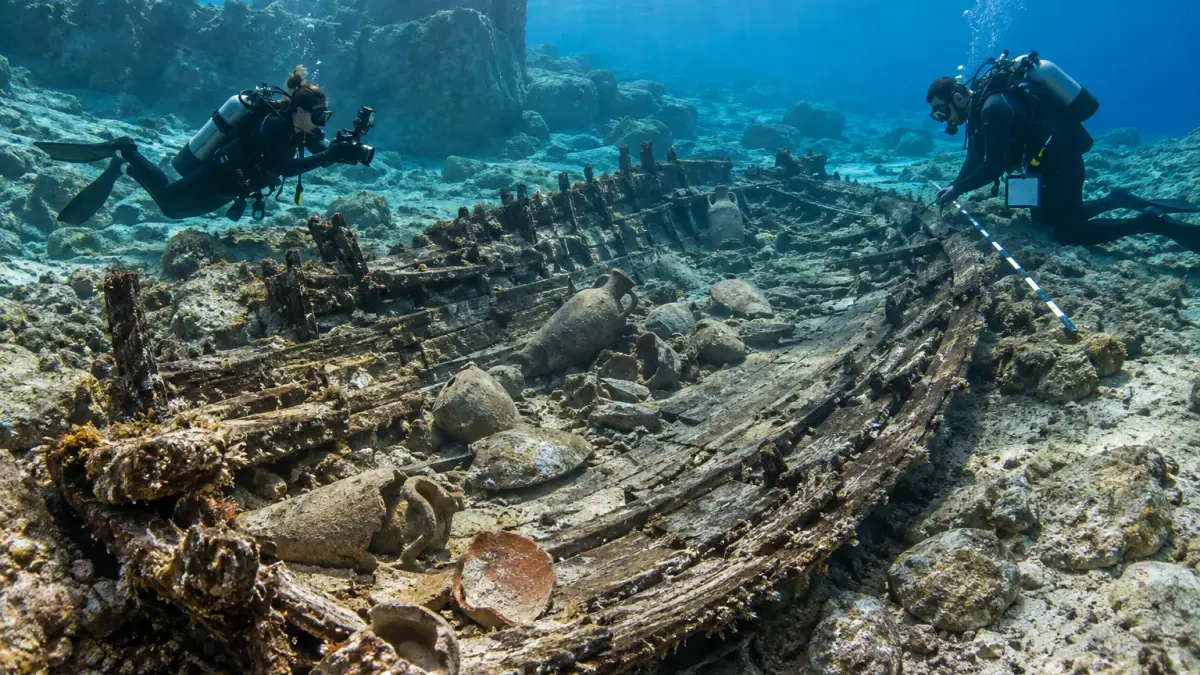
Archaeologists have identified a shipwreck off Kekova Island in Turkey as the world’s oldest known vessel, dating it to between 4,400 and 4,700 years old, from the Early Bronze Age. The find places the ship’s construction around the same era as the building of the Great Pyramid, according to the BBC.
Prof Hakan Öniz of Akdeniz University led the Mediterranean Archaeology Association expedition that located the wreck. It lies 30 meters beneath the surface, scattered across an underwater slope near the shore of Kekova Island in Antalya, Turkey.
The Main Development
The expedition recovered three ship’s anchors from the site along with a cluster of distinctive ceramics. The pottery, known as Kekova ceramics, features two handles, a ridge in the middle and a flat base, a style researchers used to pin down the vessel’s age.
“Comparing the decoration techniques… we can definitely say our wreck is Early Bronze Age. This is 100%,” Öniz said, according to the BBC.
Researchers also found residue inside large jars recovered from the wreck. The substance could be olive oil, wine or tree resins, though the jars were likely emptied upon arrival at their original destination and may have been reused for years afterward.
What It Means For The Kekova Island Oldest Shipwreck Discovery
The identification pushes the wreck past the previous record holder, a ship found off Dokos island in southern Greece that dates to roughly 4,200 years ago. The Kekova find now tops the global list of oldest known shipwrecks by several centuries.
Öniz described the significance of the discovery in blunt terms. “The shipwreck is a time capsule at the bottom of the sea,” he said, according to the BBC.
Researchers believe the ship had been carrying goods toward either the ancient city of Troy in northwestern Turkey or toward the Minoan people in Crete, based on the cargo and route evidence gathered at the site. Öniz also noted the human element of reaching artifacts untouched for millennia. “We are the first humans who [have] touched these objects after 5,000 years,” he said.
Background And Context
Kekova Island has a reputation among divers and archaeologists for strong currents and winds that have wrecked many ships over the centuries, making the area a dense site for underwater discoveries. The combination of depth, isolation and difficult waters likely helped preserve the wreck and its cargo for thousands of years before researchers located it.
The dating method relied heavily on comparing decoration techniques on the recovered ceramics against known Early Bronze Age styles, according to Öniz’s team. The anchors and jars found at the site give researchers physical evidence of trade routes connecting the eastern Mediterranean during one of the earliest periods of organized seafaring.
What’s Next
The Mediterranean Archaeology Association expedition has not announced further details on upcoming excavation phases or additional artifact recovery at the Kekova site. The BBC’s report, published Oct. 14, 2026, marks the first public confirmation of the wreck’s age and identification as the world’s oldest.
More Unusual / Fascinating Stories news from Total Apex Entertainment.
 Don't stop here
Every Score. Every Story. One Home.
Breaking sports, entertainment and news from across the Total Apex network, updated all day.
Get the Full Story →
Don't stop here
Every Score. Every Story. One Home.
Breaking sports, entertainment and news from across the Total Apex network, updated all day.
Get the Full Story →