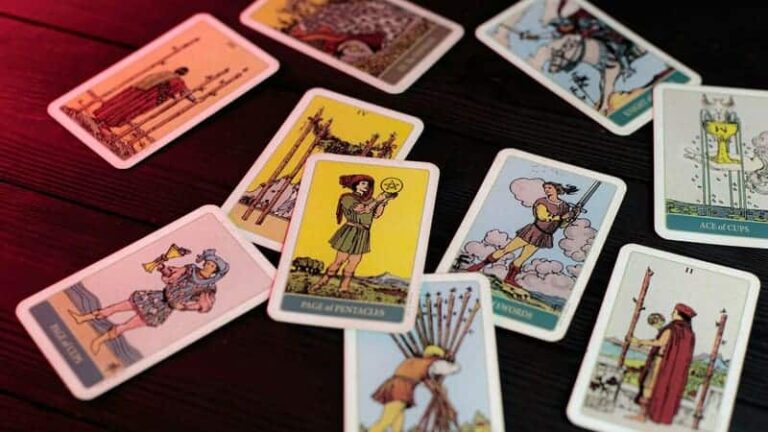
Choosing a tarot spread for decision-making comes down to matching the number of cards to how complicated your question actually is. A direct yes-or-no question can take a single card, a decision that needs some context fits three cards, and a choice between two paths gives you room for five. The size of the spread should fit the question, not the other way around.
This guide walks through those three spread sizes, what the positions in each one can look like and how to pick the right one before you shuffle. It also covers why tarot works best as a reflective tool rather than a final verdict, especially for decisions with legal, medical or financial stakes.
Start with how simple or complex the decision feels
Labyrinthos, an online tarot school, recommends keeping decision-making readings simple, since a smaller spread is less likely to leave you with a muddled answer. That makes the first step less about the subject of your decision and more about how many layers of it you want to examine.
A single card suits a direct yes-or-no question. A three-card spread adds context. A five-card spread works when you’re weighing two distinct options side by side and want to look at where each one might lead.
Step 1: Decide if you need a yes or a deeper answer
Before picking a spread, decide whether your question is binary or open-ended. Even a yes-or-no format doesn’t have to be a flat verdict. Tarot.com says its Yes or No reading offers “a directional response” that accounts for influences like timing and your own readiness.
That reading isn’t a one-card pull, though. It uses eight cards and always includes the Wheel of Fortune, and where that card lands among four categories gives the answer. If it lands in the Yes category, Tarot.com says, “conditions are supportive.” The other results include “Yes, Maybe” and “No, Maybe,” because, as the site puts it, “In many cases, Tarot lives in the in-between.” If your question has a lot of nuance, a simple yes or no may tell you less than you need.
Step 2: Use a single card for straightforward yes-or-no questions
A single-card draw is the fastest option. Labyrinthos says some readers decide on a yes or a no by checking if the card came up upright or reversed, or by looking at what the card itself suggests.
It also leaves the least room for nuance. Labyrinthos generally advises against yes-or-no questions and calls three cards “probably the minimum” for its own yes-or-no spreads, because an answer without the “why” behind it can leave you unsatisfied. Save the single card for questions that don’t need much unpacking.
Step 3: Use a three-card spread for a little more context
Labyrinthos lists a three-card spread as a simpler alternative to its five-card decision layout. Three cards give a reading more room than one while staying quick to lay out and interpret.
The positions depend on the spread you choose. Two of Labyrinthos’ three-card options suit decisions especially well:
- Supporting and opposing factors: factors supporting, factors against and what you need to know the most
- Scenarios: if yes, if no and guidance
The Scenarios layout can also give you a quick look at an either-or choice without building out a full five-card reading.
Readers who want a deeper look at the mechanics of this layout can see a full breakdown in this three-card tarot spread guide.
Step 4: Use a five-card spread when weighing two options
Labyrinthos’ five-card decision spread is built for choices that come down to two distinct paths. It gives each option one card and uses the other three to look at the situation and how you feel about it.
The five positions are:
- Your motivation: what excites you and how that affects your decision
- Ideal outcome: what you’d truly like to happen
- Your values: the principles that matter to you here
- Option 1 likely outcome: what can happen if you take this path
- Option 2 likely outcome: what can happen if you take this path
The cards at the center of the layout represent you, a reminder that the reasons behind any choice start with the person making it. That structure suits decisions where both paths are really on the table and you want to compare where each one might go.
Match the spread size to the question, not the stakes
A heavier decision doesn’t automatically call for more cards. What matters is how many factors you want to look at. A five-card layout like this one earns its extra cards when you have two options to compare, and a yes-or-no question stays a yes-or-no question even when the outcome matters a great deal.
That doesn’t make one card the best fit for a big decision. If you want to understand the reasons behind an answer, a three-card spread will give you more to work with.
Readers working on how to phrase a question clearly before choosing a spread can find more detail in this guide to asking open-ended tarot questions.
Remember what tarot can and cannot tell you
Labyrinthos is direct on this point: Tarot cards “will very rarely be able to give you a definitive answer about what to do.” The school describes them as “a mirror” and says the choice stays with you. Tarot.com similarly says a No isn’t “a judgment or a permanent verdict.”
A card pull can surface feelings, values or possible outcomes worth sitting with. It’s a reflective exercise, not a substitute for guidance from a qualified professional on legal, medical or financial matters.
Common mistakes to avoid
Pulling more cards than a question needs can muddy a decision-making reading rather than clarify it, which is why Labyrinthos stresses keeping things simple. Another mistake is expecting a strict yes or no every time. As Tarot.com’s “Yes, Maybe” and “No, Maybe” results show, plenty of readers build the gray area into the reading itself.
It helps to settle on a spread size before shuffling, based on whether your question is binary, needs light context or involves comparing two real options. If you’re new to tarot, Labyrinthos suggests you can use only the Major Arcana for a decision-making reading, since those cards have more clearly defined meanings.
 Don't stop here
Every Score. Every Story. One Home.
Breaking sports, entertainment and news from across the Total Apex network, updated all day.
Get the Full Story →