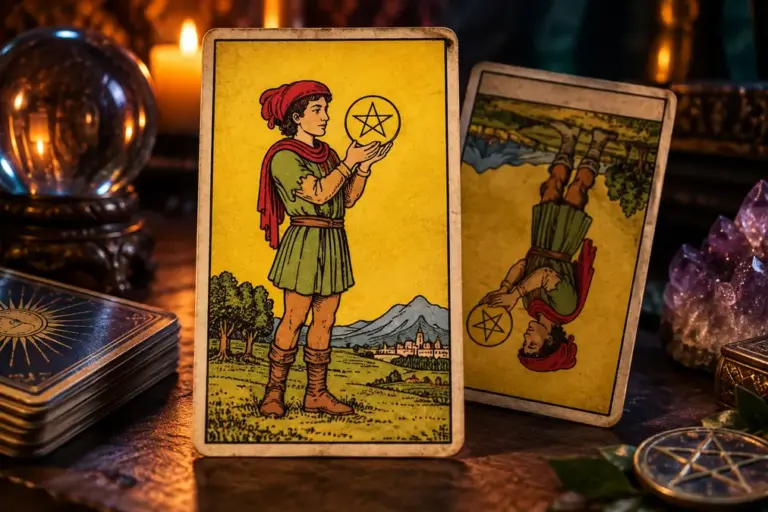
The way a question is worded shapes how useful a tarot reading turns out to be. According to Biddytarot, the quality of a reading often depends on the quality of the question asked, and vague, disempowering or future-predictive questions tend to create more confusion than clarity. For anyone sitting down with a deck, learning to ask open-ended tarot questions is the single biggest adjustment that can sharpen what the cards reveal.
This guide walks through why open-ended phrasing works better than a simple yes-or-no question and offers practical examples for love, work and personal reflection. It applies whether you’re pulling a single card or working through a full spread, including the approach covered in a three-card tarot reading for beginners.
Why Open-Ended Tarot Questions Work Better
Tarot does not function as a prediction machine. Tarot.com describes the deck as a reflective tool that guides a reader through deep reflection, pattern-spotting and highlighting blessings and blocks rather than forecasting a fixed outcome. Elle reported the same idea from a practitioner’s perspective, noting that “it’s a myth that tarot predicts the future,” and that the cards instead act as a reflective tool guiding deep reflection and pattern-spotting.
That reflective function is exactly why a question like “What’s going to happen?” tends to fall flat. Tarot.com put it directly: “‘What’s going to happen?’ leaves too much space for projection. Try rewording your query. ‘What energy am I bringing into this situation?’ ‘What am I not seeing clearly right now?’ A precise but open-ended question tends to yield a clearer mirror.”
A yes-or-no question boxes the cards into a binary they were never designed to answer, and it invites the reader to project a desired answer onto ambiguous symbolism. An open-ended question, by contrast, asks the cards to illuminate energy, perspective or blind spots, which gives the imagery room to speak with nuance.
Love Questions That Invite Reflection
Rather than asking whether a specific relationship will work out, a more productive approach centers on what’s happening internally. Try framing the question around your own patterns or feelings rather than the other person’s future behavior: What am I bringing into this relationship right now? What am I not seeing clearly about this connection? What pattern keeps showing up in how I approach love?
These versions follow the same structure Tarot.com recommended for rewording a prediction-based question into one focused on energy and blind spots. They keep the focus on self-awareness, which fits how Elle described tarot’s role: taking what’s often happening internally, like fears and questions, and placing them somewhere a person can look at them with more kindness and perspective.
Work Questions For Career Crossroads
Biddytarot noted that real-life tarot situations commonly include career crossroads and moments of uncertainty, each benefiting from a tailored approach to the question. Instead of asking if a job offer will pan out, consider: What energy am I bringing into this career decision? What am I not seeing clearly about this opportunity? What do I need to understand about where I am professionally right now?
These prompts stay open enough to let a card like The Devil, for example, point toward something layered rather than a single fixed meaning. Tarot.com noted that in a creative-direction question, that card might speak to creative obsession, ambition or fear of failure rather than something negative, underscoring how context and question framing shape interpretation.
Personal Reflection Questions
Biddytarot’s list of common reading situations also includes decisions, transitions and self-discovery. For personal reflection, useful open-ended prompts include: What do I need to understand about this transition? What pattern in my life is this moment asking me to notice? What am I not seeing clearly about myself right now?
Elle’s reporting framed tarot’s value here as permission rather than instruction. Instead of telling you what to do, a reading gives permission to slow down and think about an ongoing situation. Open-ended questions support that pacing because they don’t push the cards toward a verdict. They invite a slower, more honest look at what’s already happening.
What To Do When A Reading Feels Wrong
Sometimes a card pull simply doesn’t match what a person hoped to hear, and that reaction is itself information. A reading framed as wrong may actually reveal how strongly someone feels about what they want to be true, which is valuable insight even when it conflicts with the outcome a person was hoping for.
The practice works on symbolic time rather than clock time. A reading that seems off in the moment may point to energy that unfolds later or shifts happening behind the scenes, so it’s worth revisiting a question weeks or months down the line rather than dismissing the pull entirely.
Putting It Into Practice
Before any pull, take a moment to rewrite a yes-or-no instinct into an open-ended one. Swap “Will this work out?” for “What do I need to understand about this situation?” Swap “Should I take the job?” for “What am I not seeing clearly about this opportunity?” The goal is a precise but open-ended question that yields a clearer mirror.
For readers still building their foundation, pairing better questions with a simple layout can help. A three-card tarot spread offers an accessible format for applying these open-ended prompts across past, present and future positions, or situation, action and outcome. Understanding individual cards also helps contextualize answers; guides like the Fool tarot card meaning or the Death tarot card meaning show how a single card can carry different weight depending on the question asked.
Anyone new to the practice can also start with a beginner’s three-card reading to practice framing open-ended questions before moving into larger spreads.
More Tarot from Total Apex Entertainment.
 Don't stop here
Every Score. Every Story. One Home.
Breaking sports, entertainment and news from across the Total Apex network, updated all day.
Get the Full Story →