
Cadillac 355 Explained: The 1930s V8 Series That Evolved Every Year—Then Suddenly Disappeared

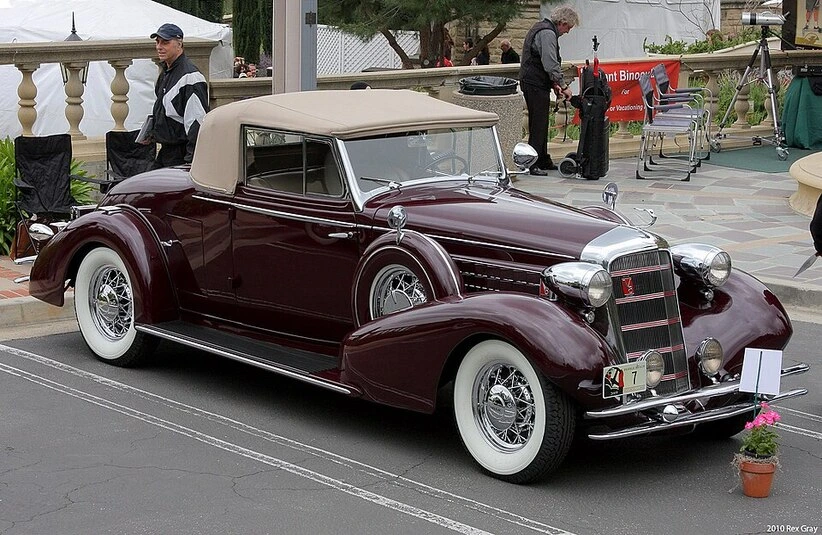
The Cadillac 355D was produced from 1931 until 1935. The car had a V8 engine and offered an alternative to the car maker’s larger, more powerful, cheaper model. The car had a variety of order options. Consumers could get a two-door coupe or convertible, or a four-door sedan, town car, or limousine.
There were five annual offers of the car, each with a different letter designation. So, 1931 was A, 1932 was B, and so forth. The car varied in length, width, and height over the time of its production, but it always had a V8 engine. The Cadillac 355 was replaced by the series 70/75. Do you think most cars have well-designed replacements?
Cadillac 355 Series
The Cadillac 355 was produced in 5 annual series. Here is a summary of the 5 series.
1931 Cadillac 355A

The 1931 Series 355A was a coach, or modified coach, with no compartments in the splash pan. The car was closely related to the Cadillac 353. The battery and tool compartment were relocated under the front seat. This was different from modern cars. Floor boards were made of metal for the first time, setting a trend. The instrument panel was oval in shape. This is similar to most modern cars. The Cadillac 355A also had a radiator screen, a single bar bumper, and dual horns. The headlight diameter was reduced by one inch. The car had a luxurious look.
There was a new frame with split side rails on the Cadillac 355A. The suspension springs had metal covers, which were novel for the producer. The radiator was mounted lower in the frame and had a condenser tank for cooling operation. The engine was a 353-cubic-inch V8, the same as the Series 353, producing 95 horsepower. There was a five-point engine suspension. A muffler was added, and the distributor was mounted 1.5 inches higher. The fan was mounted lower to match the radiator. The car was fairly commercially successful, with model year sales totaling 10,717.
1932 Cadillac 355B
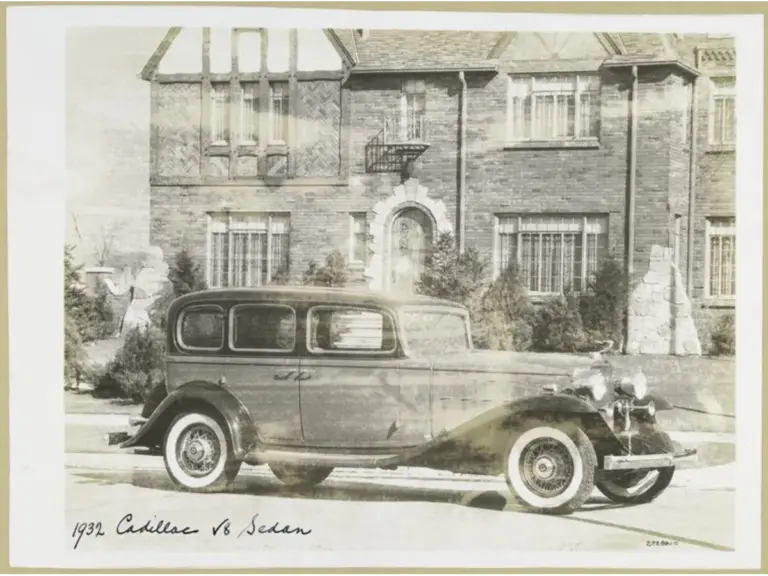
The 1932 Series 355B was a bit longer and lower, and had a restyled front assembly. The roofline was lowered 1–3 inches, as the design team went for a sleeker look. The front-end styling included a flat grille built into the radiator, head and side lights of streamlined bullet shape, and the elimination of the fender tie bar and monogram bar. This made for an entirely different-looking car. The car had dual horns projected through the headlight stanchions. The headlight lenses were 9.5 inches wide, and the dual taillights matched the headlights.
The front license plate was on the bumper. Running boards curved to match the sweep of the front fenders and blended into the rear fenders. The fenders tapered into the fuel tank. The trunk on the town sedan and convertibles were integral with the body. The vision of the driver was improved because of the elimination of the outside visor and the construction of a twelve-degree sloping windshield and corner posts. Engine horsepower went up to 115. Like with other cars, the Great Depression caused sales to fall from almost 10,000 to 2,700.
1933 Cadillac 355C
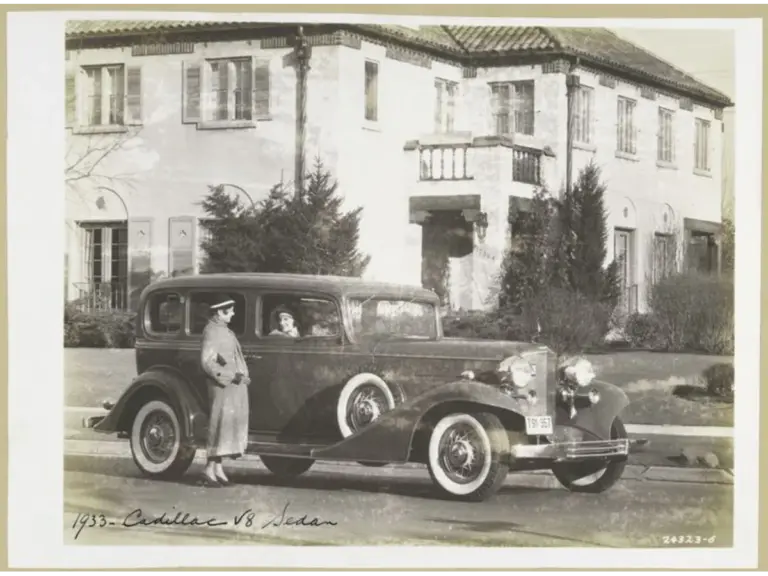
In 1933, Cadillac cars were updated with a new, corporate “streamlined” appearance shared by all General Motors cars for that year. The bumpers were sectioned, with plain ends and a three-bar center. The grille was V-shaped and blended into the radiator. The radiator cap was under the hood on the right side. Six small horizontal doors replaced the vertical hood doors. Fender skirts were optional. The biggest change in body details was the introduction of “No Draft Individually Controlled Ventilation” (abbreviated ICV) or pivoting vent windows in the front doors and the rear windows. Model year sales were 2,100.
1934 Cadillac 366D
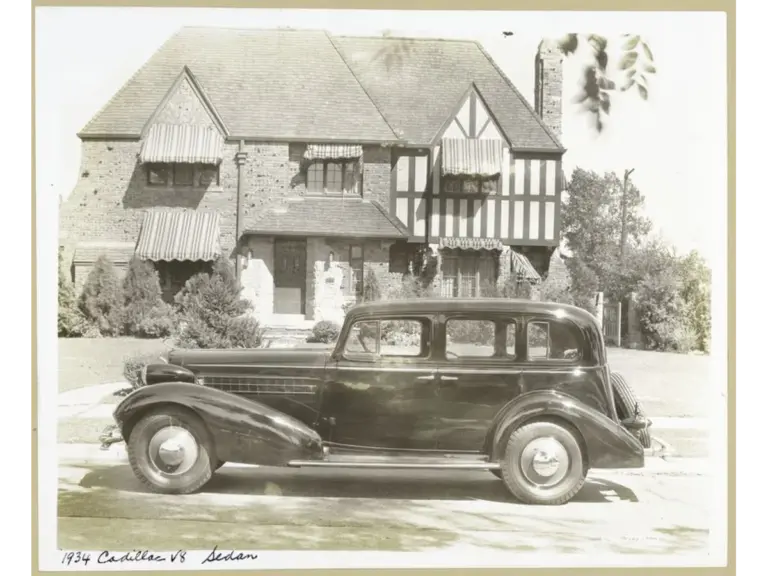
The 1934 Model 355D was restyled and had a new chassis but used the same engine as in 1933, the venerable V8. The styling was more streamlined, including concealment of all chassis features except the wheels. Body construction had better insulation against engine heat and the reduction of engine, road, and wind noise.
Bumpers were stylish, and the grille was V-shaped and sloping. A chrome-plated radiator shell was available as an option. Horns and the radiator filler cap were concealed under the hood. Headlights were mounted on the fenders. Parking lamps were mounted on the headlight supports. Fenders were low over the chassis. The hood sills were high and molded into the radiator shell. The hoods extended almost to the windshield and carried shutter-type louvers in the side panel. Windshields were fixed and steeply sloping; 18 degrees on Fisher bodies, 25 degrees flat, or a 29.5 degree V on Fleetwood bodies.
1935 Cadillac 355E
The 1935 model was basically unchanged from 1934. The bumpers got an update. Also, the car had on all-steel Fisher bodies. Those bodies have been associated with funeral and ambulance equipment for several years, since 1935. Cadillac tried to consolidate this business in 1935, particularly in its Fleetwood works. Three Fleetwood-bodied seven-passenger livery sedans were offered on the Series 30 chassis. Additionally, a 160 in (4,060 mm) wheelbase commercial chassis was offered for hearse and ambulance adaptation. Engine horsepower increased yet again to 130. Combined model year sales for 1934 and 1935 totaled 8,318.
Parting Shots
Cadillac has had a long history of producing cars; this is an example of one. The company has a tradition of replacing one model with another. This car is an example of that. This car is also a great example of one with a smaller V8 engine being commercially successful. This car was differentiated from other models of the company at the time, which typically had V12 or V16 engines.
