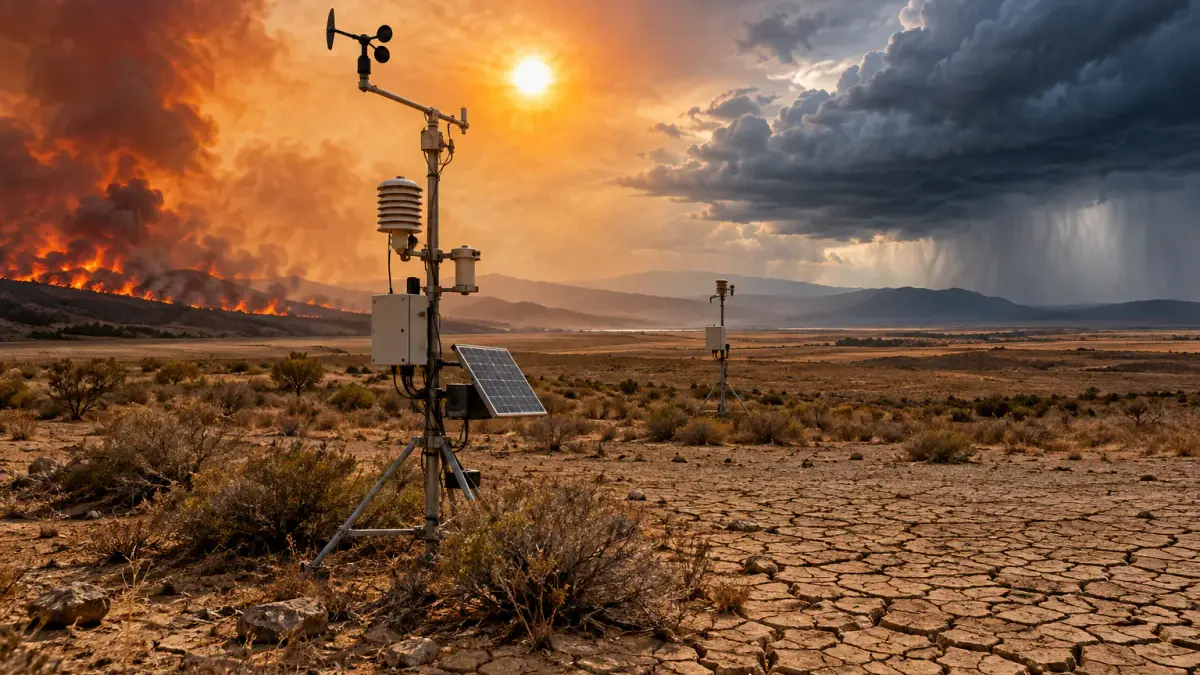
Seven of the 16 climate markers researchers use to track Earth’s condition have reached record extremes, according to a report published Wednesday, Oct. 14, 2026, in the peer-reviewed journal BioScience. The report also found that several other markers show signs of accelerating or abruptly shifting, according to CBS News.
The 16 markers examined include greenhouse gases, temperature, glacier mass, oceans, wildfires and the planet’s energy imbalance, the difference between the energy Earth absorbs from the sun and the energy it radiates back into the atmosphere, according to the report.
The Numbers Behind The Record Extremes
- Seven of 16 tracked climate markers are at record extremes, with others showing acceleration or abrupt shifts, according to the report.
- July 2026 was the warmest month ever recorded for the contiguous United States, and the country posted its hottest summer on record in 2026.
- Global ocean temperatures hit new highs in July 2026.
- Atmospheric carbon dioxide levels are now higher than at any point in the last 2 million years.
- Heat waves in Europe during the summer of 2026 killed an estimated 14,000 people.
- Heat waves in the United States fueled wildfires that burned millions of acres.
- Coral reefs became the first environmental system on Earth to cross a climate tipping point in 2025, damage researchers say could be permanent.
Those figures touch nearly every category the report tracks, from the atmosphere down to the ocean floor. The repetition across categories, heat records in the air, in the water and on land, is what researchers point to as evidence of a system under broad strain rather than an isolated event.
What The Record Extremes Mean For Fans Of Science And Weather Watchers
For anyone following weather news, the report gives a clearer picture of why 2026 has felt relentless. A record-hot U.S. summer and record ocean temperatures in the same stretch of months are not separate stories under this data, they are linked readings off the same overheated planet.
The report’s authors describe the stakes in stark terms. “Earth’s life-support systems are being pushed beyond stable limits, with changes unfolding faster than our ability to respond,” the researchers wrote, according to CBS News. “Across the globe, extreme heat, floods, droughts, storms, and wildfires are no longer rare events but defining features of a changing planet.”
That framing matters for how people plan around heat waves, wildfire smoke and storm seasons. The report treats these events as a baseline condition rather than a rare disruption, which changes what preparedness looks like for communities that previously treated extreme heat as an occasional risk.
Context: Tipping Points And The Hothouse Trajectory
The coral reef collapse in 2025 stands out in the report as the first time an entire environmental system crossed what researchers call a climate tipping point, a threshold beyond which damage may not be reversible. The report warns that amplified sea ice loss, ecosystem degradation and continued carbon emissions could combine into self-perpetuating feedback loops, a scenario researchers label the hothouse climate trajectory, in which tipping points push global warming beyond human control.
Researchers behind the report did not mince words about the pace of change. “We are witnessing the rapid destabilization of the Earth’s climate system,” they wrote, according to CBS News. “This is no longer a warning for the future; it is a diagnosis of the present.”
That shift in language, from forecast to diagnosis, is itself part of the finding. The report frames 2026 not as a preview of future climate stress but as a year in which multiple systems simultaneously showed measurable, recorded damage.
What’s Next
The report’s authors call for rapid reductions in greenhouse gas emissions, effective adaptation measures, ecosystem protection and broader societal change. “Rapid reductions in greenhouse gas emissions, effective adaptation, ecosystem protection, and transformative societal change remain essential to reducing climate risks and securing a more resilient and sustainable future,” the researchers wrote, according to CBS News.
The findings add to a running tally of annual climate assessments that track the same set of planetary markers. Future editions of the report would be expected to show whether the seven record-breaking indicators from 2026 hold steady, worsen or ease as emissions data for the following year becomes available.
More Human Interest news from Total Apex Entertainment.
 Don't stop here
Every Score. Every Story. One Home.
Breaking sports, entertainment and news from across the Total Apex network, updated all day.
Get the Full Story →
Don't stop here
Every Score. Every Story. One Home.
Breaking sports, entertainment and news from across the Total Apex network, updated all day.
Get the Full Story →