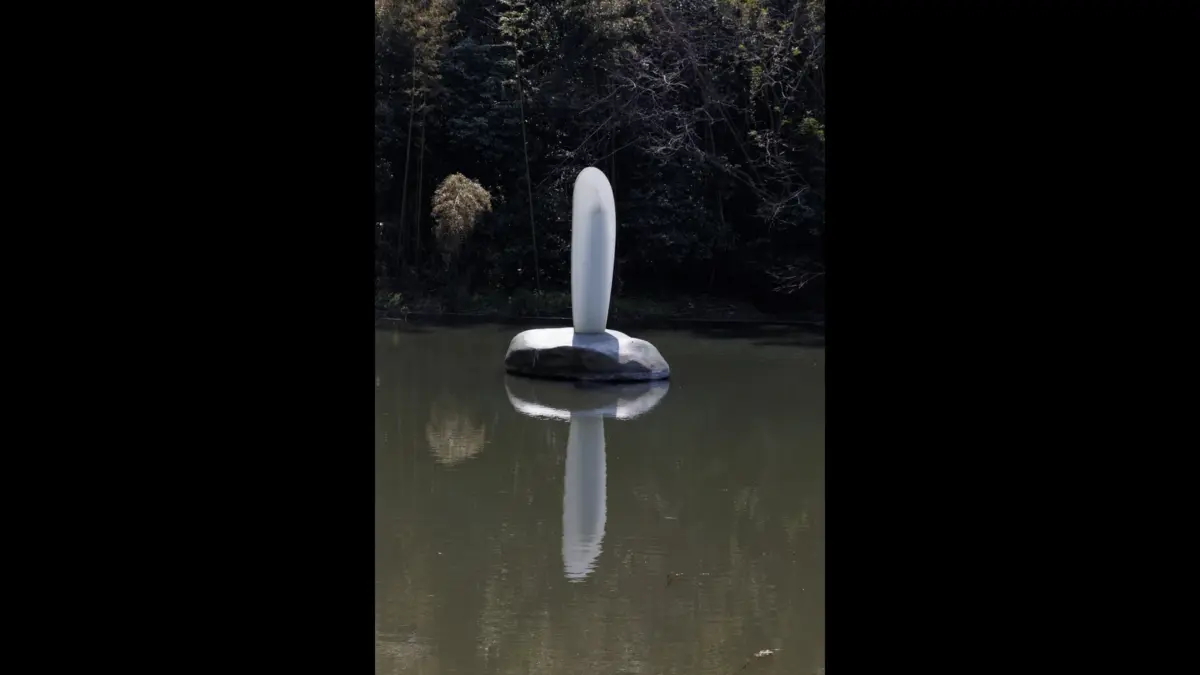
Mariko Mori made her name in the mid-1990s by casting herself as a cyborg in computer-generated scenes. More than 30 years later, a co-curator of her new Tokyo retrospective argues that the themes she chased back then have become some of the biggest subjects in contemporary art.
“Mariko Mori: All That Shines” opened Oct. 31 at the Mori Art Museum and runs through March 28, 2027. The museum calls it Japan’s first major Mori retrospective since “Mariko Mori: Pure Land” at the Museum of Contemporary Art Tokyo in 2002. It brings together 40 works from more than three decades.
The Mori Art Museum organized the show in collaboration with the Solomon R. Guggenheim Foundation. Museum director Mami Kataoka co-curated it with Alexandra Munroe, the Guggenheim’s senior curator at large for global arts. Munroe talked through the exhibition, and how Japan’s art world has shifted during her career, in an interview with The Art Newspaper published Nov. 2.
Why Munroe says Mori was ahead of her time
Munroe’s case starts with philosopher Yuk Hui and his idea of “cosmotechnics,” which she described as a whole-picture view of technology rooted in Eastern philosophy and cosmology, in contrast to the split found in modern Western thinking. She said Mori’s work resonates with those writings.
“Mariko anticipated that zeitgeist as a Japanese woman artist who conducted deep research into schools of thought like Pure Land Buddhism and Jōmon cosmology alongside contemporary sciences of the mind,” Munroe told The Art Newspaper.
She added, “Technology is not an obstacle to humanism for her, but a means of envisioning a new kind of humanism that allows for higher states of consciousness.” The show’s clearest example may be “Wave UFO” (1999-2002), which both Munroe and the museum describe as the first artwork to use brainwave biofeedback.
Munroe said those subjects now hold enormous interest for artists. She offered LuYang as one example, a Chinese artist and committed practitioner of Tantric Buddhism who uses game engines to explore reincarnation, multiple selves and the idea that the world is an illusion. She also named Korean new media artist Ayoung Kim, who she said looks up to Mori for linking art and technology as ways to “recalibrate our reality,” a phrase Munroe credited to Kim herself.
How Japan’s museums changed
Munroe’s work with Japanese institutions goes back to 1994, when “Japanese Art After 1945: Scream Against the Sky” opened at the Yokohama Museum of Art. Her landmark survey then traveled to the Guggenheim Museum SoHo in New York and the San Francisco Museum of Modern Art.
Asked how Japan’s museum world has changed over the years, she answered, “It’s changed enormously.”
Her timeline begins with that same Yokohama museum, which opened in 1989, just ahead of a 1990s boom. Cities and prefectures across Japan built ambitious new museums during that decade, with buildings by architects such as Fumihiko Maki and Arata Isozaki.
Japan already had important modern art institutions by then, including the Museum of Modern Art, Kamakura, established in 1951, and the National Museum of Modern Art, Tokyo, established in 1952. Even so, Munroe said there was “remarkably little concerted historical understanding” of modern and contemporary Japanese art and its place in global art history.
That picture started to fill in around the early 1990s, she said. Curators and scholars began tracing how the country’s art developed through World War II defeat, reconstruction and Americanization, and through Japanese artists working abroad, such as Yoko Ono, Yayoi Kusama and On Kawara.
Munroe’s reason for the collaboration
Munroe also gave the host institution its due. “It’s been gratifying to see the Mori Art Museum develop into a global museum under the trailblazing leadership of Mami Kataoka,” she said. Kataoka joined the museum in 2003, the year it opened, and became director in 2020.
Munroe called the museum’s 2025 Sou Fujimoto exhibition “one of the greatest architectural shows I’ve ever seen.” She also ranked its solo shows for Ai Weiwei in 2009, Lee Bul in 2012 and Louise Bourgeois in 2024 among the most influential ever staged for those artists.
Not everything she described was a success story. Munroe said Japan has pulled back in recent years from its postwar identity as an international country, and that one motivation for this show was to spark a new wave of collaborations that carry work made in Japan to audiences abroad.
Visiting ‘All That Shines’
The museum is open daily from 10 a.m. to 10 p.m., closing at 5 p.m. on most Tuesdays, according to its website. Adult tickets cost 2,800 yen on weekdays and 3,000 yen on weekends and holidays, with discounts for buying online. Slots to enter the “Wave UFO” pod are limited.
Munroe expects an enthusiastic response from younger artists interested in storytelling and altered states of mind. She expects the same from “anyone looking to just get away to another world.”
 Don't stop here
Every Score. Every Story. One Home.
Breaking sports, entertainment and news from across the Total Apex network, updated all day.
Get the Full Story →