
The Pentagon’s New Map 2004 Book Argues New World View For Fighting Terrorism

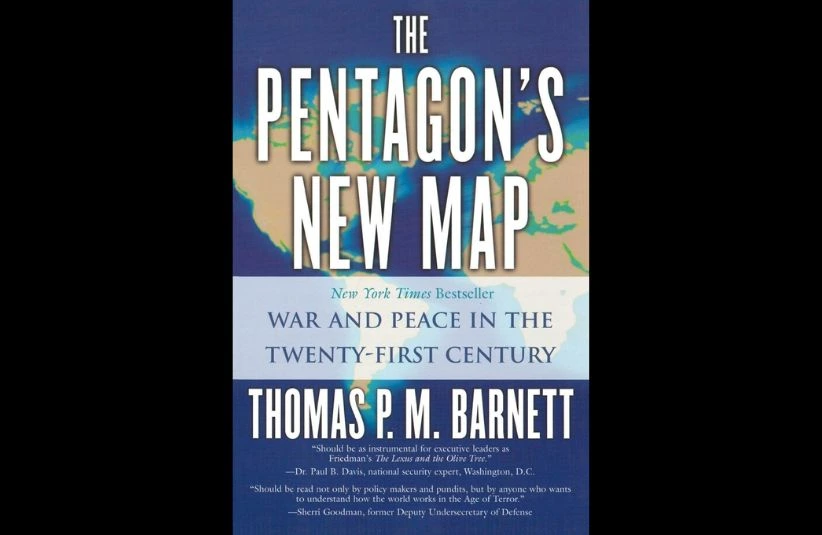
“The Pentagon’s New Map: War and Peace in the Twenty-First Century” is a 2004 book by Thomas P.M. Barnett, who, at the time, wrote for Esquire magazine. The book is based on an article he wrote for the magazine. The book outlines a new grand strategy for American foreign policy.
The book is not only based on an article in a magazine, but also an iteration of a PowerPoint presentation that Barnett had been making for years. Those slides were simply known as “The Brief.” Interested parties, at the time, included the public and private sectors, encompassing military organizations and foreign governments. Do you think “The Pentagon’s New Map” had an undue effect on American foreign policy during the beginning of the twenty-first century?
“The Pentagon’s New Map: War and Peace in the Twenty-First Century” Summary
This was a highly influential book, briefing, and magazine article. There were six main, clear arguments made.
6 Big Arguments in “The Pentagon’s New Map.”
- Systems of rules called rulesets reduce violence and conflict. These rules are often called norms by political science scholars. Violence decreases as rules are established for dealing with international conflicts. A cornerstone neoliberal argument. An example of this is the World Trade Organization, which has Dispute Settlement rules established.
- The world can be split into two halves. The Core is one part, and it can be further subdivided into Old Core, which we call the first world. It comprises North America, Europe, Japan, and Australia. This is the so-called Five Eyes+ (with New Zealand). The New Core comprises China, India, South Africa, Brazil, Argentina, Chile, and Russia. The Disconnected Gap includes the rest of the world. It has the Middle East, South Asia (not India), most of Africa, Southeast Asia, and northwest South America. We call this the third world.
- Integration of the Disconnected Gap countries into the global economy will provide opportunities for individuals living there to improve their lives. This presents an alternative to violence and terrorism. This is an old idea, going back to the German philosopher Immanuel Kant. The most controversial argument is that the American military is the only force capable of providing military support to facilitate integration. The idea is to be a rule-enforcer, and this is where we get the aggressive foreign policy of the George W. Bush administration.
- To be successful, the United States military must think of war broadly. That is in terms of demographics, energy, investment, security, politics, trade, and immigration. These things are referred to as PMESII (Politics, Military, Economics, Security, Information, and Infrastructure) by the military.
- Because the role of the United States has expanded, the military should organize itself according to two main functions: the “Leviathan” and the “System Administrator.”
- Leviathan’s purpose is the use of overwhelming force in order to end violence quickly, to take out governments, defend Core countries, and do general deterrence work. It is important to note that the United States has been playing this role since the Second World War.
- The System Administrator’s purpose is to keep the peace, build nations, and bolster weak governments. All of these functions have heaped criticism on the US military.
- There will be increased trade and investment as a result of this aggressive foreign policy. The entire world will benefit from these positive externalities.
A Famous Argument
There were two versions of Barnett’s presentation on The Pentagon’s New Map that aired on C-SPAN by 2005. In December 2004, the network showed one of Barnett’s recent presentations, followed by a live call-in program, so Barnett could answer questions. Barnett was then asked by the United States Air Force to give the presentation to every new officer who was made a general. These points show how much effect this argument had.
Around that time, the Naval War College, where Barnett worked, gave him the choice of either writing the second book or keeping his job. The college was upset that such a political argument was made so publicly in ‘The Pentagon’s New Map’. He chose to write a new book. He wrote, ‘Blueprint for Action: A Future Worth Creating.’
Parting Shots
It is difficult to overstate how important the argument of ‘The Pentagon’s New Map: War and Peace in the Twenty-First Century’ was at the time. The so-called Neo-Conservatives in the Defense Department bought the argument, hook, line, and sinker. The argument was used to justify an era of unprecedented American military intervention. The arguments herein essentially became the Grand Strategy of the United States.
