
Book Review: ‘Chain of Command: The Road from 9/11 to Abu Ghraib’ by Seymour M. Hersh

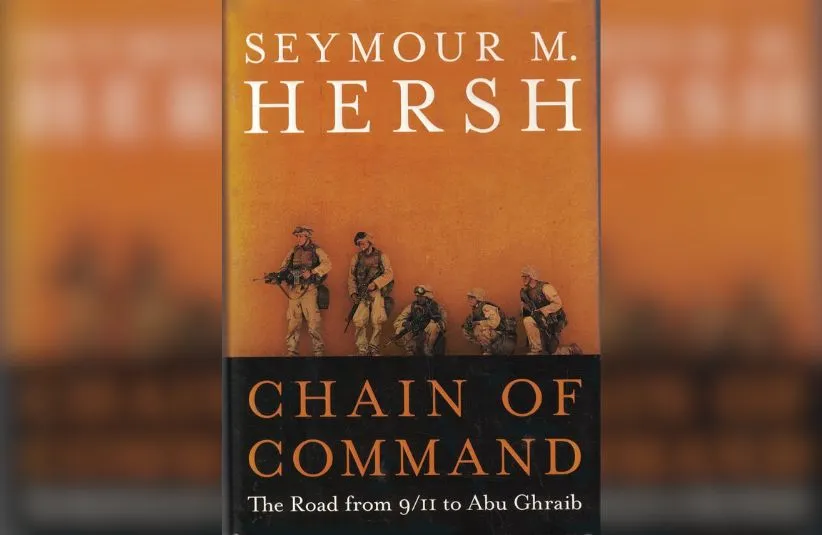
“Chain of Command: The Road from 9/11 to Abu Gharaib” was a 2004 book written by Seymour Hersh (who worked for the magazine “The New Yorker.” The book was inspired by Hersh’s investigative reporting and tells the story of a tumultuous time in American history. The book not only tells the horrible story of Abu Ghraib prison, but also opines about the causes of the war in Iraq.
We all remember the horrible images that inspired the book. To appreciate it, one must put oneself in the time’s context. Hersh tapped into a raw nerve, angst about the American war in Iraq. By 2004, when the book was written, the sentiment in the world had turned against the United States, which squandered the goodwill the country had built up after the 9/11 attacks. Has there ever been such a turn in public image?
“Chain of Command: The Road from 9/11 to Abu Gharaib” Summary
Hersh draws a comparison between the American prison at Guantanamo Bay, Cuba, and the one at Abu Ghraib. “Chain of Command” starts here, going right after the biggest story of the time. Hersh says the prison at Guantanamo Bay was very similar to the one at Abu Ghraib. Common practices, depicted in photographs that were leaked. Prisoners were hooded and tortured by barking dogs and were forced to perform sex acts. A key idea of the time was that of rendition, that is, moving a prisoner to a third country to keep him longer. The United States was scared that prisoners had secrets and were plotting more attacks on the country.
There were several critiques of American prison policy. The critiques boiled down to lambasting the Americans for their inhumane treatment of prisoners. Many international institutions criticized the United States. Among these were The Red Cross, Human Rights Watch, and Amnesty International. Hersh argues that the mistreatment was the product of poor American leadership and runaway, immature American soldiers.
There were a few key ideas associated with the war in Iraq that are important to understand. First, readers need to understand that the war in Iraq happened for the United States in the context of the so-called Global War on Terror. America viewed the conflict in Iraq as this, and it colored the American treatment of prisoners.
There is a treatment in “Chain of Command: from 9/11 to Abu Ghraib” of the intelligence failures that led to the war in Iraq. Hersh calls this war a diversion, and plumbs the depths of the intelligence failures of the CIA and FBI that led to 9/11. It turns out, they knew. There is also a good deal of treatment of the accusation that Iraq had weapons of mass destruction; they did not, but the search for them dominated the American Press.
The War in Iraq
One of the best aspects of the book is the critical treatment of the American motivations for the war. Hersh argues that the American war in Iraq was based on a lie. The Iraqis did not have weapons of mass destruction (WMD), and they did not buy uranium from Niger. He is highly critical of President George Bush, Vice President Dick Cheney, and the American Secretary of State Condoleezza Rice. The book goes in-depth into the failed attempt to discover Iraqi WMDs.
The book focuses on the Neoconservative political ideology that animated the Presidential Administration of George W. Bush. The roles of Dick Cheney, Don Rumsfeld, and Richard Perle are examined. Key to understanding the war is the role of the Iraqi Ahmed Chalabi. The leader of the Iraqi resistance, he insisted that Iraq was pursuing weapons of mass destruction.
Why You Should Read This Book
People should read “Chain of Command” if they want to understand how the Global War on Terror went sideways for the United States. The book also digs deep into the errors in American prison policy and the American motivation for the invasion of Iraq. Readers just need to understand that the book is politically motivated.
Parting Shots
“Chain of Command: From 9/11 to Abu Ghraib” is a blatantly politically motivated book. It is clear that Seymour Hersh politically dislikes the administration of George W. Bush. He is critical of, in particular, the Neoconservatives who dominated the administration and the global war they launched. That said, this is an important book to understand the political climate of the time. Readers should take the argument with a grain of salt; there is clearly political motivation here.
