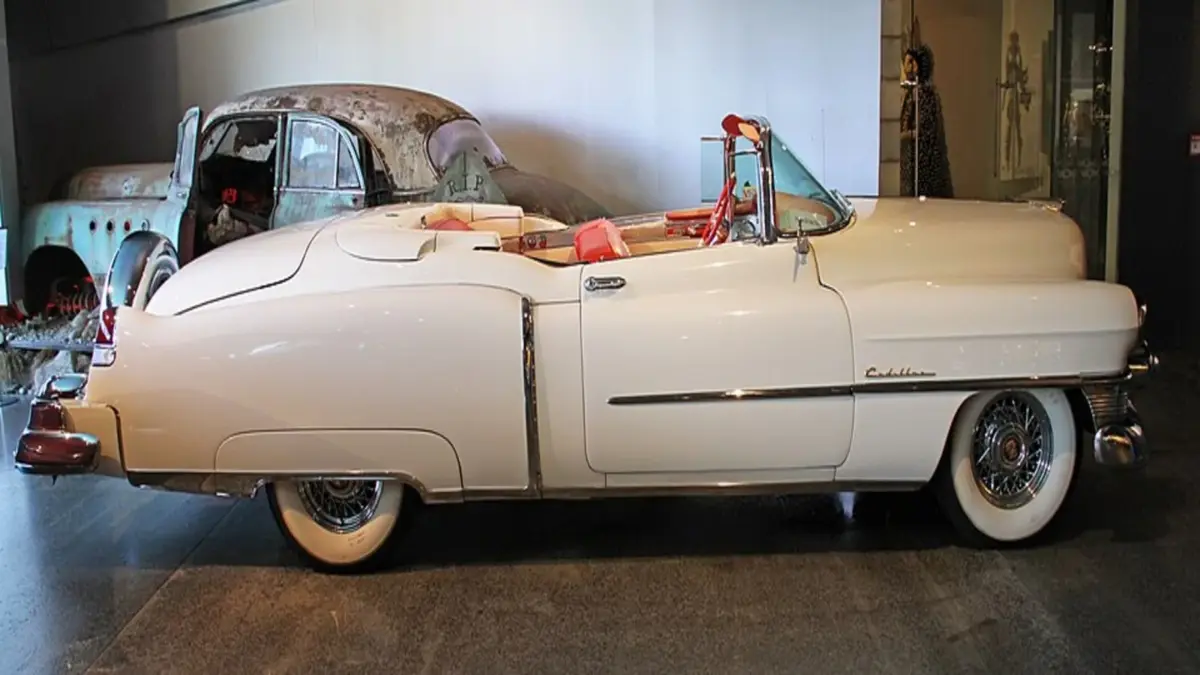
The 1953 Cadillac Eldorado was a luxury car at the very top of the Cadillac product line. In fact, it was the most expensive Cadillac you could buy that year, costing even more than the Cadillac limousine. Despite its price, the Eldorado name survived for 12 generations. It eventually had a huge engine, too. Production ended in 2002, but the car’s luxury and power earned it a loyal following that is still going strong. You can often find these cars at car shows and traded on internet sites.
Eldorado comes from the Spanish words for “the gilded one.” The name also refers to the fabled Lost City of Gold, which conquistadors searched for in vain. That allusion fit Cadillac’s golden anniversary. The company was founded in 1902, and the Eldorado name was first used on a 1952 concept car built to celebrate Cadillac’s 50th year. The production version arrived for the 1953 model year. The Eldorado eventually reached its own 50th model year in 2002, and then it was canceled. Along the way, the car carried the Fleetwood designation from 1965 through 1972. Have you ever seen one of these cars?
1953 Cadillac Eldorado: An Expensive Luxury Car With a Loyal Following
The 1953 Cadillac Eldorado was the first generation of the car. It was a limited-edition convertible, and it was expensive. The car cost $7,750, which is more than $90,000 in 2025 dollars. That was nearly $2,000 more than the Series 75 limousine. However, it was exceedingly rare, with just 532 produced. That rarity has made the 1953 Cadillac Eldorado highly collectible. The car was big, and it had a 331-cubic-inch V-8 engine that produced 210 horsepower. The 1953 Cadillac Eldorado measured 220.8 inches long and 80.1 inches wide. Power windows, a heater, windshield washers and a signal-seeking radio all came standard.
Second Generation
The second generation of the car lasted from 1954 to 1956. Cadillac cut the price by having the Eldorado share its body with the regular Series 62 convertible, and sales took off. They rose from 2,150 in 1954 all the way to 6,050 in 1956. In 1955, the car gained its own tailfins, which were popular at that time. In 1956, there was now a hardtop, the Eldorado Seville, to go along with the Eldorado Biarritz convertible.
Third Generation
The third generation of the car lasted from 1957 to 1958, just two years. The Biarritz and Seville got new rear styling with pointed fins. However, this time, there was a significant addition. The Eldorado Brougham was a four-door hardtop that cost $13,074. It was hand-built and had a brushed stainless steel roof, quad headlights and air suspension. The air suspension proved troublesome, but the Brougham still thrills car show attendees today. Only 704 were built over those two years.
Fourth Generation
The fourth generation lasted for just two years as well, 1959 and 1960. The 1959 car was redesigned, and it wore the famously tall tailfins of that year’s Cadillacs. Under the hood was a 390-cubic-inch V-8 that made 345 horsepower. We cannot stress enough how large this car was. The Brougham continued, too, but now its bodies were built by Pinin Farina in Turin, Italy. For 1960, Cadillac toned down the tailfins.
Fifth Generation
The fifth generation again lasted only two years, 1961 and 1962. The car was restyled and reengineered. Most of the visible changes were to the exterior of the car. Notable changes included a new convex jeweled grille that angled back toward the bumper and the hood. Underneath, coil springs replaced the old air suspension.
Sixth Generation
The sixth generation was from 1963 to 1964, again two years. The Eldorado now rode on a Fleetwood body and wore the Fleetwood wreath and crest. The car got a minor facelift, but the engine was increased in size in 1964. It remained a V-8, but grew from 390 to 429 cubic inches.
Seventh Generation
The seventh generation again lasted two years, 1965 and 1966. The car officially became the Fleetwood Eldorado. It was marketed that way. There were some exterior changes in 1966, but aside from that, the car was much the same, just with a new designation. This was also the last Eldorado generation with rear-wheel drive.
Eighth Generation
The eighth generation lasted from 1967 to 1970. There was a significant redesign of the car in 1967 as it became a front-wheel-drive coupe. Front disc brakes were optional at first and became standard in 1968. The car was marketed as a “personal luxury” Cadillac. That same year, a 472-cubic-inch V-8 replaced the 429. Then, in 1970, came the big one: a 500-cubic-inch V-8 with 400 horsepower.
Ninth Through 12th Generations
There were four more generations of the car. Some lasted longer, with the ninth spanning from 1971 to 1978. The convertible came back in 1971, and electronic fuel injection became an option in 1975. The 1976 model was the last Eldorado convertible. It’s interesting to think about how that 500-cubic-inch engine fared during the gas shortages of the 1970s.
The 10th generation spanned from 1979 to 1985. The car got smaller, but sales did not suffer. In fact, Cadillac sold a record 77,806 Eldorados in 1984. Then came the 11th generation, which spanned from 1986 to 1991. It was downsized again, and sales fell 72%. The 12th, and final, generation of the car was from 1992 to 2002. The last Eldorado was built on April 22, 2002.
Conclusion: A Significant Automobile
The 1953 Cadillac Eldorado was a significant car. It was big, powerful, expensive and rare. Cadillac built only 532 of them, just 0.5% of all Cadillacs sold that year. Because of its rarity, the car from that year has become collectible. That said, after a small start, the Eldorado was highly successful, with 12 generations produced over 50 model years.
 Don't stop here
Every Score. Every Story. One Home.
Breaking sports, entertainment and news from across the Total Apex network, updated all day.
Get the Full Story →