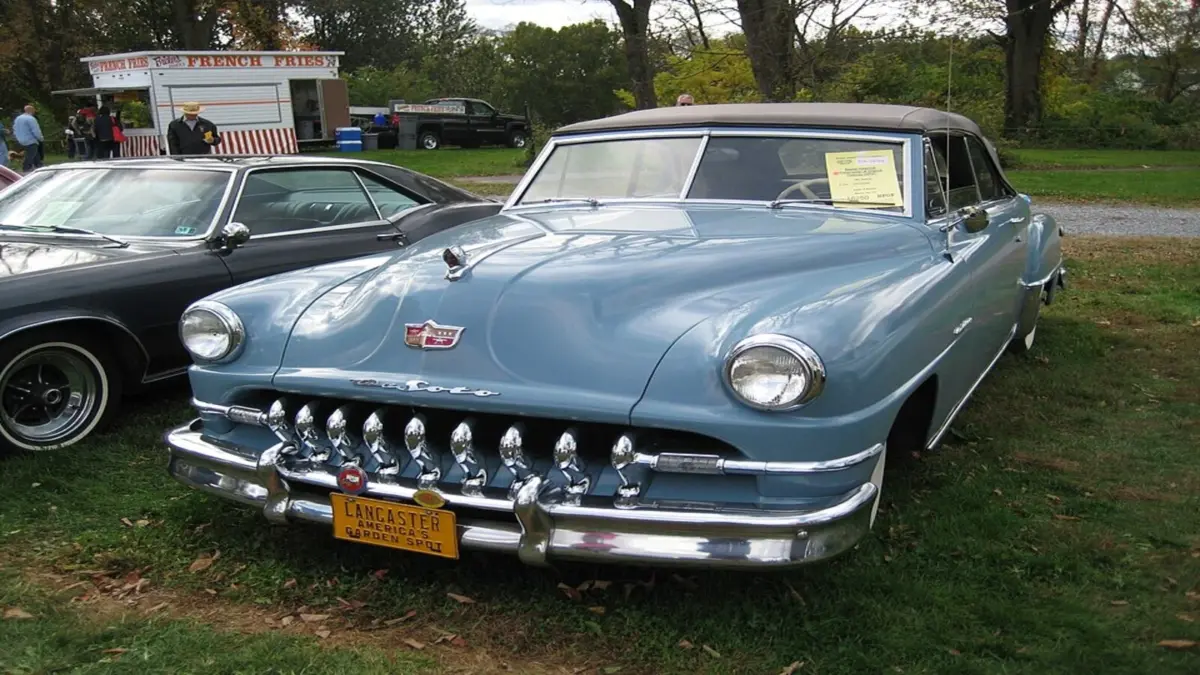
The DeSoto is one of the most distinctive automobiles in American history because of how it looked. DeSotos were produced from 1928 until late 1960, when the last 1961 models rolled off the line. DeSoto was a division of Chrysler. More than 2 million cars and trucks carried the DeSoto name during that time.
Walter Chrysler founded the DeSoto marque on Aug. 4, 1928, and the brand was named after Spanish conquistador Hernando de Soto. Chrysler wanted a mid-priced car to compete with brands like Pontiac and Studebaker. The linkage with a large company gave DeSoto plenty of muscle, especially when car production ramped up again after World War II. Do you think the linkage with the bigger company helped DeSoto?
Don’t confuse it with an earlier car of the same name, though. The De Soto Motor Car Company, started in 1912 by a group of Iowa businessmen, built cars in Auburn, Indiana. It was a subsidiary of the Zimmerman Manufacturing Company, which started out making horse buggies in 1886 and got into cars in 1908. After deaths in the Zimmerman family, the Auburn Automobile Company bought the business. That company had nothing to do with Walter Chrysler’s DeSoto.
The DeSoto, 1928 to 1961
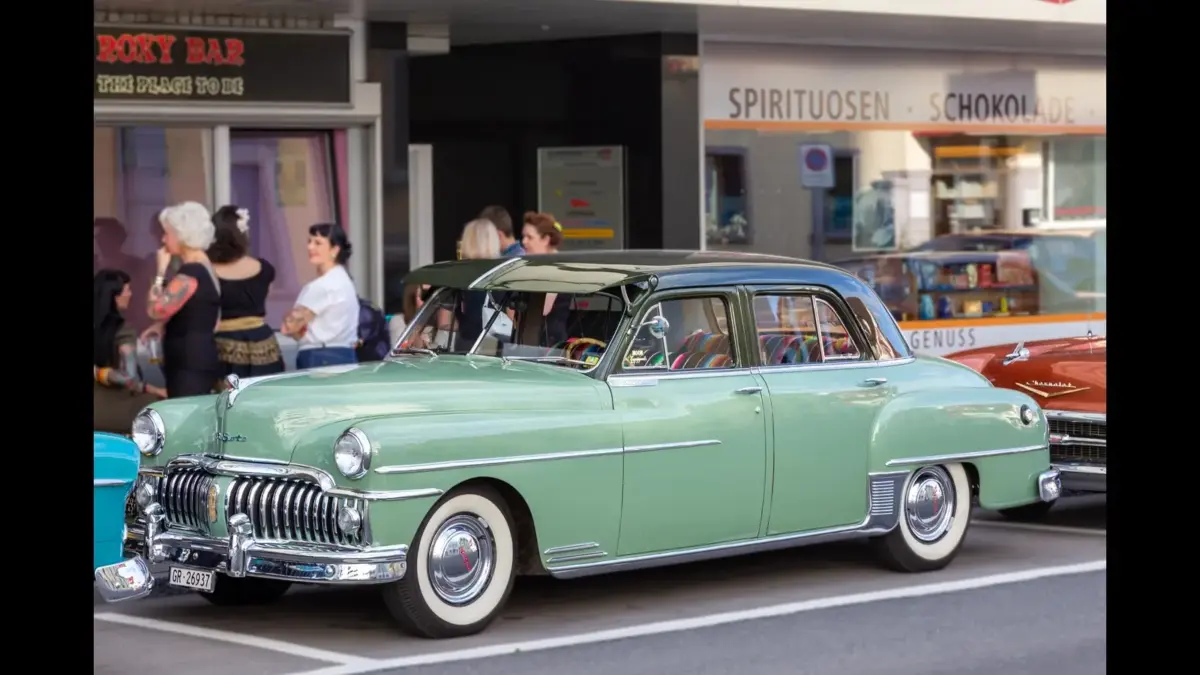
World War II halted civilian automobile production in the United States, and the DeSoto was part of that. When the war ended, DeSoto brought back its 1942 designs as 1946 models.
Then came 1951, and the DeSoto made a splash. The 1951 DeSoto had a very distinctive exterior look. The headlights were far apart and bulging. The headlights looked like eyes. The grille had big, protruding vertical bars that looked like teeth. When one combines these factors with the hood ornament, the automobile had the look of an angry face. Those “teeth” were so popular that customizers pulled them off DeSotos and bolted them onto their own hot rods.
In 1952, the DeSoto received a powerful engine. The Firedome had an eight-cylinder V-8 Hemi engine that displaced 276 cubic inches. It was the first eight-cylinder engine DeSoto had offered since 1931. In 1953, DeSoto reorganized its lineup. The six-cylinder cars became the Powermaster, and the V-8 Hemi cars remained the Firedome. The Powermaster lasted only through 1954. Starting in 1955, every DeSoto had a V-8. The DeSoto “Fire Dome” Hemi was installed in at least one other car, too: the French luxury car Facel Vega.
By the mid-1950s, the DeSoto was at the height of its popularity. Its popular models included the Firesweep, Firedome and Fireflite. In 1956, there was a new car, the Adventurer, a high-performance hardtop. That same year, a gold-and-white DeSoto Fireflite convertible served as the pace car for the Indianapolis 500. It was the only time a DeSoto ever led the field.
In 1957, all Chrysler cars were redesigned, and that included the DeSotos. The new look featured tall tailfins, and the 1957 DeSoto has been described as a “well-integrated” design. That year, DeSoto was one of the 10 best-selling car brands in the country.
There was an economic downturn in the United States in 1958, which hurt the car market and, hence, the DeSotos. DeSoto sales fell by about 60% from 1957, making it the brand’s worst year since 1938. To make matters worse, Ford introduced the Edsel for 1958, which was a direct competitor to the DeSoto in the mid-priced market. Sales slid again in 1959, and in 1960, they fell another 40%. That was the last year DeSotos were sold in Canada.
The sliding of sales caused rumors the DeSoto would be discontinued. Those rumors scared off buyers and hurt sales even more. However, in fall 1960, Chrysler released the 1961 DeSoto, with just two models, a two-door and a four-door hardtop. Part of the reason was the leftover parts. Chrysler had several million dollars’ worth of DeSoto parts, and it built cars to use them up, even if it was hard to sell them. On Nov. 18, 1960, Chrysler announced it was discontinuing the DeSoto. The last one rolled off the assembly line on Nov. 30, 1960. Only about 3,000 of the 1961 models were built.
Conclusion: Termination Factors
The fall of the DeSoto was one of the most shocking in American automotive history. The brand went from a highly successful one to defunct in just a few short years. So, what explained this? First, a recession in the United States hurt sales of all mid-priced automobiles. Second, the DeSoto was hurt by competitors, especially Ford’s Edsel. Some of the toughest competition came from inside Chrysler itself. The 1961 Chrysler Newport was priced to go after the same buyers as the DeSoto. Third, quality problems with the 1957 models hurt DeSoto’s reputation. There were also significant problems with the dealer network. Chrysler consolidated its dealers, and many chose to focus on the higher-volume Plymouth instead of the DeSoto, right as the recession was unfolding. So, we went from a popular car with a face that looked like a person to a piece of American automotive history.
 Don't stop here
Every Score. Every Story. One Home.
Breaking sports, entertainment and news from across the Total Apex network, updated all day.
Get the Full Story →