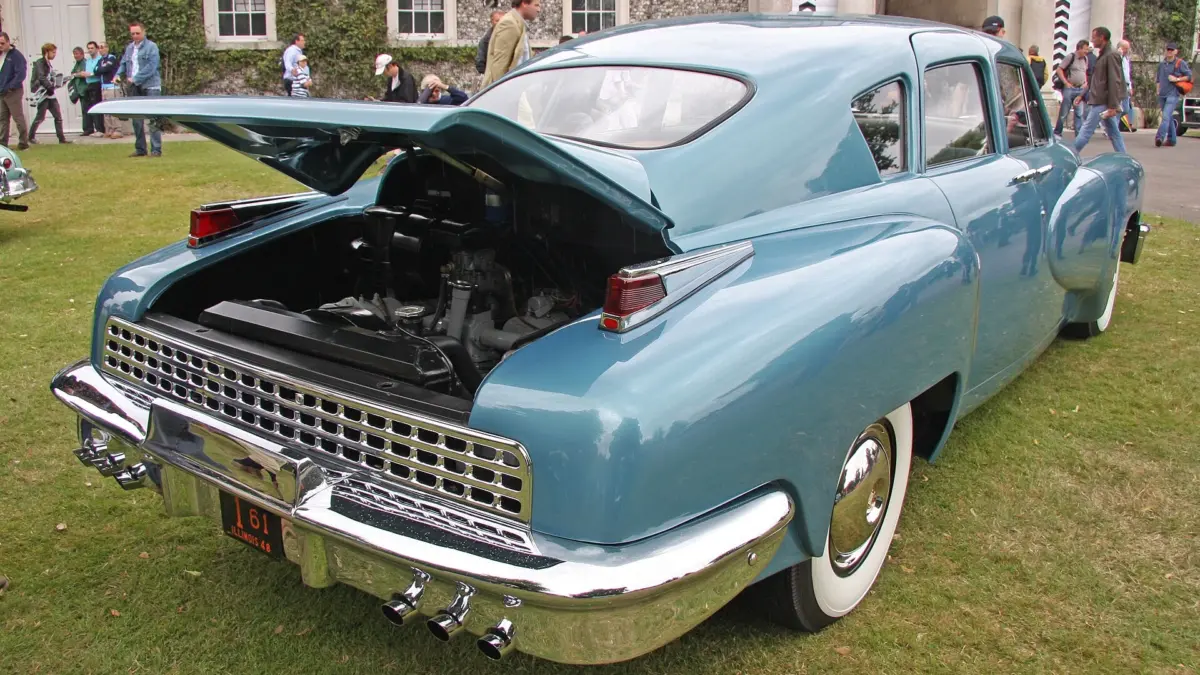
The 1948 Tucker, better known as the Tucker Torpedo, is a very rare automobile. Only 51 were built, counting the prototype, before the Tucker Corporation shut down in 1949. A Securities and Exchange Commission investigation, a fraud trial and a flood of bad press brought the company down.
That case was extremely important, and it explains why the car is so rare. Preston Tucker was found not guilty, but by then, his company was gone. Tucker believed the Big Three automakers and Michigan Sen. Homer S. Ferguson helped cause its collapse. That was never proven, but the story was dramatic enough for Hollywood. Francis Ford Coppola directed the 1988 movie “Tucker: The Man and His Dream” about the car’s saga, and Coppola is a Tucker owner himself.
1948 Tucker Torpedo: One of the Rarest Automobiles
The Tucker was a great automobile, and it was ahead of its time. Just because so few were built doesn’t mean the car wasn’t technologically advanced. It was.
First, a quick note on the name. “Torpedo” is what Tucker called the car while it was being designed and promoted. The production model was officially the Tucker 48. The nickname stuck anyway, and most people still call it the Tucker Torpedo.
It is also important to know what was happening in the car market at the time. During World War II, the Big Three automakers, General Motors, Ford and Chrysler, stopped building cars for the public and put their factories to work on the war effort. When the war ended, Americans wanted new cars badly. The Big Three ramped up production, but at first they mostly sold warmed-over prewar designs. That left an opening for a newcomer with fresh ideas, like Tucker.
Preston Tucker was already planning his postwar car by the summer of 1944, when he hired designer George S. Lawson to style it. The design process was bumpy. Lawson quit in late 1946 after a disagreement with Tucker. His replacement, Alex Tremulis, saw his contract expire before Tucker brought him back. Tucker also hired a team from the New York design firm J. Gordon Lippincott, and its clay model became the basis for the final car.
The Tucker was innovative in both design and safety. It had a rear engine and three headlights! The third one sat in the center of the front end and turned with the steering wheel to light the way around corners. At the time, 17 states had laws limiting cars to two headlights, so Tucker designed a cover for the center light.
The car looked like a torpedo, too, and safety was a big priority. A perimeter frame surrounded the car, with a built-in roll bar for crash protection. Tucker put the steering box behind the front axle so it wouldn’t be shoved back toward the driver in a head-on crash. The dashboard was padded. The sloped windshield was made of shatterproof glass and was designed to pop out in a collision. The doors were cut into the roof, which made it easier to climb in and out and also added to the car’s sleek look.
Tucker had even bigger plans that never made it into production. He wanted magnesium wheels, disc brakes, fuel injection, self-sealing tubeless tires and a direct-drive torque converter transmission. Cost, complexity and a tight schedule forced him to drop them. Still, innovation was a hallmark of the Tucker. Even with so few cars built and a troubled launch, ideas like the padded dashboard became standard on American cars in the decades that followed.
The engine was a flat-six, also called a boxer-six. It displaced 334.1 cubic inches and made 166 horsepower and 372 pound-feet of torque. It wasn’t as innovative as the rest of the car, though. Tucker’s first engine, a huge 589-cubic-inch flat-six, didn’t work out. So he turned to an air-cooled helicopter engine from Air Cooled Motors, bought the company and had the engine converted to water cooling.
The transmission was a headache, too. Tucker’s own automatic, the Tuckermatic, went through three versions in its brief existence but ended up in only a couple of cars. Most Tuckers used a manual transmission adapted from the one in the prewar Cord.
A Troubled Release
Apart from the SEC investigation that forced the company to cease operations, the car’s premiere was also troubled. The rollout was hugely hyped. On June 19, 1947, more than 3,000 people came to Tucker’s Chicago factory to see the car and tour the facility by train. But the prototype, nicknamed the “Tin Goose,” was heavier than expected, and two of its front suspension arms snapped the night before. The engine was so loud that Tucker had the band play loudly to drown it out. And the prototype had no reverse gear, so it couldn’t back up.
The legal trouble came next. Tucker had raised about $17 million by selling stock. He also sold accessories for cars that hadn’t been built yet, which let buyers hold a spot on the waiting list. That drew the attention of the SEC and federal prosecutors. The company ceased operations on March 3, 1949, and Tucker was later indicted for fraud. A jury acquitted him of all charges in January 1950, but the damage was done. The Tucker Corporation never recovered.
So, do you think you would be able to find one? It’s possible. Of the 51 Tuckers built, 47 survive, and many are on display in museums. Owning one is another story. When Coppola sold one of his Tuckers at auction in August 2025, it went for $1,545,000.
Find more reading about Motors & Machines from Total Apex Media.
 Don't stop here
Every Score. Every Story. One Home.
Breaking sports, entertainment and news from across the Total Apex network, updated all day.
Get the Full Story →