
3D Light-Field Display Runs Doom With a Century-Old TV Trick

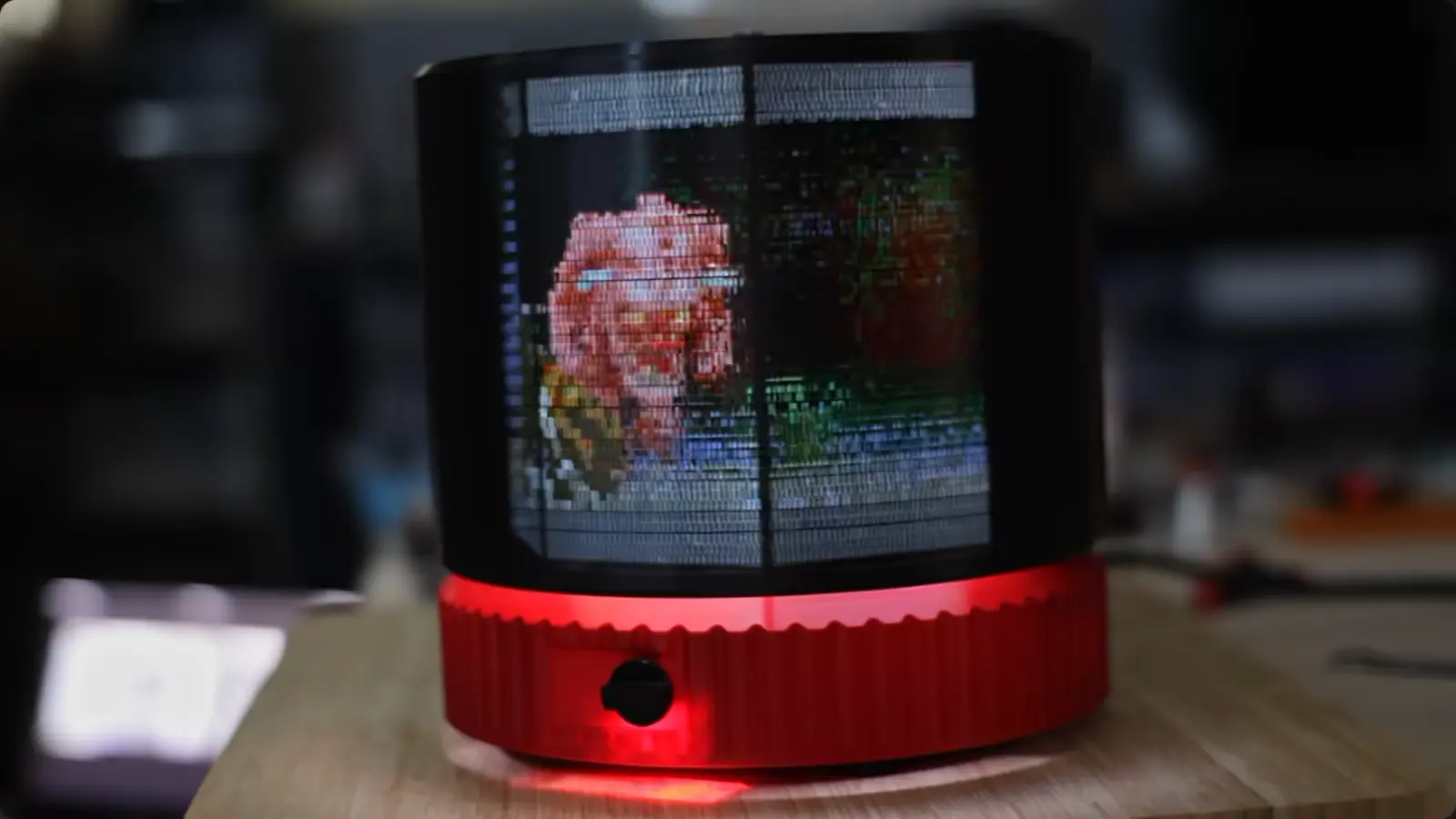
The game Doom has been ported to nearly every piece of hardware with a screen. Now it’s running on a 3D display built on an idea that predates television broadcasting.
YouTube creator AncientJames has built a working 3D light-field display around the core technique behind early mechanical televisions, and, yes, it runs Doom. In a video breaking down the build, he shows how a spinning drum and a few LED panels can produce a scene that shifts as you move around it — no pricey laser projector required.
The Century-Old Idea
The first mechanical TV systems relied on a Nipkow disk — a spinning disk punched with a spiral of holes, patented by Paul Nipkow in 1884. As the disk turned, each hole traced one line of the picture, building the image through raster scanning — the same line-by-line approach later used by CRT screens. Persistence of vision did the rest, blending those rapid lines into a single picture.
That flat version is fairly easy to grasp. Pushing it into three dimensions is another matter, which Hackaday called a real head-scratcher. AncientJames’ video walks through how he pulled it off.
How the Drum Creates Depth
AncientJames swaps the disk for a rapidly spinning drum with holes in it. In place of the single lamp, he uses stationary LED matrix displays, each 32 by 64 pixels. The key is splitting the 3D model into a light field. As each hole sweeps past the displays, it projects its own image of the object at the proper angle, so viewers standing in different spots see different perspectives of the same scene.
The demo uses three displays arranged as half of a hexagonal prism, which limits how far around the display a viewer can move. Full 360-degree viewing would take more screens. Effective resolution through the drum is about 100 by 48 pixels per eye. That’s low by modern standards but plenty for a round of Doom.
Why Doom Matters Here
The Doom demo is more than a punchline. It shows the display can handle real game graphics in real time. It also carries on maker culture’s long-running tradition of porting id Software’s 1993 shooter to every platform imaginable.
It’s not AncientJames’ first time pairing the two, either. Hackaday covered his 2024 build that ran Doom on a volumetric display. His later experiments used lasers, bubbly glass and mist to create 3D images.
The Takeaway for this 3D Light-Field Display
This version keeps the displays stationary and skips the laser projector, and Hackaday called it the most accessible of his designs so far. It’s still a proof of concept rather than a product. Even so, it shows that off-the-shelf LED panels, a spinning drum and persistence of vision can create convincing 3D without exotic optics. Anyone tempted to build one should heed Hackaday’s advice and watch their fingers around that spinning drum.
Written with the help of AI, reviewed and edited by Harmony Daniels.
