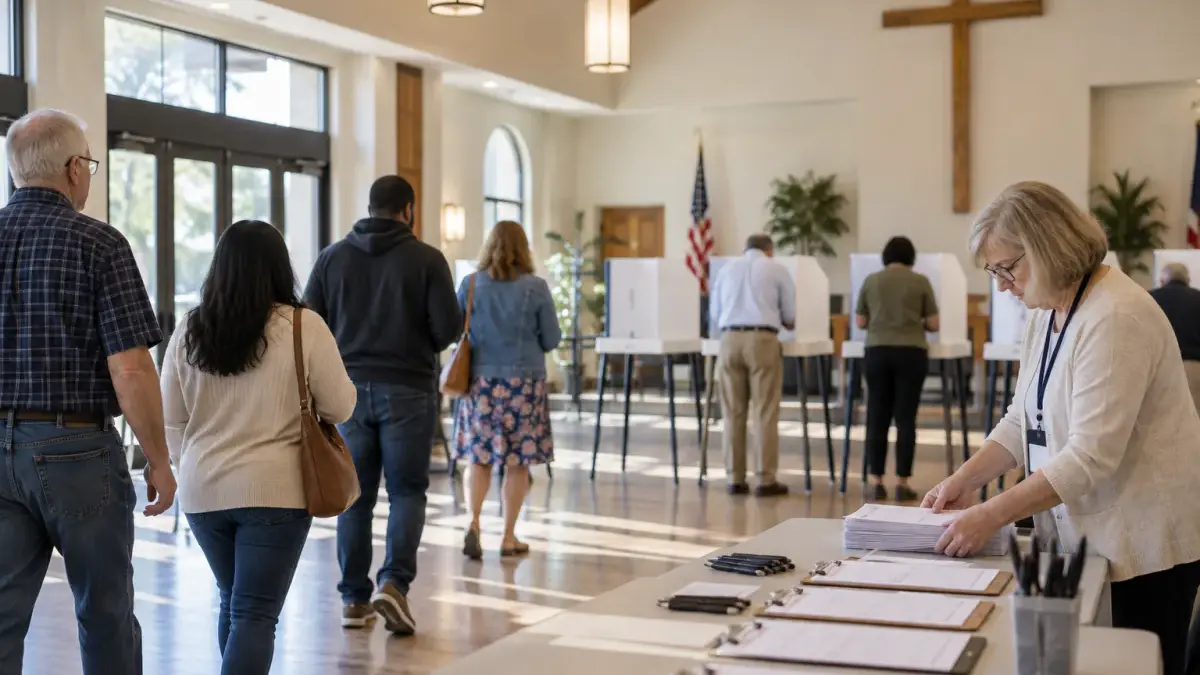
White evangelical Protestant voters remain the Republican Party’s strongest religious base heading into the 2026 midterms, with 73% saying they would back a Republican House candidate compared with just 12% favoring a Democrat, according to a Pew Research Center survey published Oct. 13. The poll, conducted Sept. 28 through Oct. 4, 2026, surveyed 5,062 U.S. adults, including 3,917 registered voters drawn from Pew’s American Trends Panel.
The findings show a religious electorate still deeply split along denominational lines, even as economic concerns and President Trump’s slipping approval numbers weigh on voters across nearly every faith group tracked.
The Numbers Behind The Evangelical Voters 2026 Midterms Split
- White evangelical Protestant voters: 73% Republican, 12% Democratic
- White Catholic voters: 50% Republican, 32% Democratic
- White nonevangelical Protestant voters: 45% Republican, 37% Democratic (not a statistically significant gap)
- Hispanic Catholic voters: 59% Democratic, 19% Republican
- Religiously unaffiliated voters: 61% Democratic, 17% Republican
- Voters who describe their religion as “nothing in particular”: 48% Democratic, 22% Republican
Pew’s data also shows Black Protestants, Hispanic Catholics, atheists, agnostics and voters who identify with no particular religion all lean far more toward Democratic candidates than Republican ones.
What The Numbers Mean
White evangelical Protestants and White Catholics stand out as the only two religious groups in the survey where Republican candidates hold a clear lead. Every other group measured favors Democrats, often by wide margins, as is the case with religiously unaffiliated voters who back Democratic candidates by a 44-point spread.
The gap among White nonevangelical Protestants tells a different story. Pew found Republicans ahead 45% to 37% in that group, but the difference falls within the survey’s margin of error, meaning the race among those voters is effectively a toss-up rather than a clear Republican advantage.
Context On Trump Approval And Religious Voters
The midterm preference numbers arrive alongside another finding from the same survey: Trump’s approval ratings have fallen among every religious group Pew studied, landing among the lowest marks of his second term. That decline includes groups that have historically formed his most reliable coalition, with Pew reporting that even traditionally pro-Trump religious communities now view him less favorably than they once did.
That erosion in approval has not yet translated into a shift away from Republican House candidates among evangelical voters, based on the topline numbers Pew released. The 73%-to-12% advantage for Republicans among White evangelical Protestants remains the widest partisan gap of any religious group in the survey.
What’s Next
Pew’s survey arrives roughly a month before the 2026 midterm elections. Turnout will determine how these preferences translate into results. Pew notes that 46% of eligible voters cast ballots in the 2022 midterms, a baseline figure for comparison as Election Day approaches. Readers interested in how economic pressures are shaping political messaging can also follow related coverage, including Trump’s defense of fuel price policy, and for background on the religious traditions referenced in the survey, see this guide to Christian beliefs and denominations.
 Don't stop here
Every Score. Every Story. One Home.
Breaking sports, entertainment and news from across the Total Apex network, updated all day.
Get the Full Story →
Don't stop here
Every Score. Every Story. One Home.
Breaking sports, entertainment and news from across the Total Apex network, updated all day.
Get the Full Story →