
‘Jihad vs. McWorld’: The 1990s Theory That Surprisingly Anticipated 21st‑Century Global Tensions

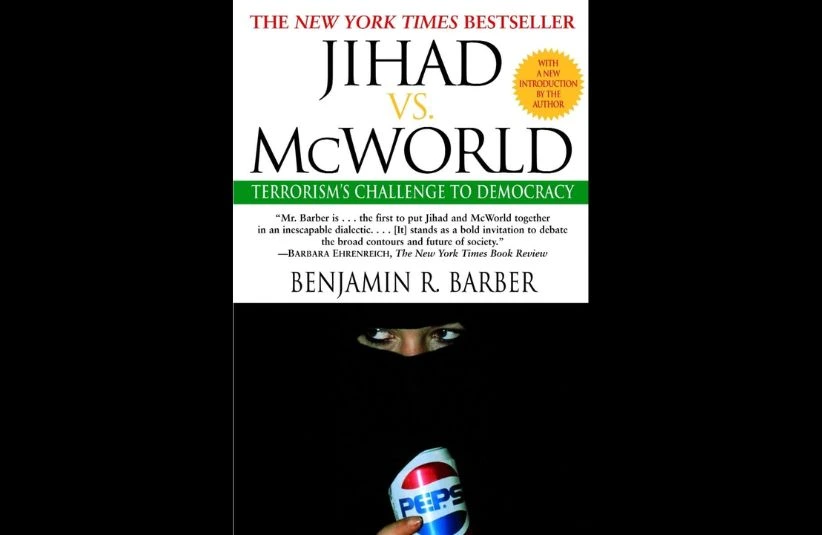
“Jihad vs. McWorld: Terrorism’s Challenge to Democracy” is a 1955 book by Rutgers Political Scientist Benjamin Barber. Barber argues that the conflict with globalization has reshaped nationalism into violent extremism. His argument is prescient because the book was published three years before the 1998 attack on the World Trade Center, and 16 years before September 11, 2001.
The book is based on a 1992 article by Barber in the Atlantic Monthly. In both the book and the article, Barber critiques the popular notion that globalization will lead to peace. He says the forces of globalization meet nationalistic forces, which he calls tribalism, to create a conflict. Can you believe Barber made his argument before the major terrorist attacks?
“Jihad vs. McWorld: Terrorism’s Challenge to Democracy” Summary

The main argument made in this book is an academic one that was soon to have enormous policy relevance. Namely, Benjamin Barber critiques the popular academic theory of Neoliberalism by stating that globalization may not lead to peace.
In his characterization of “McWorld,” Barber argues that the society relies upon a market imperative, a resource imperative, an information technology imperative, and an ecological imperative. Because of globalization, the market has expanded and is vulnerable to the transnational markets where free trade, easy access to banking, and exchange of currency are available.
With the emergence of these markets, the West came up with a series of international laws and treaties to maintain stability and efficiency in the interconnected economy. These rules define the global system. Further, the information technology of globalization has opened up communications to people all over the world, allowing us to exchange information. This technology, he argues, is part of our everyday lives.
Barber also argues that environmental changes in one nation can, and do, affect others. For instance, cutting down a jungle will upset the overall oxygen balance, which affects our “global lungs.”
In the end, “McWorld” may promote peace and prosperity, but Barber sees this as being done at the cost of independence and identity. Thus, he sets up the comparison with the tribalism of nationalization.
As far as the opposing camp, or as Barber calls it, Jihad, or Tribalism, Barber sees Jihad as offering solidarity and protecting identities, but at the cost of tolerance and stability. Intolerance is a key component of the Jihad camp. Solidarity is needed within the concept of Jihad as being secured through exclusion and war against outsiders. This is the core idea of Jihad. He argues that, as a result, different forms of anti-democratization can arise through anti-democratic one-party dictatorships, military juntas, or theocratic fundamentalism.
Barber also describes, through examples from the early 1990s, the composition of both camps.
“[T]hey are cultures, not countries; parts, not wholes; sects, not religions, rebellious factions and dissenting minorities at war not just with globalism but with the traditional nation-state. Kurds, Basques, Puerto Ricans, Ossetians, East Timoreans, Quebecois, the Catholics of Northern Ireland, Catalans, Tamils, and, of course, Palestinians. People with countries, inhabiting nations not their own, seeking smaller worlds within borders that will seal them off from modernity.”
Amazing Prediction by Benjamin Barber
An academic is rarely correct in predicting what will happen. Barber makes an unpopular academic argument that proves to be remarkably prescient. Before the major terrorist attacks on the World Trade Center. When one considers how those attacks shaped American Foreign Policy, Barber’s argument is jaw-dropping.
Why You Should Read This Book
There are at least two reasons to read this book. Foremost, in doing so, one can understand the major global forces that were shaping the international scene at the turn of the twentieth century. Understanding these forces is essential, and “Jihad vs. McWorld: Terrorism’s Challenge to Democracy” puts a finger right on it.
Second, the book is entertaining. The way in which Benjamin Barber describes both globalization and nationalism is filled with examples and analogies that make them easy to understand.
