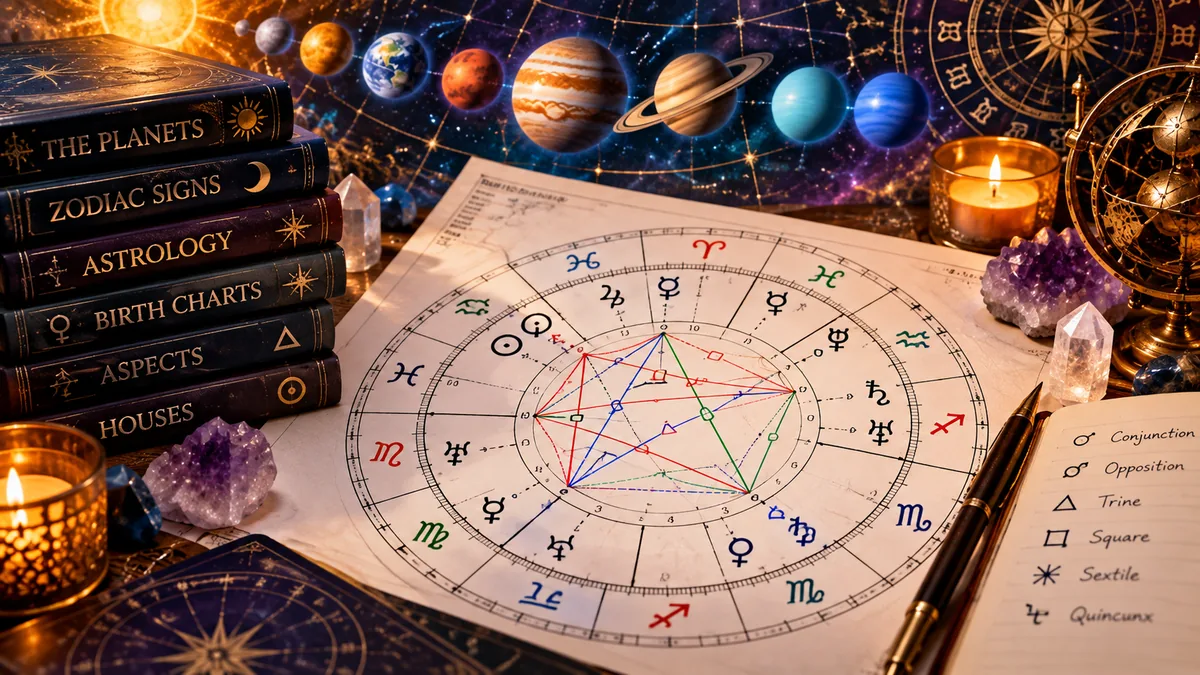
Anyone who has pulled up their natal chart for the first time knows the feeling of staring at a wheel full of symbols and lines with no idea where to start. This guide is for that person. Understanding birth chart planetary aspects, the angles formed between planets in your chart, is one of the most useful skills a beginner astrologer can build, and it does not require memorizing an entire textbook to get going.
An aspect is simply the angle between two planets in a birth or natal chart, according to Almanac.com. Those angles describe how the energies of each planet interact, whether they support each other, clash, or sit somewhere in between. Pairing that knowledge with the planets and houses involved gives a fuller picture than looking at any single placement alone.
What Counts As A Major Aspect
Astrologers generally work with five major aspects, according to Almanac.com: the conjunction (0 degrees), sextile (60 degrees), square (90 degrees), trine (120 degrees), and opposition (180 degrees). Each of these angles divides evenly into the 360-degree circle of the zodiac, a framework credited to the ancient Greek mathematician Ptolemy, Almanac.com reported. Astrostyle.com also groups aspects by how they feel.
Soft or easy aspects include the conjunction, sextile and trine. Hard aspects include the semisextile, square, quincunx and opposition. That split gives beginners a quick way to gauge whether an aspect is likely to flow smoothly or create friction before digging into the specifics.
What You Need To Get Started
You do not need to buy anything to start reading aspects. A free natal chart generator and your birth date, time and location are enough to produce a wheel showing every planet’s position and the aspects between them. The chart itself is divided into twelve houses, each spanning 30 degrees, according to Almanac.com, so the basic math behind the wheel is consistent no matter whose chart you are reading.
Learning The Orb: How Close Counts
Once you can see which planets form an aspect, the next detail to check is the orb, the degree of exactness between the two planets. The closer the orb, the more intensely that aspect is felt, Almanac.com noted. Beginners are generally better off sticking to tighter orbs, no more than 5 degrees, though some astrologers allow up to 10 degrees of difference. Starting tight and expanding later helps avoid reading too much into a loose, weak connection.
The Conjunction: Same Sign, Same Degree
A conjunction happens when two planets sit in the same sign and nearly the same degree, which intensifies the energy between them, for better or worse, according to Almanac.com. A conjunction that lines up exactly with the Sun is called a cazimi, meaning “in the heart,” a position said to give the other planet added power. Conjunctions can run hot, but aspects only show the raw energy available. How a person chooses to use that energy is still up to them.
Sextiles And Trines: The Easy Angles
A sextile forms when two planets sit 60 degrees apart, a favorable angle often compared to good friends who naturally vibe well together, Almanac.com reported. Astrostyle.com adds that a sextile only forms between planets in signs of the same energy type, either both yin (earth or water) or both yang (fire or air), which keeps the connection compatible and free of conflict. Sextiles are not the most powerful aspect, but they tend to bring easygoing interactions and general good cheer.
A trine, at 120 degrees apart, is considered the most harmonious major aspect, indicating natural talent, ease and opportunity, according to Almanac.com. The catch is that trine energy can come so easily that it breeds laziness, since without friction there is sometimes little push to act on that talent at all.
Squares And Oppositions: The Hard Angles
A square places two planets 90 degrees apart, creating difficulty and a lack of cooperation between their energies, Almanac.com reported. Astrostyle.com describes a square as a tug of war: the two planets share the same astrological quality, cardinal, mutable or fixed, but nothing else, so each side tends to dig in rather than compromise. Resolving that tension means both sides giving a little ground and meeting in the middle. Despite the difficulty, Almanac.com notes that squares can fuel bold ambition, and many highly successful people have charts loaded with them.
An opposition occurs when two planets sit 180 degrees apart in opposite signs, putting them at odds and creating an antagonistic feel, according to Almanac.com. Astrostyle.com also lists the semisextile, a 30-degree aspect between two planets, as a hard aspect, pointing out that the planets involved share no common traits, which can make the connection feel subtly uncomfortable.
Common Mistakes Beginners Make
One frequent mistake is treating a single hard aspect as a guaranteed problem or a single soft aspect as a guaranteed gift. Aspects describe available energy, not a fixed outcome, and both easy and difficult angles come with trade-offs, as the contrast between ambitious squares and lazy trines shows. Another common error is ignoring orb distance and counting every aspect within 10 degrees as equally strong, when tighter orbs carry more weight.
Beginners should also resist reading one aspect in isolation. A planet’s full story depends on every aspect it makes, not just the most dramatic one.
Bigger Patterns: T-Squares, Grand Crosses And Grand Trines
Once the five major aspects feel familiar, it helps to recognize the larger patterns they can form. A T-Square happens when three planets lock into tense 90-degree angles with one another, creating a three-way standoff where one planet tries to broker peace between the other two, according to Astrostyle.com. A Grand Cross, or Grand Square, is a rarer and more intense version involving four planets in stressful 90-degree angles, a configuration Astrostyle.com compares to a United Nations meeting where four competing agendas all demand attention and action can stall into deadlock.
On the easier end, a Grand Trine forms when three planets align in harmonious 120-degree angles with each other, according to Astrostyle.com. These larger shapes do not replace the basic aspects, they build on them, which is why learning the five majors first makes spotting these patterns much easier later.
Where To Go Next
Reading aspects gets easier with repetition. Pulling up a few charts, including your own, and simply noting which major aspects appear and their approximate orb is good practice before moving into more complex pattern recognition. From there, readers interested in how two people’s charts interact can look into synastry, which applies these same aspect rules between two separate birth charts. Those wanting a deeper dive into a single aspect can also check out a breakdown of a specific square placement, or explore how the Moon sign factors into a fuller reading of a natal chart.
 Don't stop here
Every Score. Every Story. One Home.
Breaking sports, entertainment and news from across the Total Apex network, updated all day.
Get the Full Story →
Don't stop here
Every Score. Every Story. One Home.
Breaking sports, entertainment and news from across the Total Apex network, updated all day.
Get the Full Story →