Art historian Wanda Corn has spent five decades chasing one question: How did Grant Wood’s “American Gothic” become one of the most recognized paintings in American history? Her answer fills a new book, “The Couple With the Pitchfork: ‘American Gothic’ From Easel to Icon,” released Oct. 27 by Princeton University Press. It traces the 1930 painting’s path from a juried exhibition in Chicago to a symbol endlessly borrowed, parodied and reworked across American culture, according to a review in Art in America.
For fans of art history, the book offers something rare: a researcher’s own archive, built over a lifetime, used to explain exactly how one image outgrew its frame.
What ‘American Gothic’ Shows and Who Painted It
Grant Wood painted “American Gothic” in 1930. A stern man gripping a three-pronged pitchfork stands beside a younger woman, both posed stiffly in front of a small white house with a Gothic-style upper window. The real house still stands in Eldon, Iowa. Wood’s sister, Nan Wood Graham, and his dentist, Byron McKeeby, sat as the models.
The painting marked a turning point for Wood, an Iowa artist who was working out a visual vocabulary rooted in the look and feel of the Midwest, Art in America reports.
“American Gothic” made its debut at the Art Institute of Chicago’s annual exhibition of American art in 1930, where it won a bronze medal and a $300 prize. The museum bought it that same year, and it remains in the collection today.
The Design Choices Behind Its Staying Power
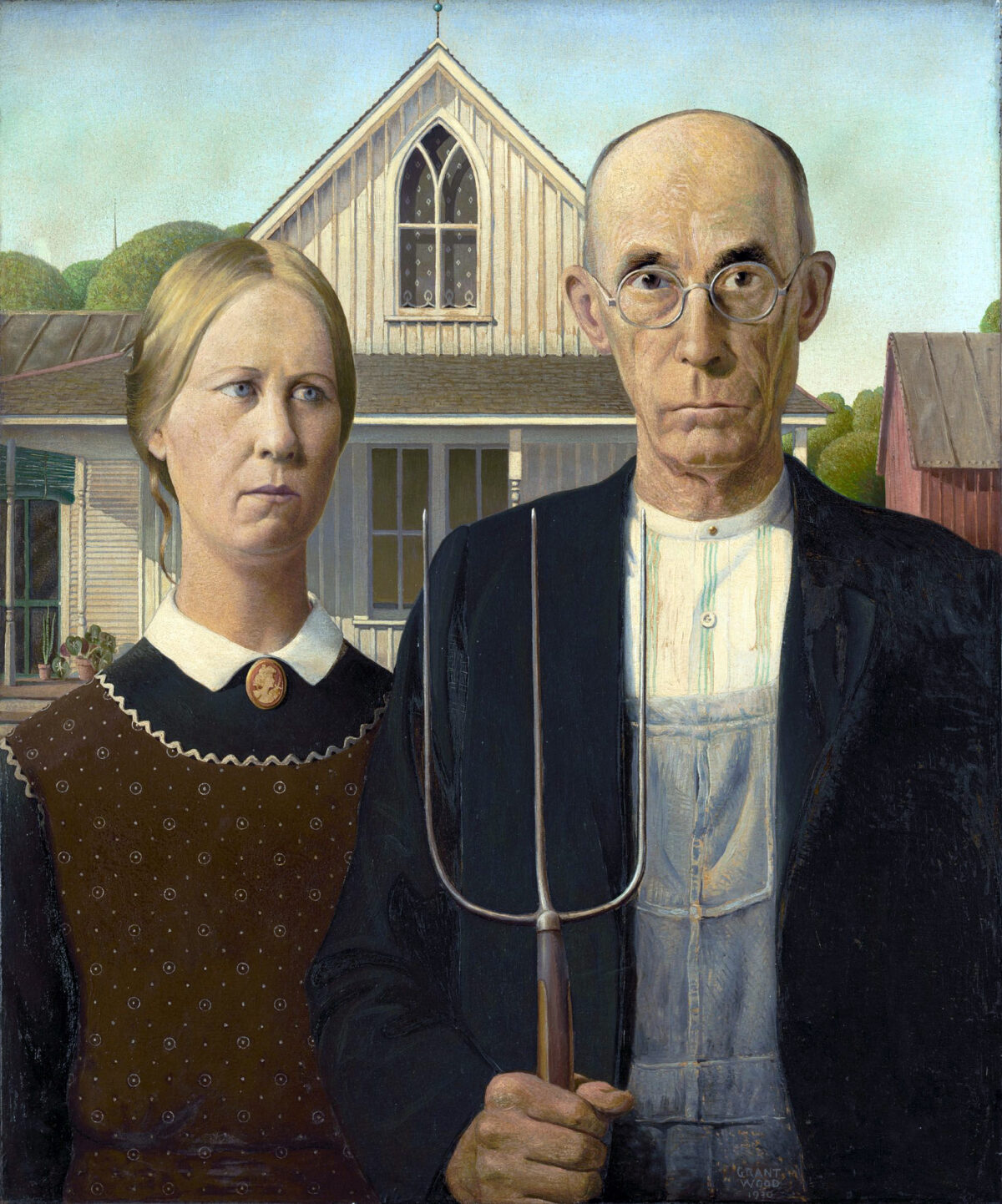
Corn’s research points to the painting’s composition as central to its endurance. Vertical lines run from the tines of the pitchfork up to a church steeple in the background, while round and oval forms repeat through the faces, the woman’s brooch, her dress pattern and the shapes of their ears. Corn argues that combination creates a sense of harmony and order within the frame.
That’s why she rejects the idea that the painting is simple realism. In her reading, it’s a carefully built study in pattern and shape that only looks effortless.
The Misreading That Made It Famous
From the start, nearly everyone saw the pair as a farmer and his wife, even though Wood intended them as a small-town father and his daughter. Some Iowans bristled, and critics couldn’t decide where the painting fit.
For Corn, that misunderstanding is the key to the painting’s success. Because viewers read the couple as married, “American Gothic” became a modern, accessible version of one of art’s oldest subjects: the marriage portrait, a motif she traces from Egyptian princes to Etruscan terra cottas to Dutch Golden Age portraits. Two figures standing together is a template almost anyone can step into, and that’s exactly what happened.
Early Reinterpretations in Chicago
Among the artists who picked up the painting’s formula were African American artists who looked to Wood, a painter from farm country, as an example of what a largely self-made artist could achieve, according to Art in America.
Chicago painter Walter Ellison was one of them. Ellison, who left Georgia for Chicago during the Great Migration, borrowed the setup of a couple posed in front of their home and used it to tell migration stories rather than scenes of Iowa life. The borrowing shows how quickly the painting’s visual grammar separated from its original subject matter and became a tool other artists could apply to entirely different stories.
A Personal Archive of Hundreds of Versions
Over the years, Corn has gathered hundreds of reworkings of “American Gothic” from fine art and pop culture alike. The examples span an unusually wide range. One version was sculpted in butter at a state fair. Others have recast the couple as a same-sex pair in support of marriage equality or sent the woman off to her own job in a feminist retelling.
That range forms the backbone of Corn’s larger argument. A painting built on deliberate structure, once mistaken for a simple portrait of a farm couple, became flexible enough to carry migration narratives, political messages and fairground novelty acts alike.
What Comes Next
Corn will discuss the book during a free program Nov. 15 at 1 p.m. at the Cedar Rapids Museum of Art in Iowa. The museum will follow up with a Zoom conversation from 2 to 3 p.m. Dec. 13, when Executive Director Sean Ulmer will interview Corn about Wood and the book.
Readers interested in the painting’s visual mechanics or its long afterlife in American pop culture can find the detailed history, along with Corn’s catalog of reinterpretations, in “The Couple With the Pitchfork.”
 Don't stop here
Every Score. Every Story. One Home.
Breaking sports, entertainment and news from across the Total Apex network, updated all day.
Get the Full Story →