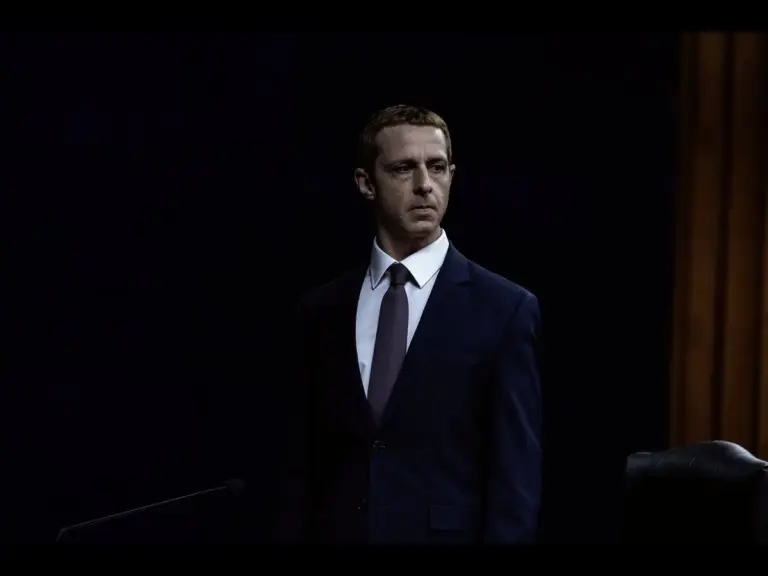

Tom McCarthy’s A Statement earned strong reviews at the New York Film Festival, with critics praising the film’s ensemble cast and humanist approach to a real 1980 climate conference, though some questioned whether dialogue-driven drama sustains cinematic tension.
A Statement brings a real 1980 conference to screen
A Statement is set during a real 1980 conference in St. Petersburg, Florida, where U.S. Congress assigned officials to advise on climate change.
The screenplay, adapted by McCarthy and co-writers Thomas Bidegan and Noé Debré from Nathaniel Rich’s book Losing Earth: A Recent History, is drawn largely from actual transcripts. The entire film takes place around a St. Pete Beach conference room.
Praise for the ensemble cast and McCarthy’s direction
Deadline called A Statement “a gem,” crediting McCarthy’s approach for transforming dense material into compelling cinema. The ensemble cast, featuring Paul Rudd, Paul Giamatti and John Turturro, anchors the dialogue-heavy narrative with strong performances. Cinematographer Stuart Dryburgh keeps the confined setting visually compelling, drawing comparisons to Sidney Lumet’s 12 Angry Men for its ability to sustain cinematic tension within a single room.
Deadline framed the film as a “quirky and unexpected period piece about a time when civil discourse was still possible on hot-button topics,” and emphasized McCarthy’s humanist approach, his films center on people, not polemics.
Concerns about length, pacing and intellectual impact
Variety took a more measured stance, acknowledging the film as a conversation piece for viewers who prize intelligent dialogue but noting that committee members debate how to frame uncertainty rather than clash over core ideas. Much of their disagreement centers on whether to state what will happen versus what could happen regarding climate projections.
The review also highlighted that some committee members protect institutional interests rather than pushing for stronger action, with one character described as “a colorfully corrupt blowhard.” While Variety praised the film’s central thesis, that scientists and policymakers in 1980 understood the climate threat better than the public knew, it suggested the movie could have benefited from more forceful argument and conflict.
What’s next
A Statement will be released theatrically in 2027. The film is produced by Jonathan King, David Levine, Jim Whitaker, Rae Baron, McCarthy, Jonathan Schwartz, Nick Shumaker, Bard Dorros and Mary Aloe.
Reporting from Deadline and Variety contributed to this story.
 Don't stop here
Every Score. Every Story. One Home.
Breaking sports, entertainment and news from across the Total Apex network, updated all day.
Get the Full Story →