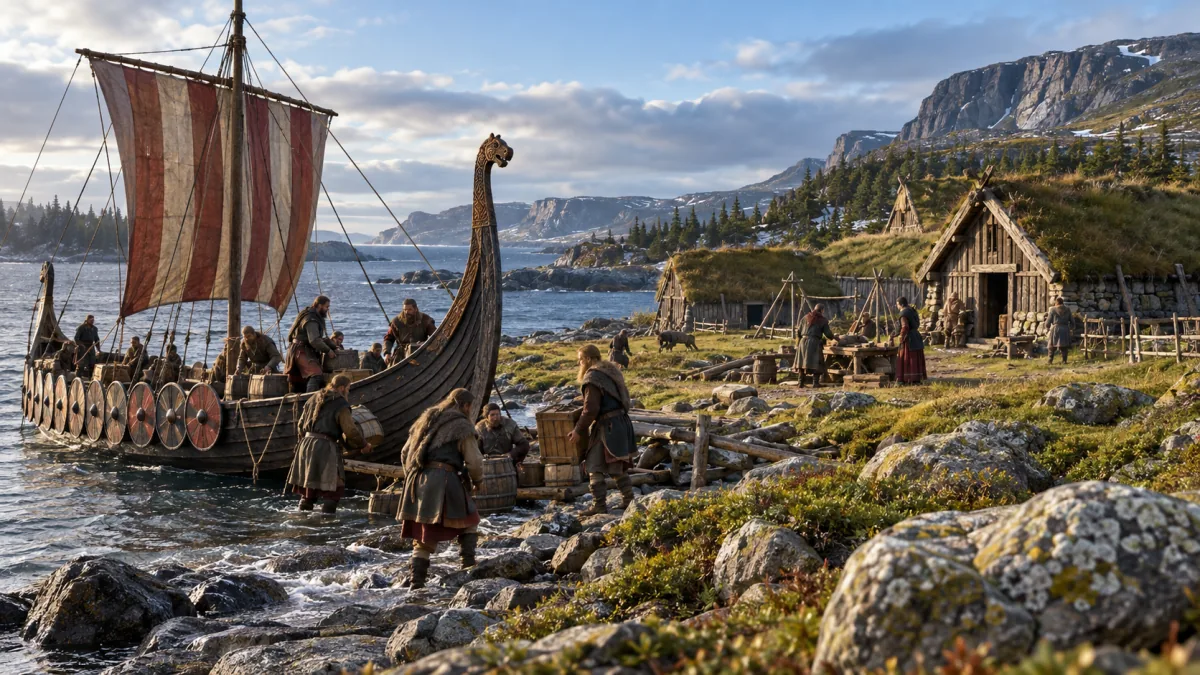
Christopher Columbus arrived in the Bahamas on Oct. 12, 1492, a date long marked as Europe’s first contact with the Americas. But archaeological and historical evidence shows Vikings reached the Americas before Columbus, landing on the shores of North America roughly 500 years earlier, according to the BBC.
The proof sits at L’Anse aux Meadows in Newfoundland, Canada, where researchers discovered a Norse transit camp in 1960. In 2021, scientists using a new dating technique determined that Vikings had occupied the site 1,000 years earlier than previously believed, according to the BBC. That timeline places Norse explorers in North America centuries before Columbus ever set sail.
What The L’Anse Aux Meadows Site Tells Historians
L’Anse aux Meadows is believed to have functioned as a base camp, a staging point the Norse used to push deeper into the continent rather than a permanent settlement, the BBC reported. Its location fits with the broader pattern of Norse expansion westward across the North Atlantic, a chain of exploration that started well before anyone in North America had set eyes on a European ship.
That chain began with Iceland, which the Norse reached around 870 AD. About a century later, roughly 970 AD, they found Greenland. The colony they built there lasted around 500 years, continuing until the early 15th century, and it became the launching point for Norse voyages into North America.
How The Vikings Crossed Into North America
From Greenland, the next leap was the Davis Strait, a roughly 200-mile crossing to Baffin Island in modern Canada. The Norse named that island Helluland, meaning the land of slabs. They called Labrador Markland, the land of forests, and a southern region Vinland, the land of vines.
The sagas describe the Vikings tracking the coastline south from Baffin Island to Labrador and continuing further south into Vinland. Leif Eriksson led multiple journeys from Greenland to North America, according to the BBC, and the accounts describe more than a single landing.
“The sagas describe not only these guys stopping off in one place, but stopping off in a number of places. And they left for several years. They had a whole new world to explore,” one source told the BBC.
Why The Norse Sagas Matter As Historical Sources
Much of what is known about these voyages comes from Norse sagas, stories first told aloud and later written down by descendants. Those sagas are now recognized as containing reliable historical truths, according to the BBC, rather than pure legend.
One of the key manuscripts is the Flateyjarbók, or Flatey Island Book, a 14th-century Icelandic text described as “one of the most valuable Icelandic manuscripts in existence.” It contains accounts of Norse settlement in Greenland during the 10th century alongside the record of Norse discovery and attempted colonization of North America five centuries before Columbus.
The manuscript’s value was clear even in the 19th century. In 1893, organizers of the Chicago World’s Fair offered to send a warship to Denmark and an armored train across America just to borrow it, and they offered to insure the book for $1 million.
What The Evidence Means For Fans Of History
For anyone who grew up learning that Columbus found the New World, the dated Newfoundland site and the saga manuscripts tell a different story, one where a separate group of European explorers crossed the Atlantic and walked North American shores five centuries earlier. It does not erase the significance of 1492, but it does reposition it as one chapter in a longer story of contact between Europe and the Americas.
What stands out most is the scale of the undertaking. Open-boat crossings of the Davis Strait and the wider North Atlantic required real nerve from a crew with no maps of what lay ahead.
“They were people who took chances and were prepared to undergo huge physical trials, such as sailing in open boats across the Atlantic, to see what they could find,” a source told the BBC.
Background On Norse Exploration
The Norse push into the North Atlantic followed a clear progression over roughly a century, moving from Iceland to Greenland and finally to North America. Each step depended on the colony before it, with Greenland’s 500-year settlement serving as the base for the journeys that reached Helluland, Markland and Vinland.
The L’Anse aux Meadows discovery and its 2021 redating give that saga-based history physical backing, placing Norse boots on North American ground roughly 1,000 years before the present day.
More Unusual / Fascinating Stories news from Total Apex Entertainment.
 Don't stop here
Every Score. Every Story. One Home.
Breaking sports, entertainment and news from across the Total Apex network, updated all day.
Get the Full Story →
Don't stop here
Every Score. Every Story. One Home.
Breaking sports, entertainment and news from across the Total Apex network, updated all day.
Get the Full Story →