George Major, the Pearly King of Peckham, could hold a whole conversation in a language most visitors could not follow. When NPR correspondent Lauren Frayer interviewed him in 2016, he told her he was a costermonger who used to fly-pitch on the “frog and toad,” and she needed years to decode it. Major died Aug. 1 at 88, and Frayer looked back on his life in a story for NPR published Thursday, Oct. 1.
Translated, Major was a street hawker who used to sell goods without a license on the road where they were standing.
A buttoned-up suit and a big personality
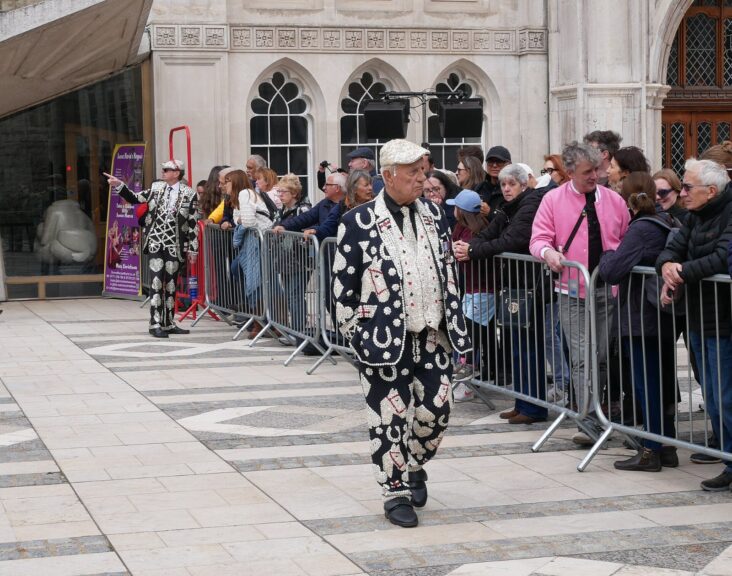
Major showed up to that 2016 interview, when he was 78, in a black suit and flat cap covered in sequins and mother-of-pearl buttons, his title spelled out in buttons across the back. As they walked through the East End, a vendor ran out to give him a high-five and tourists stopped for photos, Frayer wrote.
The life story of the Pearly King of Peckham was harder than the sparkle suggested. Born in 1938 inside a military barracks in Peckham, in southeast London, Major was abandoned as a child, grew up in a workhouse and found odd jobs in the local market as a teenager, his daughter Janet Major told NPR. He became one of the costermonger kings who ran market stalls, later trained as a plumber and ran a plumbing supply shop. On weekends, he led his seven children door to door in matching pearly suits to collect money for charity.
How the Pearly King of Peckham’s tradition began
The pearly kings and queens trace back to the 1870s, when an orphaned street sweeper named Henry Croft started sewing mother-of-pearl buttons onto his suit. He collected them from the streets around the textile factories that once filled the East End, according to NPR.
“These pearly suits are now cultural artifacts with fantastic designs, telling a profound story about London and Cockneys, what we call the non-posh Londoners,” Andy Green, co-founder of the Modern Cockney Festival, told NPR.
Many early pearlies were street traders or charity canvassers, and many were immigrants whose slang borrowed from Yiddish or Bengali. Today a shrinking number still raise money for children’s hospitals, women’s shelters and veterans groups, NPR reported.
Frog and toad: Decoding Cockney rhyming slang
The Pearly King of Peckham mixed Cockney rhyming slang with what he called “backspeak,” a style of saying words backward. A few common rhymes:
- “Frog and toad” = road
- “Porky pies” = lies
- “Apples and pears” = stairs
- “Whistle and flute” = suit
- “Ruby Murray” = curry
Backspeak has left at least one mark on everyday British English: “yob,” which is “boy” spelled backward. Green told NPR that rhyming slang probably started as a way to confuse police or to quietly fix prices among street sellers.
From ‘Mary Poppins’ to Del Boy
The pearlies inspired Bert, the chimney sweep Dick Van Dyke played in Disney’s “Mary Poppins.” Van Dyke later called his own effort “the most atrocious Cockney accent in the history of cinema.” (See our look at Van Dyke’s best roles.)
Major’s family and others believe the Pearly King of Peckham was a model for Del Boy, the get-rich-quick schemer of the British sitcom “Only Fools and Horses,” and his eulogy was full of Del Boy lines, NPR reported. Like Del Boy, Major had run-ins with the law: He pleaded guilty to benefits fraud and was sentenced in 2012 to six months in prison, though he was released early. That same year, he marched with other pearly royals in the opening ceremony of the London Olympics.
A send-off fit for a Pearly King of Peckham
Major was buried Sept. 14 near the Cockney Museum he founded. A horse-drawn cart brought his casket to the chapel, where mourners sang pub songs loudly enough to rattle the walls, Frayer wrote. Four generations of his family wore matching pearly suits.
His great-granddaughter, Aleisha Gordon, 19, explained the family pattern he once called “the line of life.” “There’s a straight line, which is your life line,” she said. “The triangles are the ups and downs in life, and the flowers are the friends and family that help you along the way.”
Travelers can still see the Pearly King of Peckham: A portrait of Major covers a wall at Heathrow Airport. For more stories like this one, visit our special interests section.
 Don't stop here
Every Score. Every Story. One Home.
Breaking sports, entertainment and news from across the Total Apex network, updated all day.
Get the Full Story →
Don't stop here
Every Score. Every Story. One Home.
Breaking sports, entertainment and news from across the Total Apex network, updated all day.
Get the Full Story →