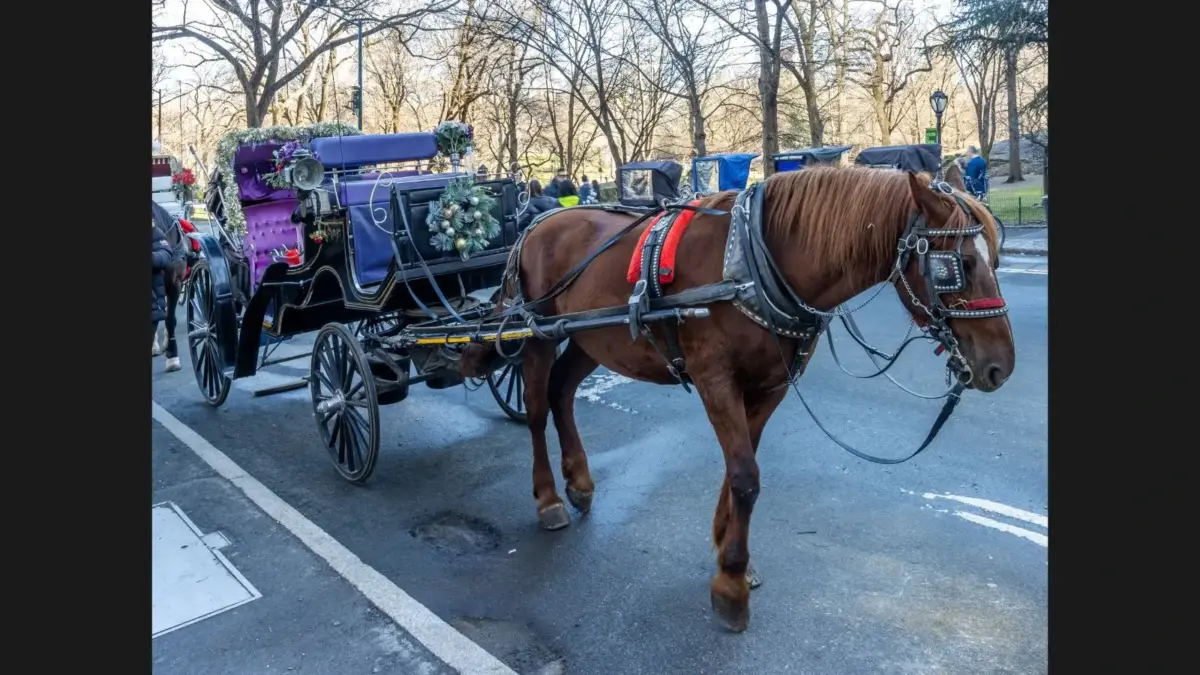
The New York City Council voted 40-7, with two abstentions, on Oct. 22, 2026, to ban horse-drawn carriages in Central Park, stopping the city from issuing new carriage licenses and ordering all rides to end by June 1, 2028. The NYC horse carriage ban ends a tourist tradition that dates back more than 150 years.
Mayor Zohran Mamdani backs the bill, known as Romanch’s Law, and his office said after the vote that “the mayor will sign this bill.” The margin is also large enough to override a veto. The 51-member council passed the measure after months of debate over the industry’s future.
What the Council Approved
The ban bars the city from issuing new horse-carriage licenses and sets June 1, 2028, as the final date for existing operators to shut down, according to USA Today. The number of carriage medallions has been capped at 68 since the end of World War II, and more than 150 active drivers currently work in the industry, according to The Associated Press.
Before the vote, City Hall spokesperson Sneha Choudhary told USA Today that officials had been coordinating with multiple stakeholders. “We have been working closely with the City Council, union partners, carriage drivers, animal welfare advocates, and community leaders to deliver a just transition that protects workers while ending horse-drawn carriages in Central Park once and for all,” she said.
The push for a ban gained momentum after the June 17 death of Romanch Mahajan, an 18-year-old tourist from India. USA Today reported Mahajan was thrown from a carriage, while the AP reported he died after jumping from a runaway carriage to help his mother, who had been thrown from her seat when the horse bolted. His father, Deepak Mahajan, described the incident to lawmakers. The legislation carries Mahajan’s name.
What It Means for Drivers and Tourism
The law requires Mamdani’s office to produce a transition plan by April 2027 to help the more than 150 affected drivers find new work, the AP reported. That plan is set to include job referrals, career counseling and educational opportunities, and the city may consider compensation for displaced workers.
Drivers and their union say that promise falls short. The Transport Workers Union of America said in a social media statement cited by USA Today that “hundreds of blue-collar drivers, owners, and their family members will be financially ruined and emotionally devastated” by the ban. The union has vowed to file a legal challenge “the minute the ink dries” on the bill.
Individual drivers voiced similar worries to the AP. Alexus Lawson, 28, a Queens driver who has worked as a riding instructor, said, “No one can come up with an appropriate answer because there is none.” She worries about her 7-year-old horse, Starlight, and her other horses. “Without a job, how can I take care of my horses?” she asked.
Medet Fidan, 56, a former cab driver who has driven a carriage for 15 years, said, “I think the city is leaving us a big mess. We’re going to lose our businesses, we’re going to lose our jobs, we’re going to lose our livelihoods.” Industry spokesperson Christina Hansen added, “It does nothing for alternate employment, for the continuation of our businesses. Who’s going to pay my rent while I’m looking for a job?”
Not everyone on the council backed the final version. City Council member Joann Ariola withdrew her support the day before the vote, saying drivers deserve a clear path forward before losing their livelihoods, according to USA Today.
Background and Reaction
Horse-drawn carriages have carried tourists through Central Park since the 1800s and have appeared on screen in “Barefoot in the Park,” “Sex and the City” and “Home Alone 2: Lost in New York.” New York joins Philadelphia, Chicago and San Antonio, which have all banned horse-drawn carriages in recent years. Chicago acted in 2020, San Antonio in 2024 and Philadelphia in June 2026.
Reaction has reached beyond the city. President Donald Trump called the carriages “a Great Tradition” in a post on Truth Social and said they will be missed.
What’s Next
Mamdani is expected to sign the bill into law, formally starting the clock toward the June 2028 shutdown deadline. His office must deliver its worker transition plan by April 2027, and the carriage drivers’ union has said it will challenge the law in court as soon as it is signed.
 Don't stop here
Every Score. Every Story. One Home.
Breaking sports, entertainment and news from across the Total Apex network, updated all day.
Get the Full Story →