
Automotive History: Auburn 120 Speedster, An American Car Built for Speed!

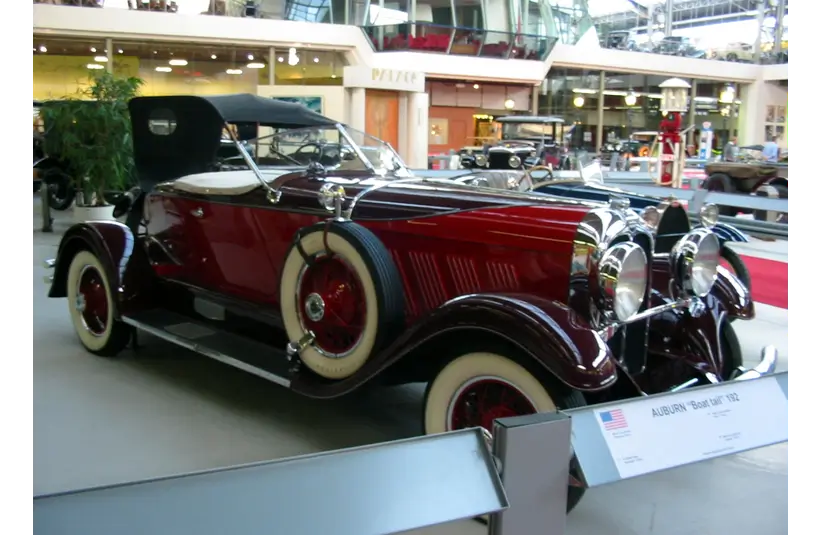
The Auburn 120 Speedster was a very fast car for the 1930s. There were 887 Auburns made between 1928 and 1936. The cars were produced in Union City, Indiana, by the Auburn Automotive Company. The cars were produced in three series. They were produced for speed. The engine had eight cylinders until 1933, and twelve cylinders thereafter.
Al Jenkins broke 70 American speed records in the 1935 car. However, in 1924, the Auburn Automotive company was down to just six cars. That was when Errett Lobban Cord bought the company. Cord was a successful automobile salesman. He helped redesign the car. Do you think a redesign could turn the company’s fortunes around?
Auburn 120 Speedster Was Built For Speed
The redesign of the cars produced was successful insofar as they built a visually attractive racecar. The Speedster had a fixed windshield, but no side windows, no interior door release, an optional roof, and a cockpit for only two in an aerodynamic body. There were three series of cars produced.
Series One
The first eight-cylinder-engined car was produced in 1925. It was known as the “Auburn Eight-In-Line.” In 1926, it got a more powerful engine, which remained in use until 1930. A 115-horsepower engine was installed in the car, and it was thereafter known as the “Speedster 115.” The suspension had semi-elliptic springs, and mechanical brakes were used. The open two-seater body featured a boat-tail and a V-shaped windscreen, and invited those who drove the car to go fast.
The Auburn 120 Speedster with a 268 cubic-inch, 120-horsepower engine was built in 1928 and 1929. This car had a longer chassis and a longer hood. 100 were built, and only 8 survive today. In 1930, the Auburn Speedster was upgraded again and renamed “Speedster 125.” The Speedster 125 was advertised as a “racing car with comfort of a closed car,” featuring a 125-horsepower engine that gave it a top speed of over 100 miles per hour. The car was well on the way to being a racecar.
Series Two
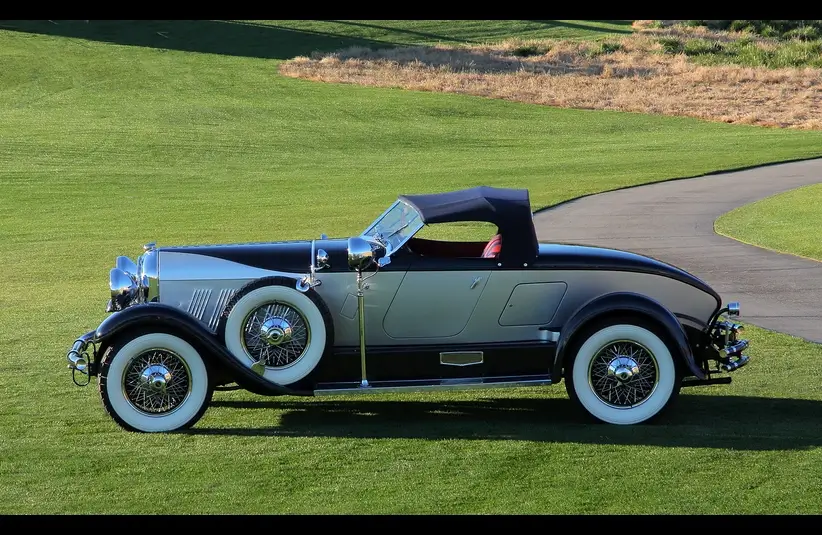
In 1931, the Auburn 12 had a twelve-value, using a 6.4-liter engine designed by George Kublin and built by Lycoming Engines. Unfortunately, the Great Depression was beginning to take its toll, and it did on this car. The twelve-cylinder was expensive, and only about 25 of them were built. The cars were called the Auburn Speedster 160. The twelve-cylinder engine design was successful despite the economic challenges of the time and was especially used in fire trucks.
Series Three
The “Speedster 851” was the manufacturer’s final production model, introduced in 1934, with bodywork that was smartly constructed and cost-effectively built. The design was popular with actors in Hollywood. It had sandwiched front and rear fenders, a backswept radiator, and external side-threaded exhaust pipes. Its flathead straight-eight engine was powerful, reliable, and of a strong, solid design.
There were advanced technical features for the time. These included a dual-ratio rear axle that had an epicyclic gear train between the axle and the crown wheel. The drive ratio was set to a fast 4.5:1. If the clutch was dipped, the ratio became 3:1. There was a three-speed gearbox and a six-speed transmission.
The 852, introduced in 1936, was identical. The final year of production for the company was 1937, when Auburn ceased car production altogether. A total of 143 supercharged 851 and 852 Speedsters were built. Interestingly, the Speedster’s iconic body design would reappear in later decades. Two examples include the 1963–1967 Chevrolet Corvette Stingray coupe and the 1971–1973 Buick Riviera.
Parting Shots
This was a very fast car. It was built more for racing than for consumers. That is why so few cars were produced. Unusually, the company was headquartered in Indiana. There are not many automobile production companies located there. This car, however, did a lot to advance the power of American cars.
