
Game Review: School Teacher Simulation — Does It Make the Grade?


School Teacher Simulation, developed and published by Eathrabaria, is a 3D life-sim and job-sim available on Steam. I played for around 30 minutes for this game review — enough to get a feel for the core loop and the tone the developer is aiming for.
As a former teacher, I was genuinely excited to see how a game developer would interpret the school environment. Unfortunately, my early impression wasn’t great, and several design choices held the experience back right from the start.
The Gameplay Report Card (Spoiler: Needs Work)
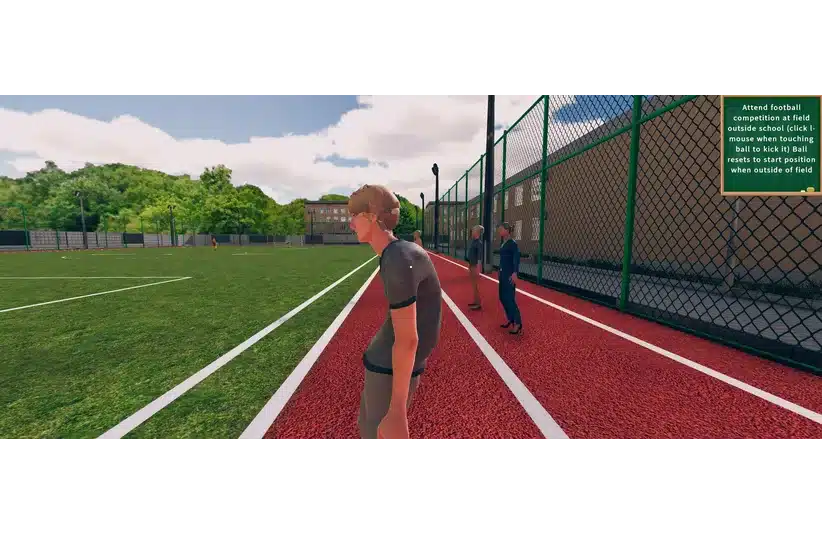
The core loop revolves around teaching lessons, keeping students focused, and reacting when they misbehave or get into conflicts during breaks. Keyboard and mouse controls are easy to navigate, but I had difficulty using a remote despite the game advertising remote-friendly support.
This game isn’t trying to be difficult — the tasks themselves are straightforward. The only real frustration I ran into was locating the singing contest, which is a required task after finding a student partaking in substances in the bathroom. That scenario is, frankly, on par for a high school, but the navigation challenge wasn’t.
The onboarding also feels thin. It’s essentially the teaching equivalent of, “Here is your classroom, your students, and your schedule — figure the rest out.” And to be fair, it is a simulation game, so some level of self-direction is expected. The objective itself was usually clear; the location of where to complete that objective, on the other hand, was sometimes not so much. The location was usually stated, but actually finding it would have been far easier with the simple addition of a map.
One early frustration: there is no map or navigation aid. I’m not saying schools are the hardest buildings to navigate — they’re usually pretty easy — but a simple map or directional indicator would go a long way in helping new players understand where they’re supposed to be. Without it, the early minutes feel more like being a student who wanders the hallways all day in search of the class they have no intention of attending.
NPC interactions also feel inconsistent. On the first floor, as soon as you exit the classroom, you can interact with students and staff. One of the NPCs I spoke to immediately launched into aggressive language. Sure, in a real school, you’ll hear all kinds of things, but it didn’t feel realistic for a student to automatically speak to a teacher like that without any buildup or context.
Story and Worldbuilding
The game leans into a “living school” concept, with each teacher and student having their own personality. There’s also a promised deeper storyline involving one student whose personal struggles you’ll uncover.
The game is rated Mature, and while real schools can involve mature themes, the way the game handles them feels uneven — almost as if the mature content is concentrated in a few characters rather than woven naturally into the world. The tone and character dynamics often feel like they were shaped by what the developer has seen in movies or on the news rather than by any real understanding of how students and teachers actually interact in a school setting.
One example: the principal stands outside a classroom window, smoking a cigar, flushed in the face, and staring inside. It’s not remotely realistic for a school environment and comes across more like a caricature than an administrator. Moments like this reinforce the sense that the game is built on secondhand impressions rather than lived experience.
Visuals, Art Direction and Performance
The graphics in School Teacher Simulation are extremely basic and clearly need improvement. Character models, animations, and environments feel bare-bones, giving the game a prototype-level look.
Besides having flashbacks to simulation graphics from the 90s, there are other UI issues that also show up early. When taking attendance on the first day, a voice announces whether a student is present, but the roster turns red regardless of whether the student is there or not, making the system confusing and visually misleading.
Performance quirks appear quickly, too. When I moved to the second floor, I could still hear the cursing and music from the NPC downstairs, even though they were nowhere near me. The audio seems tied to a physical spot on the map rather than the character, which breaks immersion and makes the school feel less like a functioning space.
Music, Voices and Other Surprises
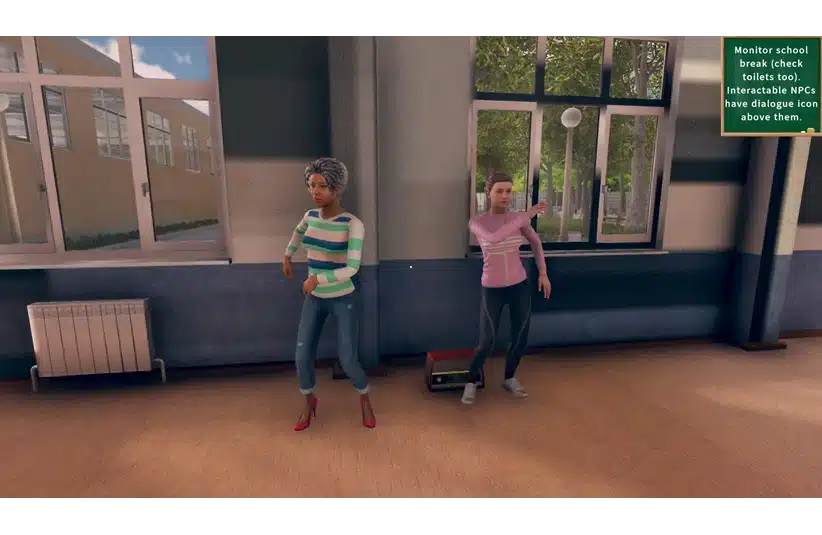
The audio direction is one of the more jarring parts of the early experience. The start-menu music is full-on club energy — not inherently a bad choice, and everyone has different tastes — but it feels aggressive right out of the gate for a school-themed simulation. Then, once you enter the game, the music disappears entirely, replaced only by ambient student noise. The tonal shift is noticeable.
The voice lines also rely heavily on AI-generated audio, and it shows. The delivery is stiff, the tone rarely matches the situation, and several lines contain awkward phrasing or outright grammatical errors. Given the advancements in AI voice tools, the grammatical mistakes and awkward delivery are hard to overlook. The voices feel artificial and detached from the scenes they’re in, which pulls you out of the moment and adds to the impression that the game’s idea of school culture is based more on stereotypes than reality.
There’s also a strange mix of old and new audio cues. For a game released in 2025, the presence of a boombox and what looks like an old-school radio feels out of place. The dancing in the hallway makes sense — students absolutely dance between classes — but in a modern school, they’d be filming themselves doing whatever is trending on social media, not gathering around a retro stereo setup.
What’s Working So Far
- Easy keyboard and mouse navigation
- A lively school environment with distinct personalities
- Daily events that break up the routine
- A narrative thread centered on a troubled student
What Needs More Time (or Raises Concerns)
- Graphics are extremely basic and need significant improvement
- Remote control support is unreliable
- No map or navigation aid
- Attendance system is visually confusing
- Mature content feels unevenly distributed
- Audio triggers play in the wrong locations
- Start-menu music feels tonally disconnected from gameplay
- Outdated props (boombox, old radio) clash with a 2025 setting
- The overall design feels like someone took every stereotype or assumption about schools and smashed them together without consulting any educators. It creates a world that’s chaotic in ways that feel exaggerated rather than authentic.
Who This Game Seems to Be For
- Fans of niche life-sim and job-sim titles
- Players who enjoy routine-based gameplay with personality-driven interactions
- Those curious about school-themed simulation games
School Teacher Simulation: Did It Make the Grade?
Right now, School Teacher Simulation feels like a game with an interesting premise but rough execution. There’s potential in the daily-life structure and character personalities, but the visuals, UI issues, audio inconsistencies and lack of navigation tools make the early experience more frustrating than engaging.
I would say this is a School Teacher Simulation game is play at your own risk — and if you have kids, be aware of the mature topics being addressed. The School Teacher Simulation game is not for me as it currently is, but the concept behind it has a lot of room to develop, creating a more realistic and engaging simulation game. A school simulation could genuinely help students practice tasks they need to learn as they move through school: joining clubs, requesting letters of recommendation, finding resources for those who are less fortunate, and understanding how schools function as essential parts of a community.
Not everyone in a school building is perfect, but the world of education — simulated or not — is an important “game” to complete.
Disclosure
Review code provided by the publisher for coverage. Opinions are based on early gameplay and may change in the final game review.
Author
