
Automotive History: The Ford Model T 1908-1928


The Ford Model T is an iconic American car. It was produced for 20 years, from 1908 to 1928, and about 15 million cars were sold. One of the main reasons for the success of the car was its cost. It was cheap. Due to innovative mass production techniques, a lot of cars were produced, which drove down their cost.
Ford’s efficient fabrication included assembly line production instead of individual handcrafting. Now, many items are produced that were started by this car. The Model T was designed by three engineers: Joseph A. Galamb (the main engineer), Eugene Farkas, and Childe Harold Wills. The Model T was colloquially known as the “Tin Lizzie.” Did you know that nickname?
Model T Engine
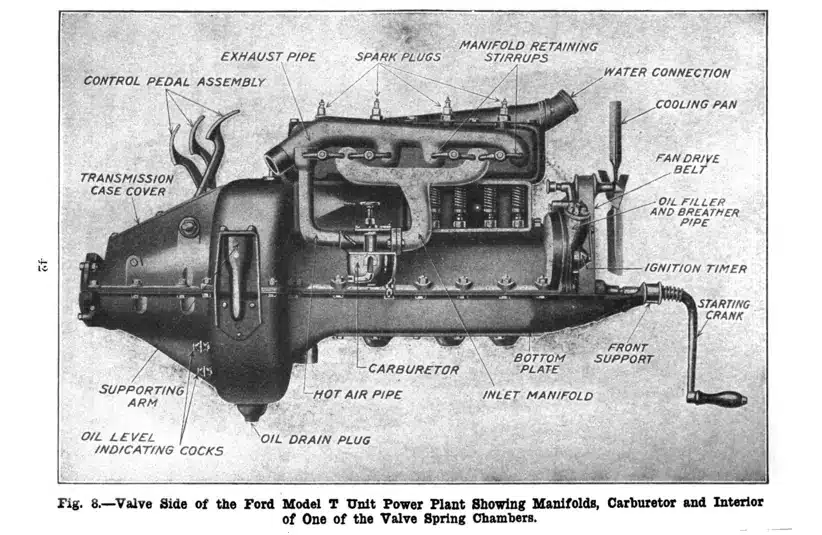
Because the car was so innovative, we need to explain its power plant. The Model T had a front-mounted 177-cubic-inch inline four-cylinder engine, producing 20 horsepower, and had a top speed of 42 miles per hour. The car had a fuel economy of 13–21 miles per gallon. Innovatively, the engine was designed to run on gasoline, although it was able to run on kerosene or ethanol.
The Model T was a rear-wheel drive vehicle. It had a three-speed transmission, which was known at the time as a planetary gear type. The car’s transmission was controlled with three floor-mounted pedals. This was a revolutionary feature at the time. The throttle is controlled with a lever on the steering wheel. This set-up was novel and is world-famous.
Model T suspension was also innovative. The Model T employed a transversely mounted semi-elliptical spring for each of the front and rear beam axles, which allowed a lot of wheel movement. Road conditions were not great at the beginning of the 20th century. So, the flexibility of wheel movement allowed the car to work with the roads.
In the Model T, the right foot pedal applied a band around a drum in the transmission, thus stopping the rear wheels from turning, and the car. The parking brake lever controlled band brakes on the inside of the rear brake drums, which were an integral part of the rear wheel hubs. Optional brakes that acted on the outside of the brake drums were available from aftermarket suppliers. Modern brakes have evolved a lot; however, the brakes on this car were an inspiration to modern cars.
Colors
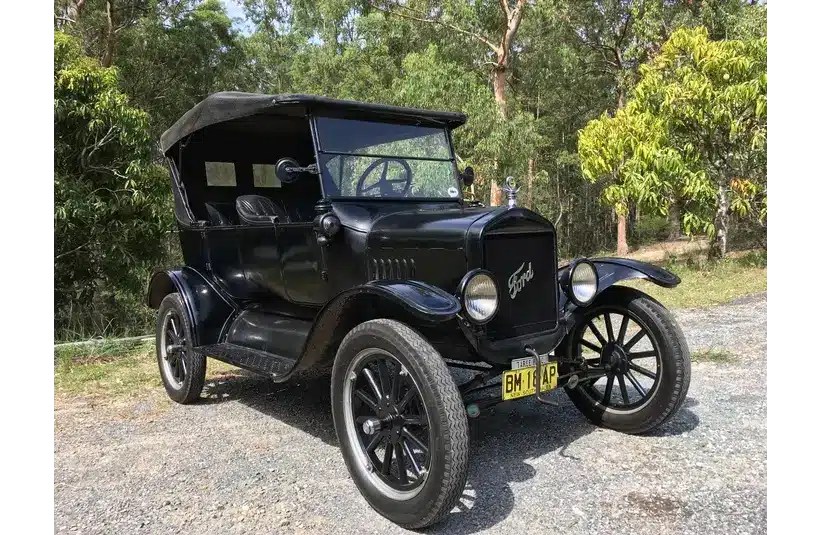
By 1918, fully half of the cars in the United States were Model Ts. Until 1913, all of the cars were available in gray, green, blue, and red. Starting in 1914, all of the cars had an underlying color of black. Because black dried faster. The final color choices were constrained to dark shades of maroon, blue, green, or black. Drying time had a lot to do with the paint chosen because the Ford Motor Company was very concerned with efficient production.
Production
The production of the Model T cars was novel, as the Ford Motor Company pioneered the use of the production line. By 1910, after Henry Ford himself tinkered with the production process, moving it from one plant to another, Model Ts were produced every three minutes. Engineers specified 84 specific manufacturing areas, and assembly line workers executed them.
Parting Shots
The Model T was innovative and important. It was important because so many of the cars, 15 million, were produced. By 1918, half of the cars on the roads in America were Model Ts. So, the company had tremendous market share and a lot of the cars still survive. The car was innovative because of the production line manufacturing technique. Now, nearly everything is produced in this manner, but that was not the case back then. The Ford Motor Company pioneered the manufacturing technique with this car.
Author
