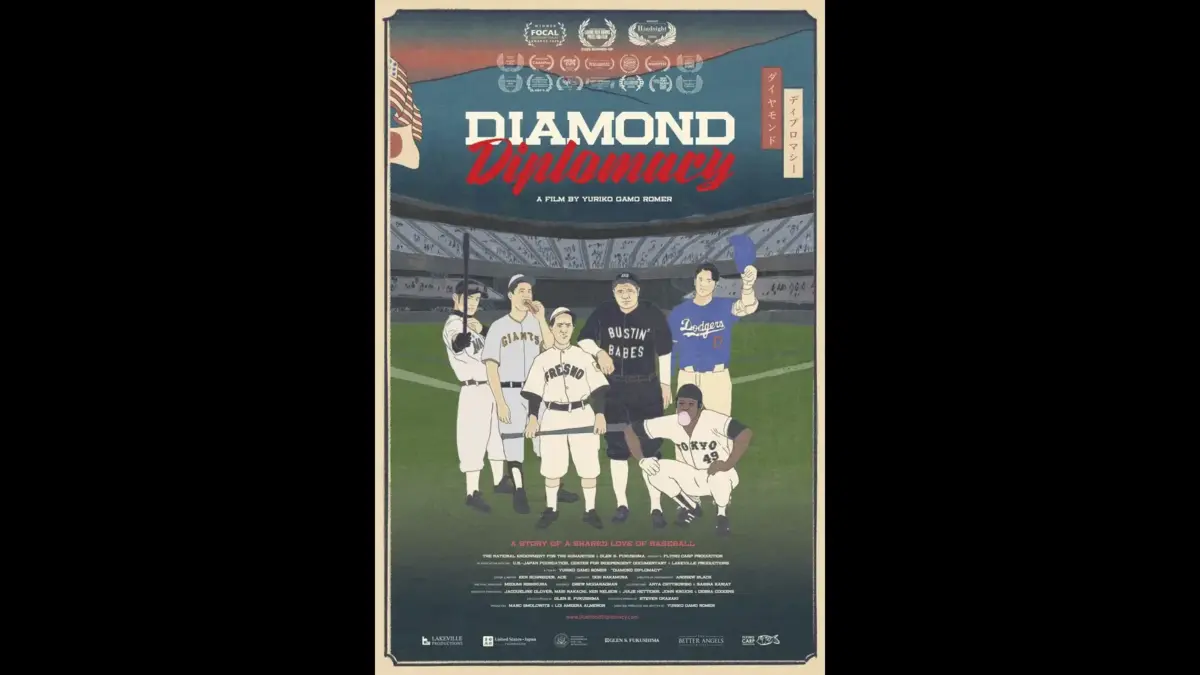
“Diamond Diplomacy” tells 150 years of Japan-U.S. history through baseball, and the documentary has finally reached the country at the center of its story. Yuriko Gamo Romer’s film had its official Japan premiere during the Tokyo International Film Festival, about a year after it premiered at California’s Mill Valley Film Festival, The Hollywood Reporter reported.
Romer, a Tokyo native who grew up in the United States, frames the sport as a link between her two countries. The story centers on two players who crossed the Pacific: Masanori “Mashi” Murakami, the first Japanese player in Major League Baseball, and American slugger Warren Cromartie. It runs all the way to Shohei Ohtani.
What the documentary covers
The history starts in 1872, the year American teacher Horace Wilson is generally credited with showing baseball to his students in Tokyo. Japanese schools took up the game, professional teams followed and Japanese players eventually reached the major leagues.
Archival footage captures Babe Ruth’s 1934 tour with an all-star American League team, which played both with and against Japanese players. Huge crowds came out to see them while relations between the two countries soured. Ruth has been credited, “perhaps hyperbolically” in The Hollywood Reporter’s words, with delaying war between the United States and Japan.
The goodwill didn’t survive Pearl Harbor. Ruth’s daughter, Julia Ruth Stevens, later recalled that he started tossing his Japan mementos out their apartment window after the attack, while her mother rushed to grab them before he could.
Romer’s earlier documentary, “Baseball Behind Barbed Wire,” looked at the games Japanese Americans played while held in camps during World War II. She returns to that history here and shows how baseball helped them push back against prejudice after the war.
The film also follows Negro League teams to Japan, where players often got far better treatment than they did in the United States. Japanese hosts admired their humility and sportsmanship, and they compared those qualities favorably with the arrogance they often saw from visiting white teams.
American players who moved to Japanese leagues get their due, too. Cromartie spent seven eventful seasons with the Yomiuri Giants, while others struggled with punishing training regimens and unfamiliar customs.
Murakami, Whiting and the voices in the film
Murakami debuted for the San Francisco Giants against the New York Mets at Shea Stadium in September 1964, at age 20, and played with Willie Mays. In the film, he says he used to whistle “Sukiyaki” to settle his nerves before games. The song, a smash at the time, also inspired the film that opened this year’s Tokyo festival.
Baseball wasn’t what first drew him to America. After the screening, Murakami said he wanted to go because he loved the cowboy drama “Rawhide,” not because he dreamed of the majors.
He also grew emotional recalling a run-in with an umpire in San Francisco. A Japanese chef shook his hand afterward and told him he was proud to see him stand up for himself because, Murakami said, “since the war, Japanese people felt they had to be subservient to Americans.”
Author Robert Whiting, whose books helped bring the quirks of Japanese baseball to a wider audience, is among the film’s commentators. “Japanese baseball is older than judo,” he says. Whiting suggests the game took on its demanding, exacting character from martial arts training.
Funding, timing and what’s next
Romer has heard that her timing was perfect. “People from MLB told me that I had great timing and was making the film at just the right moment with Ohtani’s success,” she said at a screening before the official Japan premiere. “But it was just coincidence. I started researching this film 12 years ago and it took me years of making money and raising money to fund it.”
Those years got harder late in the process. The film landed a $600,000 National Endowment for the Humanities grant, but more than half of that money was canceled in April 2025 during Department of Government Efficiency cuts, The Hollywood Reporter reported. Former American diplomat Glen S. Fukushima then contributed $300,000, which allowed the film to be finished.
During the festival, the Motion Picture Association partnered with MLB and Nippon Professional Baseball on a special screening at Toho Cinemas Roppongi Hills. Murakami and Cromartie both attended the reception that followed.
Strand Releasing holds North American rights, and Variety reported in May that it planned a national rollout after the festival run, with a theatrical release anticipated in the fall. Wondergenic will release the film in Japan. Producer Marc Smolowitz told Deadline the plan there is April, with at least 60 screens expected, though no start date has been officially announced.
 Don't stop here
Every Score. Every Story. One Home.
Breaking sports, entertainment and news from across the Total Apex network, updated all day.
Get the Full Story →