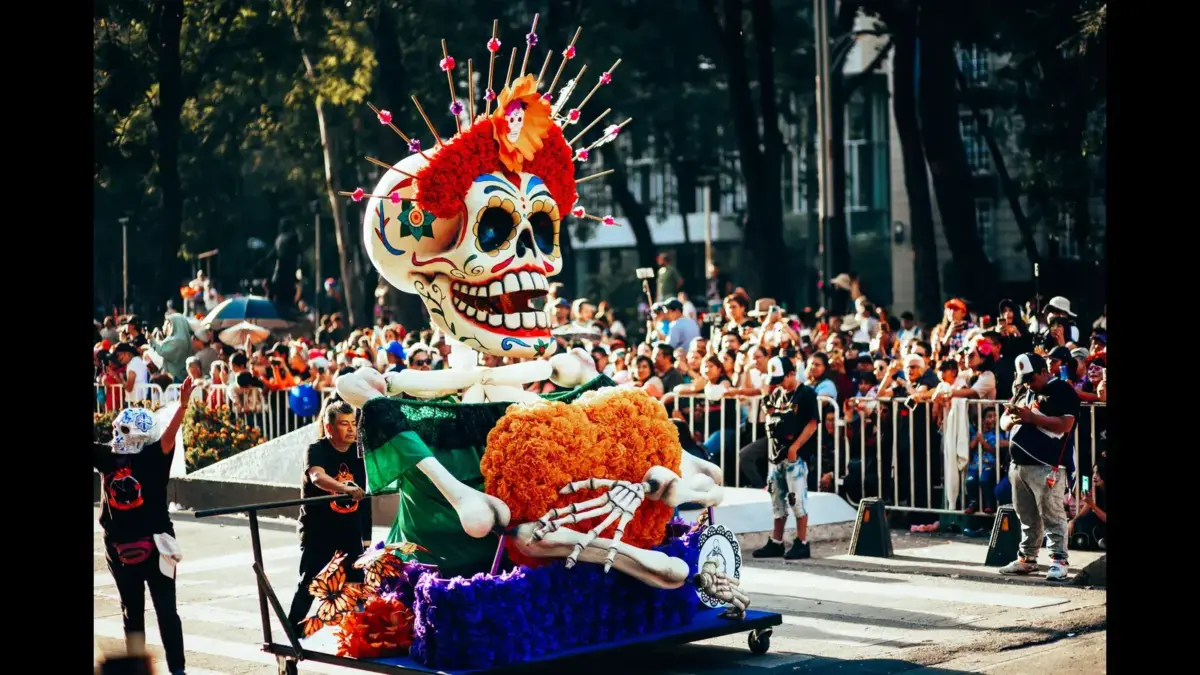
Día de los Muertos 2026 falls on Sunday, Nov. 1, and Monday, Nov. 2, when families across Mexico and parts of Latin America and the United States honor loved ones who have died. The holiday, also called Day of the Dead, treats death as something familiar rather than something to fear, according to Britannica.
It often gets lumped in with Halloween because the dates sit so close together, but the two have different histories. Mexico City’s biggest celebration has a surprising history of its own: It began as a scene in a James Bond movie.
Where Día de los Muertos comes from
Britannica traces the holiday to Indigenous peoples of Mesoamerica, including the Aztecs, Toltecs, Olmecs and Maya, who saw death as a continuation of life. The Nov. 1 and 2 dates came later. Spanish colonizers brought the Roman Catholic observances of All Saints’ Day and All Souls’ Day in the 16th century, and Indigenous communities folded them into their own rituals of remembrance.
How much of the modern holiday is Indigenous remains a matter of debate. The Horniman Museum in London, for one, describes its foundations as Catholic practices that were later enriched by Indigenous beliefs.
UNESCO, the United Nations’ cultural agency, added Mexico’s “Indigenous festivity dedicated to the dead” to its Representative List of the Intangible Cultural Heritage of Humanity in 2008, after first proclaiming it in 2003.
Why it isn’t ‘Mexican Halloween’
Halloween began with Samhain, a festival of the ancient Celts in Britain and Ireland. Its name comes from the holy evening before All Saints’ Day, so the two holidays do share a spot on the Christian calendar. Readers can learn more in Total Apex Entertainment’s look at the spirit of Samhain.
The line “Día de Muertos is not Mexican Halloween” is a catchphrase that took hold during the Chicano movement, Britannica notes. Scholar Mathew Sandoval wrote that Latinos used it to protect the holiday from misrepresentation, educate the public and shield themselves from discrimination. Many non-Latinos had mistaken its skull and skeleton imagery for witchcraft, he wrote.
Sandoval also argues that line is getting harder to draw, with Halloween candy, costumes and horror-movie characters now turning up at Day of the Dead events in Mexico.
How the holiday went public in the US
Large parts of the present-day U.S. once belonged to Mexico, so Britannica says some observances there may be considered native to those regions. Elsewhere, immigrants brought the tradition with them and kept it at home with their families.
Public celebrations among Mexican Americans and other Latinos came with the Chicano movement of the 1970s and ’80s. A group of Chicano artists and activists in East Los Angeles, led by Self Help Graphics & Art, created one of the first modern celebrations in 1973, according to the Smithsonian American Art Museum.
“For Chicano artists in the 1970s, celebrating an indigenous Mexican ritual in an Anglo-dominant country was an act of political resistance as well as an act of cultural pride,” Regina Marchi, a Rutgers University professor, said.
The Mexico City parade that started in a movie
The 2015 Bond film “Spectre” opens with a huge Day of the Dead procession through Mexico City, but the capital had no such parade at the time. The city launched the real thing, the Gran Desfile de Día de Muertos, in 2016 as part of a push to promote tourism, Britannica reported.
This year’s 10th edition rolled along Paseo de la Reforma on Oct. 31 with about 4,000 participants. City officials estimated the crowd at 1.6 million.
Not everyone is a fan. Claudio Lomnitz, a Columbia University professor of Mexican studies, criticized it in an editorial for La Jornada. Atlas Obscura summed up his view as a parade composed with foreigners in mind rather than one that reflects tradition.
Seattle’s Pike Place Market joins in
Public celebrations keep spreading in the U.S. Seattle’s Pike Place Market held its first Día de Muertos celebration Oct. 23, The Associated Press reported, with mariachi and folklórico performances, ofrendas and an evening parade. The event previously took place in Seattle’s Ballard neighborhood, according to the market.
AP photos showed the youth folklore dance group Santana Charro Bros., women dressed as Catrinas and a horse painted to look like a skeleton performing with its rider. A large crowd gathered to watch the wrestlers of Lucha Libre Volcánica.
What’s next
Monday marks the end of the traditional two-day observance, though some communities add other days. Whether it’s a quiet family altar or a parade down Paseo de la Reforma, the point stays the same: remembering the people who are gone.
 Don't stop here
Every Score. Every Story. One Home.
Breaking sports, entertainment and news from across the Total Apex network, updated all day.
Get the Full Story →