
Beginner’s Guide to Angel Numbers: Meaning, History, Interpretation and How They Work (Amy DM’d)


Angel numbers are basically the universe’s version of push notifications—except instead of reminding you to update your apps, they remind you to update your life. You see them everywhere: clocks, receipts, license plates, timestamps. One minute you’re minding your business, the next you’re staring at 444 like it personally called you out.
But angel numbers didn’t appear just because TikTok decided spirituality was cute. The idea that numbers carry meaning goes back thousands of years — back to ancient civilizations doing math by torchlight. This guide breaks down what angel numbers are, where they came from, how to interpret them and why they’ve become the unofficial language of modern intuition.
What Angel Numbers Are

Angel numbers are repeating or patterned number sequences—111, 222, 333, 444, 555, or mirrored patterns like 1212 and 1010. People interpret them as symbolic messages, nudges or reminders rather than predictions or cosmic ultimatums. They’re more like the universe whispering, “Hey, pay attention.”
They aren’t tied to any religion and don’t require spiritual membership. They’re simply a tool for reflection and grounding, and the meaning isn’t in the number alone—it’s in the moment you notice it.
Angel numbers tend to surface in the cracks of transition—during stress, growth or choice‑making—when your mind is already wide open. That’s why they land with such uncanny precision. They show up in the middle of your real life, not in a vacuum, and that timing is part of what makes them resonate.
What angel numbers don’t do is predict the future or hand you a cosmic to‑do list. They’re not warnings, ultimatums or fortune‑telling devices. They’re reflective, not directive—meant to help you think, not panic. Their purpose is to nudge you inward, not overwhelm you with decoding homework.
The History of Angel Numbers
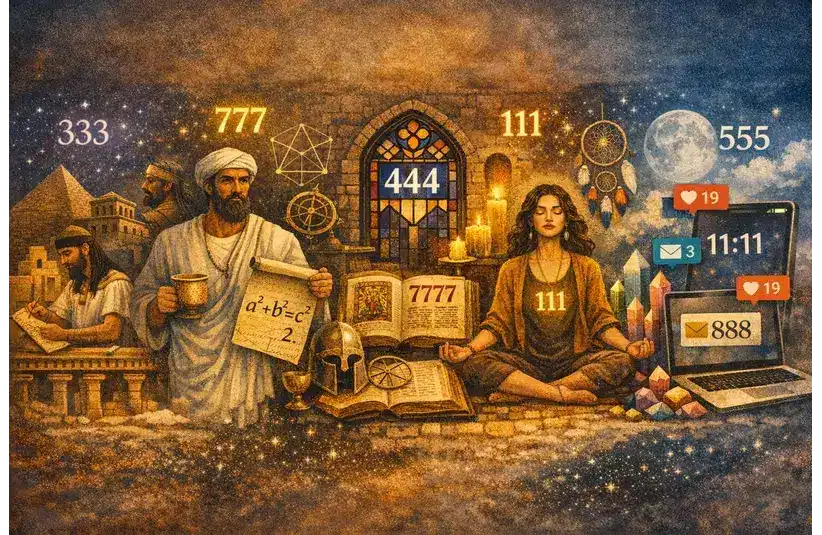
Angel numbers appear like they are a new, hip modern spiritual trend, but the belief that numbers hold deeper meaning is ancient—older than many of the constellations we still point to today. Across civilizations, numbers served as symbolic language, spiritual markers and coded messages woven into belief systems.
Ancient Numerology
Egyptians used numbers to design temples and map the stars, like it was the original cosmic blueprint. Babylonians treated numerical patterns as the universe’s operating system. Chinese numerology tied numbers to luck and elemental balance—though the whole “repeating numbers mean energy spikes” thing is definitely a modern add‑on. Meanwhile, Hebrew mysticism used gematria to turn letters into numbers, unlocking hidden messages long before anyone had a password.
Pythagoras and Western Numerology
Pythagoras was more than a mathematician; he saw numbers as the architecture of reality itself. His influence on Western numerology introduced the idea that numbers carry energy, meaning and pattern. It’s no exaggeration to say that the modern angel‑number movement traces its roots back to him.
Biblical and Medieval Symbolism
Biblical texts used numbers symbolically—three for divinity, seven for completion, forty for transformation. Medieval scholars expanded these associations, turning numbers into moral and spiritual metaphors that shaped centuries of religious interpretation.
Renaissance Mysticism
In the Renaissance, math, astrology, alchemy and mysticism all lived under the same philosophical roof. Repeating numbers were read as synchronicities—those blink‑and‑you‑feel‑it moments when the universe and your life clicked into the same beat.
New Age Spirituality and the Modern Term
The phrase “angel numbers” emerged in late-20th-century New Age literature, where authors framed recurring numbers as intuitive nudges or signs of alignment. This era gave the concept its name and its modern spiritual framing.
Digital Culture and Social Media
Angel numbers went mainstream when smartphones entered the chat. With clocks, notifications and timestamps flashing all day, repeating numbers became impossible to miss. Social media made them easy to screenshot, share and interpret. Gen Z took one look and said, “Yes, this is our religion now.”
The Psychology Behind Angel Numbers
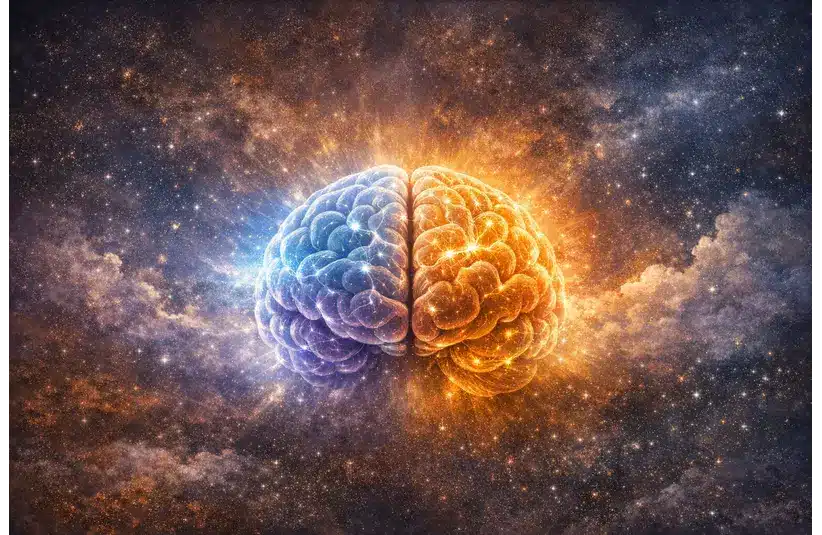
Angel numbers feel meaningful because humans are wired to find patterns. When those patterns show up during emotional or transitional moments, they naturally feel like messages. Carl Jung called this synchronicity—those meaningful coincidences that seem intentional even when they’re not—and angel numbers fit that idea perfectly.
You tend to notice them when you’re already thinking, worrying or reflecting, which makes the number feel like a mirror for whatever’s happening internally.
They also feel personal because different cultures assign different meanings to numbers. In China, eight is tied to prosperity while four is linked to misfortune. In Japan, nine carries undertones of suffering. Western traditions treat seven as completeness and three as unity, while Indian numerology connects numbers to cosmic cycles and Vedic philosophy. Angel numbers draw from all these traditions but reinterpret them through a modern, intuitive lens, which is why they resonate so widely today.
Angel numbers fuse psychology, symbolism and timing into their fundamental language. They show up when your mind is already open to meaning, they echo centuries of cultural associations and they land in moments when you’re paying closer attention. That combination is what makes them feel so strangely accurate, even when they’re just numbers on a clock.
How to Interpret Angel Numbers
There’s no single correct way to interpret angel numbers because interpretation is personal, contextual and flexible.
Some folks go straight to intuition, asking what the number feels like and trusting that gut hit. Others zoom in on the moment it appeared, noticing their thoughts or mood, since the context can carry as much meaning as the number itself. And then there’s the pattern‑based approach, where a number repeating over days or weeks becomes a clue that a theme or emotional pattern is trying to get your attention.
Angel numbers tend to show up during transitions, stress, relationship shifts, creative blocks or periods of emotional growth, acting like cosmic highlighters marking important chapters.
When the same number keeps showing up, it’s usually a nudge to look at your current life themes, emotional patterns or decisions. Repetition is the universe’s way of saying, “Hey, this again. Let’s deal with it.”
But even then, you don’t need to obsess over every sighting or decode every sequence. Meaning comes from patterns, not one‑offs, and angel numbers should feel supportive—not stressful. You’re not meant to hunt for them or treat them like cosmic homework. They’re simply reminders to pause, reflect and notice what’s happening within you.
How Angel Numbers Are Used Today
Angel numbers have become a versatile tool for reflection, mindfulness and manifestation because they slip so easily into everyday life. People often use them as gentle check‑ins, noticing which number appeared, what was happening in the moment and what themes keep resurfacing over time. That simple act of paying attention can turn into a grounding practice.
Within meditation and manifestation, angel numbers work like quiet markers of focus, alignment and inner recalibration. They’re not guarantees—they’re invitations to be intentional. In relationships, they tend to appear during seasons of growth, renewal or stability, offering moments of clarity without ever replacing the need to communicate. And in career or creative life, they often surface during blocks, transitions or periods of self‑doubt, nudging you to reconnect with what you’re trying to build.
For people who like structure, journaling with angel numbers can be especially powerful. A simple log of which numbers appeared, what was on your mind and what theme stands out can reveal patterns you didn’t realize were there. Review it weekly and the connections become obvious—almost like the universe is handing you a breadcrumb trail back to yourself.
Interpreting Angel Numbers in Everyday Life
In Relationships
People often see angel numbers when thinking about someone.
Common relationship numbers:
- 222—partnership
- 717—relationship growth
- 818—cycles and renewal
- 444—stability
They should never replace communication. They’re prompts, not psychic readings.
Manifestation: The Cosmic Collab
Angel numbers can support manifestation by:
- Reinforcing focus
- Highlighting alignment
- Encouraging clarity
- Supporting mindset shifts
They’re not guarantees. They’re reminders to stay intentional.
Angel Number Meanings: The Classics
- 111—alignment
- 222—balance
- 333—creativity
- 444—protection
- 555—change
- 666—reassessment
- 777—intuition
- 888—abundance
- 999—closure
Other Angel Number Patterns Worth Knowing
- 1212—momentum
- 1010—reset
- 1234—progress
- 717 or 818—relationship themes
- 55 or 88—amplified energy
Angel Numbers in Context
Angel numbers don’t exist in a vacuum—they sit alongside other spiritual systems.
Angel Numbers vs Zodiac Signs: Zodiac signs are fixed; angel numbers are fluid. Astrology describes personality; angel numbers describe timing. Astrology is planetary; angel numbers are numerical. Astrology can be predictive; angel numbers are reflective. Both can coexist peacefully in your spiritual toolbox.
FAQ: The Questions Everyone Googles at 2 a.m.
Question: What does it mean if I see angel numbers every day? Answer: You’re more aware, not cursed.
Question: Are angel numbers good or bad? Answer: They’re neutral. You give them meaning.
Question: Do these numbers come from angels? Answer: Some say yes. Some say intuition. Some say algorithms. Choose your fighter.
Question: Can I ask for angel numbers? Answer: You can, but they’re most meaningful when they appear naturally.
Question: What if I stop seeing them? Answer: Your focus shifted. That’s all.
The Message Beneath the Numbers
Angel numbers are a modern spiritual tool rooted in ancient numerology, shaped by philosophy and amplified by digital culture. They’re not predictions or ultimatums. Think of them as punctuation on a situation. See them, read them, check in and notice what’s happening within you. The real magic isn’t the number itself—it’s the awareness it sparks.
Author
