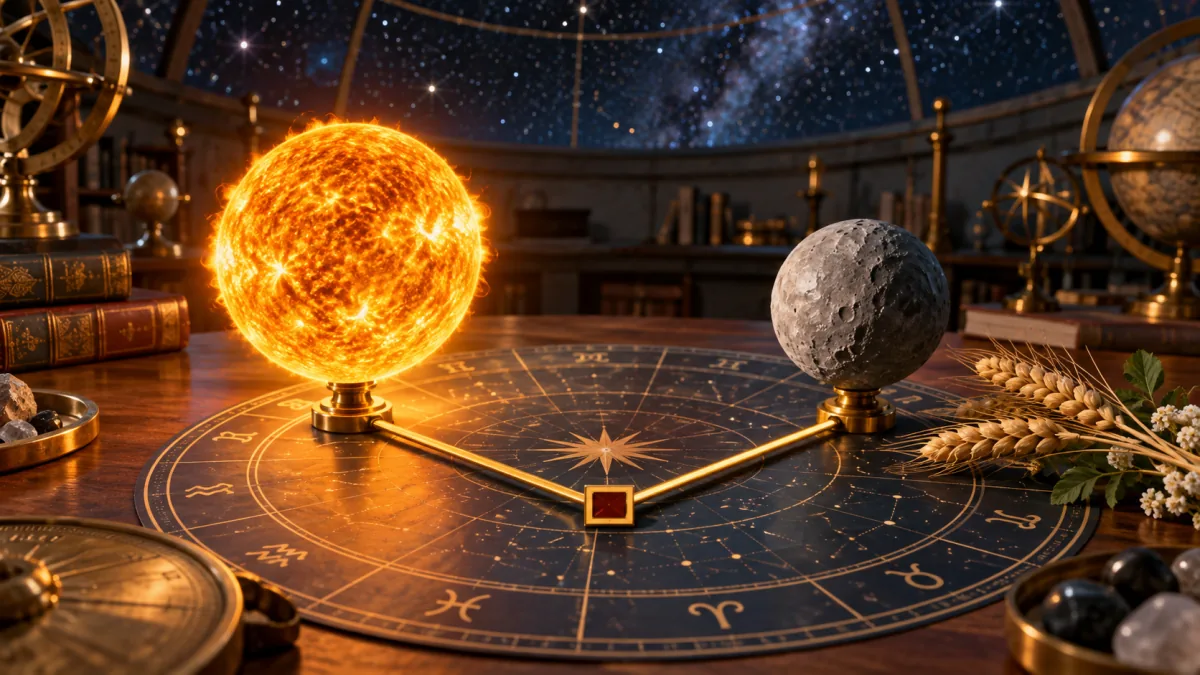
Anyone who starts reading about natal charts quickly runs into a wall of terms like conjunction, square and trine. These are aspects, the angles formed between planets in a birth chart, and they are the key to understanding how different parts of a personality interact, according to Almanac.com. This guide is for beginners who want to understand what a Sun square Ceres aspect, or any other aspect, actually means before they start reading too much into a single placement.
Astrologers use aspects to describe how planetary energies work together or clash, Almanac.com reported. Learning the five major aspects first makes every other part of chart reading easier to follow.
What Is An Aspect In Astrology
An aspect is simply the angle between two planets on a birth chart, as measured in degrees, according to Almanac.com. The five major aspects, all defined by the ancient Greek mathematician Ptolemy, are the conjunction (0 degrees), sextile (60 degrees), square (90 degrees), trine (120 degrees) and opposition (180 degrees), Almanac.com reported. Each of these numbers divides evenly into the 360-degree circle of the zodiac.
Astrostyle groups these into two broader categories. Soft or easy aspects include the conjunction, sextile and trine, while hard aspects include the square, opposition, semisextile and quincunx, according to Astrostyle. Favorable aspects show an easy flow of energy between planets, while challenging aspects show where that energy runs into obstruction, Almanac.com reported.
What You Need Before You Start
Reading aspects does not require special tools beyond a completed natal chart, which lists each planet’s degree and sign. The one extra concept worth learning early is the orb, which measures how close two planets are to forming an exact aspect, Almanac.com reported. The tighter the orb, the stronger the aspect’s influence is felt, and most astrologers focus on orbs of no more than 5 degrees, according to Almanac.com.
First Steps: Learning The Five Major Aspects
Start by learning what each aspect represents on its own, before trying to apply it to specific planets.
A conjunction happens when two planets sit at 0 degrees apart, occupying the same sign and degree. This intensifies the energy between the two planets, for better or worse, Almanac.com reported. When a conjunction lines up exactly with the Sun, it is called “cazimi,” meaning “in the heart,” which is said to give that planet added power, according to Almanac.com.
A sextile forms at 60 degrees and is considered a favorable aspect that shows ease and opportunity. Astrostyle described a sextile as two planets “vibing well, like good friends,” since both planets typically sit in signs of compatible energy, either both yin (earth or water) or both yang (fire or air).
A square sits at 90 degrees and signals tension. The two planets involved share the same astrological quality, cardinal, fixed or mutable, but little else, which creates what Astrostyle called a tug of war. Despite the friction, a square can also act as a catalyst for ambition and drive, and some of the world’s most successful people have charts full of squares, Almanac.com reported. Astrostyle noted that resolving the stress of a square requires each side to give a little and meet in the middle.
A trine forms at 120 degrees and indicates harmony, talent and natural opportunity. Cafeastrology described the trine as a harmonious connection where planetary energies combine in pleasant, supportive ways. Almanac.com reported that a trine points to where a person has built-in gifts and good fortune, though that ease can sometimes tip into laziness if the talent goes untested.
An opposition occurs at 180 degrees, placing two planets in opposite signs of the zodiac, according to Almanac.com.
How Aspects Play Out Between Two Planets
Seeing the same aspect applied to different planet pairs helps show why context matters. Almanac.com offered Mercury and Mars as an example. A conjunction between the two could produce a sharp mind or an argumentative streak.
A sextile between them suggests a positive, dynamic mindset, while a trine points to a sharp, decisive mind with strong strategic planning ability. A square between Mercury and Mars, on the other hand, might show up as a short temper, sarcastic speech or a tendency to pick fights, Almanac.com reported.
That same square principle applies when reading a Sun square Ceres aspect. The Sun represents core identity and sense of self, while a square aspect by definition creates friction between the two points involved, forcing a kind of negotiation rather than a smooth blend. Reading any square, including one involving Ceres, means looking at what each planet represents and asking where the tug of war between them actually shows up in daily life.
Common Mistakes Beginners Make
The biggest mistake is treating one aspect as a fixed prediction instead of one piece of a larger puzzle. Even a tense aspect like a square is not purely negative, since Almanac.com reported that squares can fuel ambition and drive rather than simply cause problems. Likewise, an easy aspect like a trine is not purely positive, since too much comfort can lead to passivity instead of growth, according to Almanac.com.
Beginners also tend to ignore the orb, which measures how exact an aspect actually is. A wide orb weakens the aspect’s influence, so two placements that are technically square but several degrees apart will feel less intense than one with a tight orb, Almanac.com reported.
Finally, it helps to remember that an aspect describes a tendency, not a destiny. Almanac.com quoted the idea directly: “You still have a choice in how you decide to manifest that vibe.” A square under tension and a trine under ease still leave room for the person to decide how that energy gets expressed.
Where To Go Next
Once the five major aspects feel familiar, the next step is applying them across an entire chart rather than studying one pairing at a time. Readers who want to go deeper into how individual planets shape personal traits can start with placements like Venus, which governs love and attraction. Total Apex Entertainment’s guide on how to find your Venus sign offers a useful next stop for anyone building out their understanding of a full natal chart.
From there, daily horoscope coverage can show how these aspect principles get applied to real-time planetary movement for each zodiac sign, including recent entries like the Aries Horoscope for Oct. 12 and the Taurus Horoscope for Oct. 12.
 Don't stop here
Every Score. Every Story. One Home.
Breaking sports, entertainment and news from across the Total Apex network, updated all day.
Get the Full Story →
Don't stop here
Every Score. Every Story. One Home.
Breaking sports, entertainment and news from across the Total Apex network, updated all day.
Get the Full Story →