Celtic Shapeshifters & Heroes: The Wildest Legends from the Old World

We tend to think of biology as fixed. You are born a human, you stay a human, and eventually, you die a human. But in the ancient legends of the Celtic world, the laws of physics and anatomy are merely suggestions. Here, the boundaries between the observer and the observed dissolve. We are looking at a culture that treats transformation not as a fairy tale, but as a fundamental mechanic of the universe. It is a place where a seal is not just a seal, but a person wearing a wetsuit of blubber, and a wolf might actually be your neighbor serving a seven-year sentence of fur and fang.
Celtic Lore: The Data from the Druids
We must approach Celtic legends with a researcher’s skepticism and a witch’s intuition. The ancient Druids, the original keepers of this data, refused to write anything down. They believed that committing knowledge to ink killed its spirit. So, what we have today are the field notes of Christian monks who came centuries later. These scribes often tried to sanitize the weirdness, painting gods as mere kings and demons. But if you look closely at the texts, the old magic still bleeds through the parchment.
In this worldview, nature is not a backdrop. It is a sentient, breathing entity. The veil between our reality and the Otherworld is permeable. It is less like a wall and more like a membrane. Beings pass through it via sacred mounds, mist-covered lakes, and specific times of the year like Samhain. This is not just mythology, it is an ancient form of quantum mechanics where location and form are relative to the observer.
Shapeshifters of the Old World
The most fascinating specimens in Celtic lore are the shapeshifters. These entities defy standard taxonomy. They suggest that identity is fluid, shifting like the tides these creatures often inhabit.
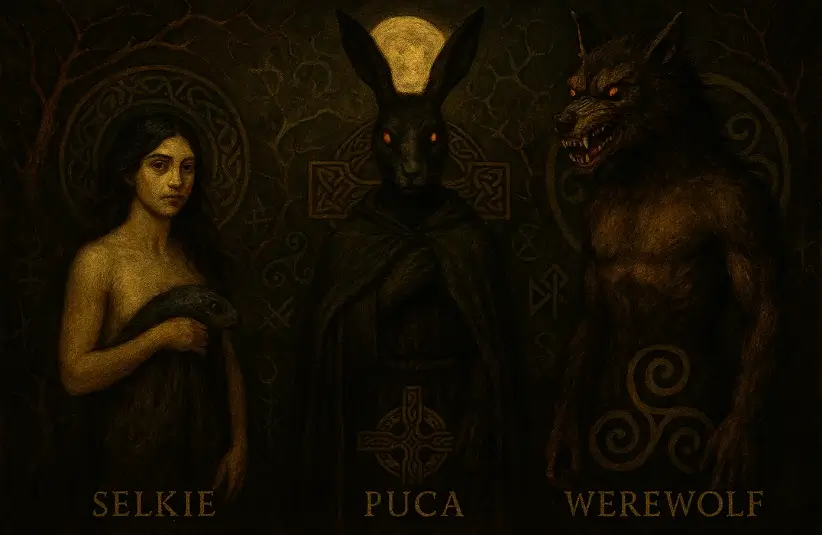
Selkies are the most scientifically curious of the bunch. Found in the cold waters of Scotland and Ireland, they appear to be seals. However, this is merely a biological exosuit. When they come ashore, they unzip this skin to reveal a human form underneath. It is a mechanism of camouflage and freedom.
Then we have the Púcas. If Selkies are biology, Púcas are chaos theory incarnate. These tricksters do not have a fixed baseline form. They appear as horses, rabbits, goats, or shadowy figures. Their morphology depends entirely on their mood, which usually ranges from “mildly helpful” to “absolute menace.”
We also find the Werewolves, but forget what you know about Hollywood monsters. The Celtic werewolf, specifically in tales like the Werewolves of Ossory, is often a tragic or protective figure. This is not a virus, it is often a curse or a ritualistic state of being.
Legends of the Heroes: The Alpha Specimens
To understand the Celtic mindset, we must examine their heroes. These are not perfect knights in shining armor. They are messy, violent, and often genetically enhanced.
- Cú Chulainn: Think of him as the Hulk of the Iron Age. He is the champion of Ulster. His superpower is the ríastrad or “warp-spasm.” When he gets angry, his anatomy literally inverts and expands into a terrifying monstrosity.
- Fionn mac Cumhaill: The leader of the Fianna warriors. He gained all the world’s wisdom not by studying, but by accidentally burning his thumb on the Salmon of Knowledge and sucking on it. It is a strange way to download data, but it worked.
- Queen Medb: The ruler of Connacht. She is the ultimate alpha female, initiating wars just to match her husband’s wealth. She represents sovereignty and raw, unfiltered power.
- Lugh: Known as the “Master of All Arts.” He is a god-hero who is annoying good at everything, from warfare to board games. He defeated his grandfather, the giant Balor, with a slingshot.
- The Dagda: The “Good God,” meaning he is good at everything. He wields a club that acts like a defibrillator, one end kills, the other brings you back to life. He is the ultimate father figure of the pantheon.
Stories from the Old World: Case Studies in Magic
Let us analyze five specific narratives to understand how these elements collide.
Case Study 1: The Cattle Raid of Cooley (Táin Bó Cúailnge)
This is the “Avengers” event of Irish myth. Queen Medb invades Ulster to steal a prize bull. The hero Cú Chulainn fights off her entire army single-handedly. But the real variable here is the Morrígan, the Phantom Queen of war. She is a shapeshifter who attacks Cú Chulainn in the forms of an eel, a wolf, and a heifer. It is a masterclass in tactical polymorphism. She uses these forms not just for combat, but to disrupt the battlefield environment itself.
Case Study 2: The Children of Lir
This is a study in temporal displacement. A jealous stepmother, Aoife, transforms Lir’s children into swans. But here is the cruel twist, they keep their human minds and voices. They spend 900 years migrating between lakes and seas. This story explores the horror of a human consciousness trapped in an animal biology for nearly a millennium. It is endurance testing on a spiritual level.
Case Study 3: The Birth of Taliesin
This Welsh tale is a high-speed chase through the food chain. The sorceress Ceridwen chases the boy Gwion Bach. He turns into a hare, so she becomes a greyhound. He hits the water as a fish, she becomes an otter. He takes to the air as a bird, she becomes a hawk. Finally, he becomes a grain of corn, and she, as a hen, eats him. This results in her pregnancy and his rebirth as the bard Taliesin. It is a perfect metaphor for the cycle of consumption and creation.
Case Study 4: The Selkie Bride
A man finds a Selkie bathing on the shore and steals her seal skin. Without this biological key, she cannot return to the ocean. She is forced to marry him and bear his children. This is not a romance, it is a tragedy of coerced domestication. Eventually, she finds her skin and immediately abandons her human family to return to the sea. The call of the wild is encoded in her DNA, overriding her human attachments.
Case Study 5: The Werewolves of Ossory
This Celtic legend tells of a tribe cursed to turn into wolves every seven years. If they survive the wolf-life, they turn back into humans. A priest once encountered a talking wolf from this tribe who asked for last rites for his dying wolf-wife. The wolf peeled back his wife’s skin to reveal the elderly woman beneath. It suggests a dual consciousness, where the human soul remains intact inside the animal chassis.
The Bottom Line
These Celtic legends aren’t just fairytales for bedtime. They are observations of a world where the line between the observer and the observed is blurry. Whether it is shifting skins or warping time, these stories remind us that the universe is a lot weirder than our science books admit.
