
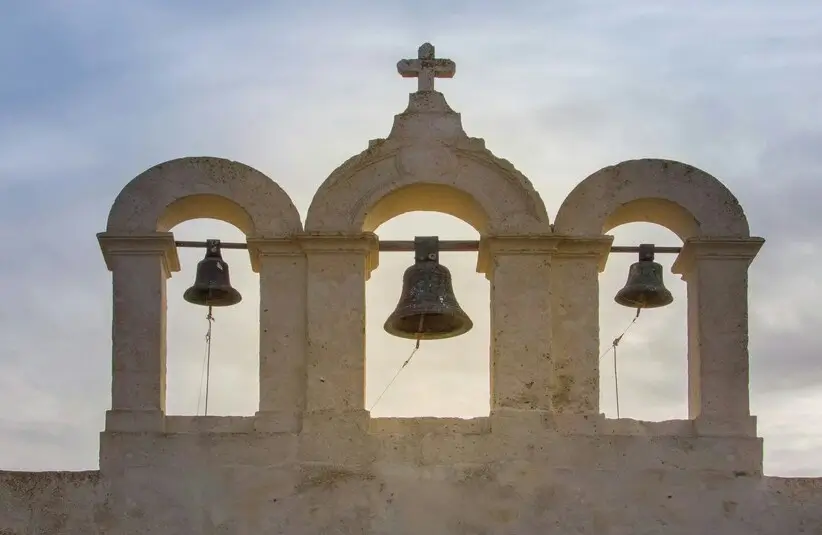
Saint Paulinus: Roman Poet Turned Bishop Who Brought Bells to Christian Worship

Saint Paulinus of Nola was born about 354 and died on June 22, 431. He was born Pontius Meropius Anicius Paulinus, and he was a Roman poet, writer, and senator who attained the ranks of suffect consul and governor of Campania, but Saint Paulinus abandoned his career, was baptized as a Christian, and, probably after His wife Therasia’s death, Saint Paulinus became bishop of Nola in Campania. He is credited with the introduction of bells to Christian worship, and so is important in this Christmas season. Do you like the use of bells in Mass?
Saint Paulinus Biography
Saint Paulinus was born Pontius Meropius Paulinus around 352 in southwestern France. He was from a notable senatorial family with estates in the Aquitaine province of France, northern Iberia, and southern Italy. At some time during his boyhood, he visited the shrine of St Felix.
Saint Paulinus’s career as a member of the senatorial class did not last long. In 375, the Emperor Gratian succeeded his father, Valentinian. Gratian made Paulinus suffect consul at Rome in about 377 and appointed him governor of the southern Italian province of Campania in about 380.
In 383, Emperor Gratian was assassinated, and Saint Paulinus went to attend the school of Ambrose. Around 384, he returned to Bordeaux and married Therasia, a Christian noblewoman from Barcelona. He was baptised by Bishop Delphinus of Bordeaux. He and his wife travelled to Iberia about 390. When they lost their only child eight days after birth, they decided to withdraw from the world and live a secluded religious life.
In 394, Saint Paulinus was ordained a presbyter on Christmas Day. Paulinus refused to remain in Barcelona, where he was ordained, and in late spring of 395, he and his wife moved from Iberia to Nola in Campania, where he remained until his death. The great building works undertaken by Paulinus in 402–403 were the restoration and improvement of the ancient basilica erected in honour the Saint Felix. He also rebuilt a church commemorating Saint Felix, of great size and richly decorated, a monument of Christian art, with magnificent porticoes and fountains, for which a copious supply of water was brought from nearby Avella.
In January 406, Paulinus’ guests, including Melania the Younger and her husband and mother (Albina) and many other Christians, such as the Bishop of Beneventum, where Melania wished to stay with all her household. During these years, Saint Paulinus engaged in dialogue with Jerome about monastic topics. “Paulinus decided to invest his money for the poor and the church rather than rejecting it completely, which stands in contrast to other more severe contemporary views, such as Jerome’s.”
Therasia died between 408 and 410, and shortly afterwards, Saint Paulinus received episcopal ordination. Around 410, he was chosen Bishop of Nola, where he served for twenty years. Paulinus died at Nola on 22 June 431. The following year, the presbyter Uranus wrote his “On the Death of Paulinus” (De Obitu Paulini), an account of the death and character of Paulinus.
Saint Paulinus Veneration
There is a legend about Saint Paulinus. Gregory the Great tells a popular story that alleges that when the Vandals raided Campania, a poor widow came to Paulinus for help when her only son had been carried off by the son-in-law of the Vandal king. Having exhausted his resources in ransoming other captives, Paulinus said, “Such as I have I give thee,” and went to Africa to exchange places with the widow’s son. There, Paulinus was accepted in place of the widow’s son and employed as a gardener.
After a time, the king found out that his son-in-law’s slave was the great Bishop of Nola. He at once set him free, granting him also the freedom of all the captive townsmen of Nola. According to Pope Benedict XVI, “the historical truth of this episode is disputed, but the figure of a Bishop with a great heart who knew how to make himself close to his people in the sorrowful trials of the barbarian invasions lives on.”
In about 800, Prince Grimoald III of Benevento removed Paulinus’s bones as relics. From the 11th century, they rested at the church of Saint Adalbert, now Saint Bartholomew, on the island in the Tiber in Rome. In 1908, Pope Pius X permitted them to be translated to the new cathedral at Nola, where they were reinterred on 15 May 1909. The bones are now Sicilian city of Sutera.
Conclusion
Saint Paulinus’s renunciation of his wealth in favour of an ascetic and philanthropic life was held up as an example by many of his contemporaries, including Augustine, Jerome, Martin, and Ambrose, saints all. Indeed, his life is san example to us.