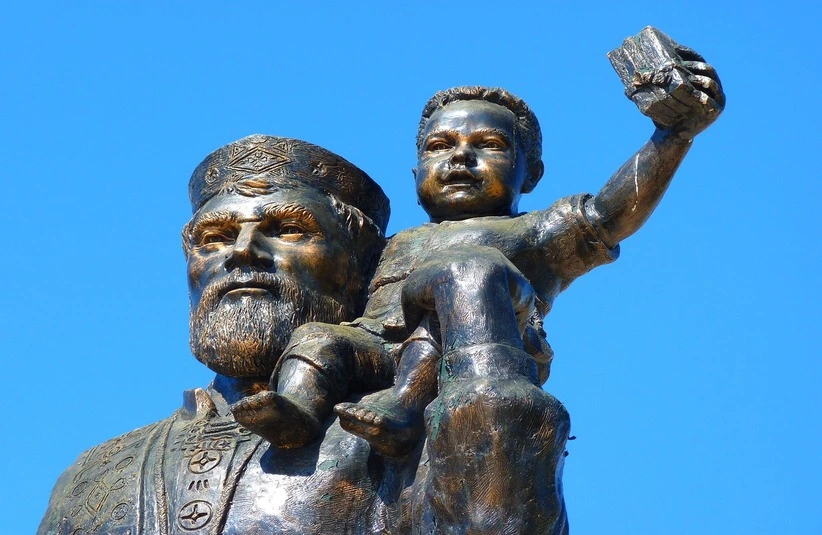
Saint Nicholas 3rd Century Bishop and Martyer who Wore Red and Gave Gifts to Children

Saint Nicholas was born on March 15, 270 and he died on December 6, 343. He was an early Christian bishop of Greek descent from the maritime city of Patara in Anatolia, near Turkey, during the time of the Roman Empire. There are so many miracles attributed to his intercession; he is also known as Nicholas the Wonderworker. Saint Nicholas is the patron saint of sailors, merchants, archers, repentant thieves, children, brewers, pawnbrokers, toymakers, unmarried people, and students in various cities and countries around Europe. Saint Nicholas’s reputation evolved, and his legendary habit of secret gift-giving gave rise to the folklore of Santa Claus (“Saint Nick”). Do you believe in Santa Claus?
Saint Nicholas Biography
Little is known about Saint Nicholas’s historical life. Any writings Saint Nicholas himself may have produced have been lost. Nicholas lived during a turbulent time in Roman history, so this may be the reason for the lack of a historical record. The earliest mentions of Saint Nicholas indicate that, by the sixth century, his following was already well-established. He has churches dedicated to him, by Roman Emperors, in Myra and Constantinople.
Nicholas attended the Council of Nicaea. The Life of Saint Nicholas of Sion, written around 250 years after Nicholas of Myra’s death, briefly mentions Nicholas of Sion visiting Nicholas’s tomb to pay homage to him. The fact that Nicholas had a tomb that could be visited serves as the almost solitary definitive proof that he was a real historical figure. So, Saint Nick existed.
However, when was he born, and what did he do? According to the Accounts of Saint Nicholas’s life, he was born in the city of Patara, a port on the Mediterranean Sea in the Roman Empire. His family was wealthyand his uncle was the bishop of the city of Myra, also in Lycia. Nicholas’s uncle ordained him as a priest.
After his parents died from an epidemic, Saint Nicholas is said to have distributed their wealth to the poor. In his most famous exploit, which is first attested in Michael the Archimandrite’s “Life of Saint Nicholas,” Nicholas heard of a devout man who had once been wealthy but had lost all of his money due to the “plotting and envy of Satan.” He went to the house under the cover of night and threw a purse filled with gold coins through the window opening into the house. That was just the start.
A subsequent story tells how, during a terrible famine, a malicious butcher lured three little children into his house, where he killed them, placing their remains in a barrel to cure, planning to sell them off as ham. Saint Nicholas, visiting the region to care for the hungry, saw through the butcher’s lies and resurrected the pickled children by making the sign of the cross.
After that, he made giving alms to children a regular habit. They would leave their shoes outside, and he would fill them with candy. He always wore red, though he was hundreds of miles from the nearest reindeer.
Saint Nicholas Verneration
Saint Nicholas has become the patron saint of several cities that maintain harbours. In centuries of Greek folklore, Nicholas was seen as “The Lord of the Sea”, often described by modern Greek scholars as a kind of Christianized version of Poseidon. In modern Greece, he is still easily among the most recognizable saints, and 6 December finds many cities celebrating their patron saint. He is also the patron saint of all of Greece and particularly of the Hellenic Navy.
In the Eastern Orthodox Church, Saint Nicholas’s memory is celebrated on almost every Thursday of the year with special hymns to him, which are found in Octoechos. Nicholas had a reputation for secret gift-giving. His putting coins in the shoes of those who left them out for him is celebrated on his feast day, 6 December.
In late medieval England, on Saint Nicholas Day, parishes held Christmastide “boy bishop” celebrations. Today, Saint Nicholas is still celebrated as a great gift-giver in several Western European and Central European countries. In medieval times, Christian nuns in Belgium and France began to deposit baskets of food and clothes anonymously at the doorsteps of the needy, which gave rise to the practice of gift-giving on Saint Nicholas Day.
Santa Claus evolved from Dutch traditions regarding Saint Nicholas. When the Dutch established the colony of New Amsterdam, they brought the legend and traditions of Sinterklaas with them. Howard G. Hageman, of New Brunswick Theological Seminary, maintains that the tradition of celebrating Sinterklaas in New York existed in the early settlements of the Hudson Valley, although by the early nineteenth century had fallen by the way.
St. Nicholas Avenue and St. Nicholas Terrace, streets in the Harlem neighborhood of Manhattan, New York City, an area originally settled by Dutch farmers, were named for St. Nicholas of Myra. The name was later taken for nearby St. Nicholas Park, located at the intersection of St. Nicholas Avenue and 127th Street.
Conclusion
Believe! Santa Claus exists in a real person named Saint Nicholas who lived in the Roman Empire in the 3rd Century. He was a bishop, always wore red, and gave gifts. There are several legends that surround him, not the least of which is the fact that several billion Christians currently celebrate Christmas. A certain man, dressed in red, gives gifts.