
The Meaning of Imbolc: Midwinter’s Quiet Thaw

Here, in the Northern Hemisphere, we’re nearly at the middle point of winter. Imbolc (ˈimˌbälk), traditionally celebrated on February 1, is a time to look for those first bright signs of the spring to come. It’s a time for looking ahead to warmer days while sitting by candelight.
It may also be called Brigid’s Day, Oimelc, the Feast of St. Brigid, or even Candlemas, though the last two are Christian reinterpretations of something far older. Whatever you choose to call the day, the meaning is all the same.
Why February 1?
If you’re in the United States, like I am, you may wonder about the timing of Imbolc. After all, many parts of the country are still deep in snow. The date is the midpoint between the Winter Solstice and the Spring Equinox. And in the United Kingdom and Ireland, the weather is not the same as in the U.S. It’s also suggested that the timing was related to the sheep breeding cycle. Still, even with snow still in the weather forecast, you may notice the first signs of life pushing up through the snow or brown earth.
In “Imbolc,” (affiliate link) from “Llewellyn’s Sabbat Essentials,” they suggest that you could choose to celebrate Imbolc at the beginning of March instead, when nature more closely aligns with the themes of the day. But, no matter when you celebrate, it’s the intention that matters.
The Meaning of Imbolc
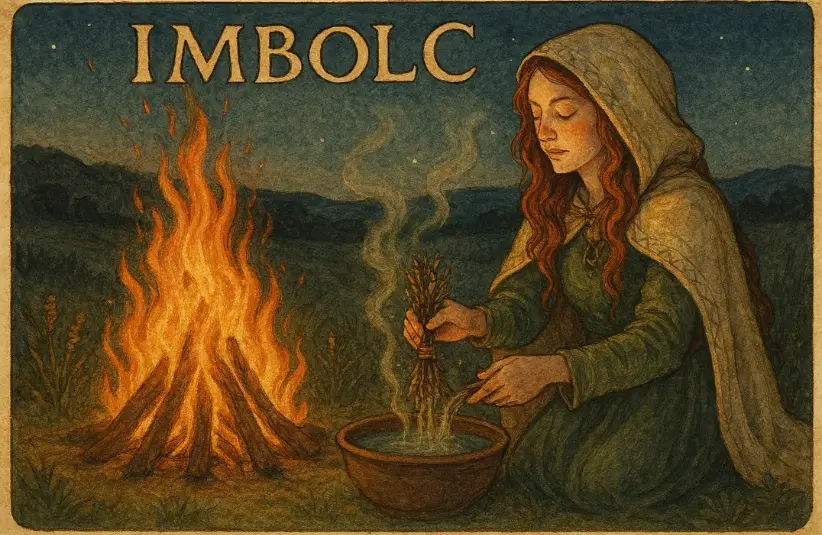
Imbolc is a time of renewal. The land begins to thaw, and the earth shows new signs of fertility. Though the weather remains bleak, we’re reminded that spring is on its way. In ancient times, the day was dedicated to the powerful Celtic Goddess Brigid, daughter of the Dagda. She’s a Goddess of fire, fertility, water, and poetry. She is a triple Goddess: Maiden, Mother, and Crone.
On Brigid’s Day, we symbolically emerge from the hold winter has had on us, just as nature is doing. Animals, plants, and even the sun are moving towards spring and new growth. So, for people, it makes sense for us to do the same. Spring cleaning, ridding ourselves of physical and mental clutter, removing the things that no longer serve us, and beginning our plans for the spring planting (whether literal or figurative).
Celebrating Imbolc
This is a quieter holiday than most. Though Sabbats revolve around fire, for Imbolc, candles are more appropriate than bonfires. The small lights can represent the light at the end of winter. Of course, a meal with family, including chosen family, is a good way to celebrate the day.
Making a Brigid’s Cross as a symbol of protection is traditionally done before Imbolc. Corn dollies, or Brigid’s Dolls, are also commonly made, though they can also be associated with the harvest season. If you’re especially crafty, you might even try making your own hand-dipped candles.
Magick and Rituals
A Sabbat is a special time for spellwork, so if you are a practitioner of magick, you may choose Imbolc for spells related to the day. Divination, blessings, and healing are appropriate, though these are, of course, merely suggestions.
You don’t have to use magick to perform special acts. Prayers and rituals are equally powerful. If you’re part of a coven, there is likely a tradition that will be followed, but for those who are solitary, you can find many ritual ideas online and in books. It’s wonderful to have so many resources! For example, Llewellyn has a ritual as part of their Mind Body Reference.
It’s Time to Plan Your Garden
Whether you’ll be planting a garden of plants or planting the figurative seeds of your spring, Imbolc can give you a reason to break out of routines that are no longer serving you. It’s time to face the spring cleaning. Get rid of things that you don’t need and welcome in the light of spring for promising days to come.
More Related to Imbolc
- Imbolc: Welcoming the First Bright Stirring of Celtic Spring
- Imbolc: A Festival of Purification and New Beginnings
- Imbolc Traditions: From Hearth Magic to Early Light
- Celtic Lore for the Modern Soul: Ancient Myths That Still Shape Us Today
- From Winter to Light: Understanding the Candlemas Meaning and Its Hopeful Traditions