Kwanzaa and Christianity: Can You Celebrate Both?

For many African American families, the Christmas season doesn’t end on December 25. Just as the wrapping paper is being cleared away, the kinara is brought out to welcome Kwanzaa. However, for families of faith, this can sometimes bring up a quiet tug-of-war in the heart. There is often a lingering question that comes up in church pews and around dining tables: Can you fully embrace Kwanzaa while walking faithfully in Christianity?
There has been so much confusion over the years, and honestly, a bit of misinformation. If you’ve been hesitant to blend these celebrations, or if you’re just curious about how they fit together, take a deep breath. It is entirely possible to honor your heritage and your Savior at the same time. Let’s talk about what that looks like.
Understanding the Heart of Kwanzaa
To understand how Kwanzaa fits into a Christian life, we first have to look at what it actually is. A common misconception is that Kwanzaa is an African religious festival. Actually, it is an African-American cultural holiday. It was created right here in the United States in 1966 by Dr. Maulana Karenga.
The name comes from the Swahili phrase “matunda ya kwanza,” which means “first fruits.” Think of it less like a religious high holy day and more like a harvest festival—similar to how we view Thanksgiving. It’s a time set aside to celebrate family, community, and culture.
While the holiday was born during a turbulent time in American history as a way to foster Black pride and unity, it has evolved into a beautiful celebration of life. It’s not about worship; it’s about remembering where we come from and building up who we are.
Bridging the Gap Between Culture and Faith
So, where does the conflict come from? In the early days, the founder presented Kwanzaa as an alternative to Christmas. But as the holiday grew and was embraced by the wider community, that narrative shifted. Today, millions of people celebrate both.
Think of it this way: Being proud of your heritage doesn’t subtract from your faith. In fact, for many, it enhances it. Celebrating Kwanzaa doesn’t mean you are putting culture above Christ. It means you are taking time to honor the history, struggles, and triumphs of a people that God created.
Kwanzaa is not a religious holiday. It doesn’t have a theology or a deity. This distinction is crucial. It means that participating in the lighting of the candles or discussing the principles doesn’t violate the commandments to have no other gods before the Lord. You aren’t worshiping the ancestors; you are honoring their memory and their endurance, much like we do on Memorial Day.
Seeing God in the Seven Principles
When we look closely at the Nguzo Saba, or the Seven Principles of Kwanzaa, we can actually see how beautifully they align with biblical values. Instead of seeing them as separate from our walk with God, we can see them as ways to live out our faith in our community.
- Umoja (Unity): The Bible tells us how good and pleasant it is when God’s people live together in unity (Psalm 133:1).
- Kujichagulia (Self-Determination): This reminds us that we are made in God’s image and have the responsibility to define ourselves by His word, not by the world’s standards.
- Ujima (Collective Work and Responsibility): This is the essence of the church—bearing one another’s burdens (Galatians 6:2).
- Ujamaa (Cooperative Economics): We are called to support our brothers and sisters and be good stewards of our resources.
- Nia (Purpose): We know that God has plans to prosper us and give us a future and a hope (Jeremiah 29:11).
- Kuumba (Creativity): We serve the ultimate Creator, and using our gifts to beautify our community honors Him.
- Imani (Faith): While Kwanzaa focuses on faith in people and parents, as Christians, we know that our ultimate faith rests in Jesus. We can celebrate the faith of our forefathers who prayed us through difficult times.
How to Celebrate With a Faithful Heart
If you feel led to celebrate Kwanzaa this year, you can do so in a way that feels authentic to your Christian walk. It doesn’t have to be an “either/or” situation.
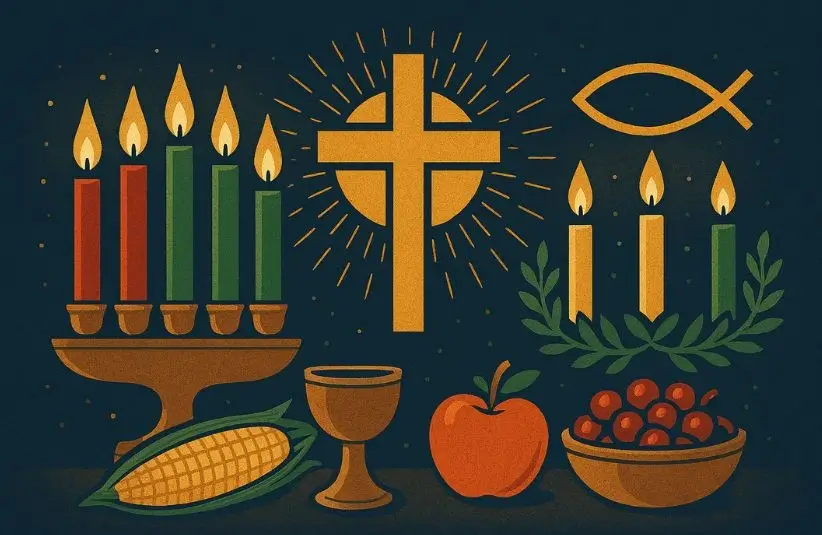
You might start your Kwanzaa gatherings with a prayer, thanking God for the “first fruits” of the year and His protection over your family. When you light the candles and discuss the principles, you can use scripture to anchor those discussions. For example, when discussing Imani (faith) on the final day, it’s the perfect opportunity to share your testimony or talk about Hebrews 11.
The beauty of this season is that it allows us to pause and reflect. We can celebrate the birth of our Savior at Christmas, and then immediately move into a week of celebrating the resilience and beauty of the family He gave us. It’s a chance to teach our children that their identity as African Americans and their identity as Christians are both gifts to be cherished.
So go ahead—light the candles, pour the cup of unity, and give glory to God for the rich heritage you possess.