

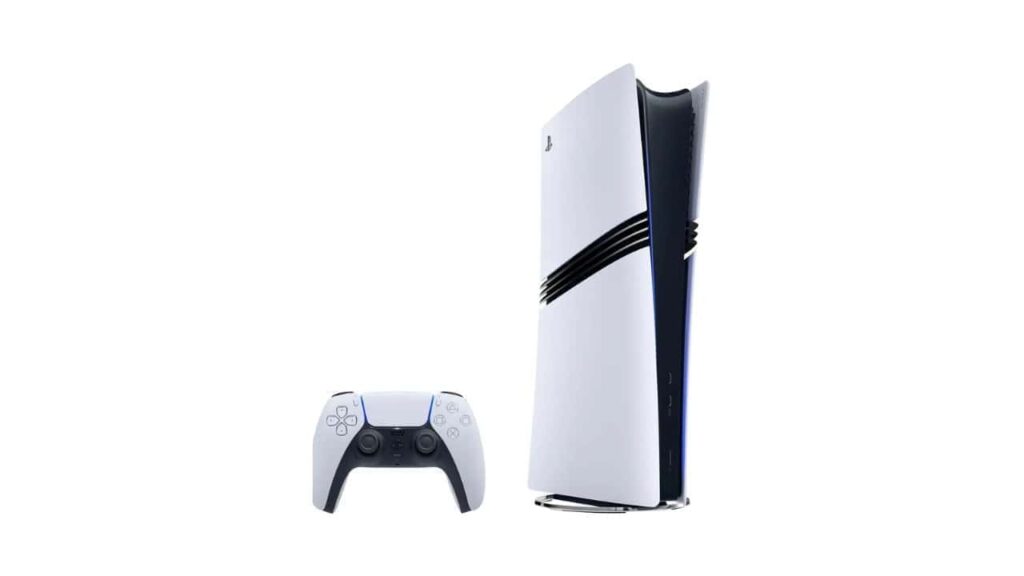
For fans hoping for updates on the rumored PlayStation 6, there’s exciting news. Mark Cerny, the PS5 system architect, and Jack Huynh from AMD presented these innovations. Sony and AMD have jointly announced that the console and future AMD graphics cards will likely have three key technologies, designed to enhance future gaming hardware. So, what can gamers get out of these unique features?
The Tech That Will Power Tomorrow’s Games
These core technologies, including Neural Arrays, Radiance Cores, and Universal Compression, speed up demanding graphical processes like ray tracing and path tracing. At the same time, it makes upscaling and denoising techniques more efficient. For starters, Neural Arrays reorganize a graphics processor’s compute units or CUs. Furthermore, these CUs don’t work in isolation as they link together to form a single, powerful AI engine.
This new arrangement makes the use of larger and higher-quality machine learning models, which proves more efficient for AI tasks. Ultimately, upscaling algorithms like PSRR will run faster and produce even better image quality, offering cleaner ray-traced graphics. As a result, the PlayStation 6 will show improvement in visual fidelity and performance. How will developers leverage this new AI power to create previously impossible in-game effects?
More Power, Less Waiting, All Fun
A technician carefully works on the intricate hardware of the Nintendo Switch 2.Second, Radiance Cores represent a dedicated hardware change in the PlayStation 6. These specialized units were built directly into the GPU. Moreover, it’s designed solely for handling the complex calculations of ray tracing and path tracing. Meanwhile, this move shares similarities with Nvidia’s strategy with its RT cores. The tech’s hardware is dedicated to this single task, performing ray tracing much faster than general-purpose compute units could.
While this strategy accelerates lighting and reflections, it also frees up the rest of the CPU and GPU. As a result, they can focus on their own specialized tasks, like simulation and shading, becoming more efficient and powerful overall. Universal Compression is the final technology in the PlayStation 6 that simplifies data management. In this system, all data is compressed and sent to the GPU memory, not just specific types like textures.
Specifically, this comprehensive approach significantly increases the effective memory bandwidth. So, what can gamers expect? Certain benefits, like higher frame rates, can potentially provide more detailed game assets and reduced power consumption. Moreover, this feature makes the Neural Arrays and Radiance Cores even more effective by streamlining data flow.
The PlayStation 6 is a Brainy Beast
Given the universal need for efficiency, this compression technology’s design transformation of the next-generation consoles and PCs. Although these technologies exist in simulation, both Sony and AMD are confident enough to reveal them early. Meanwhile, AMD ensured that all developers had access to these features across all gaming platforms, following its open approach to graphics innovation.
In this partnership, known as Project Amethyst, more information about the hardware release can be found. This announcement of a potential PlayStation 6 has also shown that these advancements are perfectly suited for gaming handhelds. As power and bandwidth are critical constraints, this discovery was considered a welcome addition for the community.
To create a true generational leap for a device like a Steam Deck 2, companies like Valve could find success in this very technology. As a result, the desktop market could finally allow AMD to close the longstanding ray tracing performance gap with Nvidia. Due to this collaboration, companies are innovating to overcome rising hardware costs. More importantly, it promises powerful gaming experiences that everyone will enjoy.
 Don't stop here
Every Score. Every Story. One Home.
Breaking sports, entertainment and news from across the Total Apex network, updated all day.
Get the Full Story →


