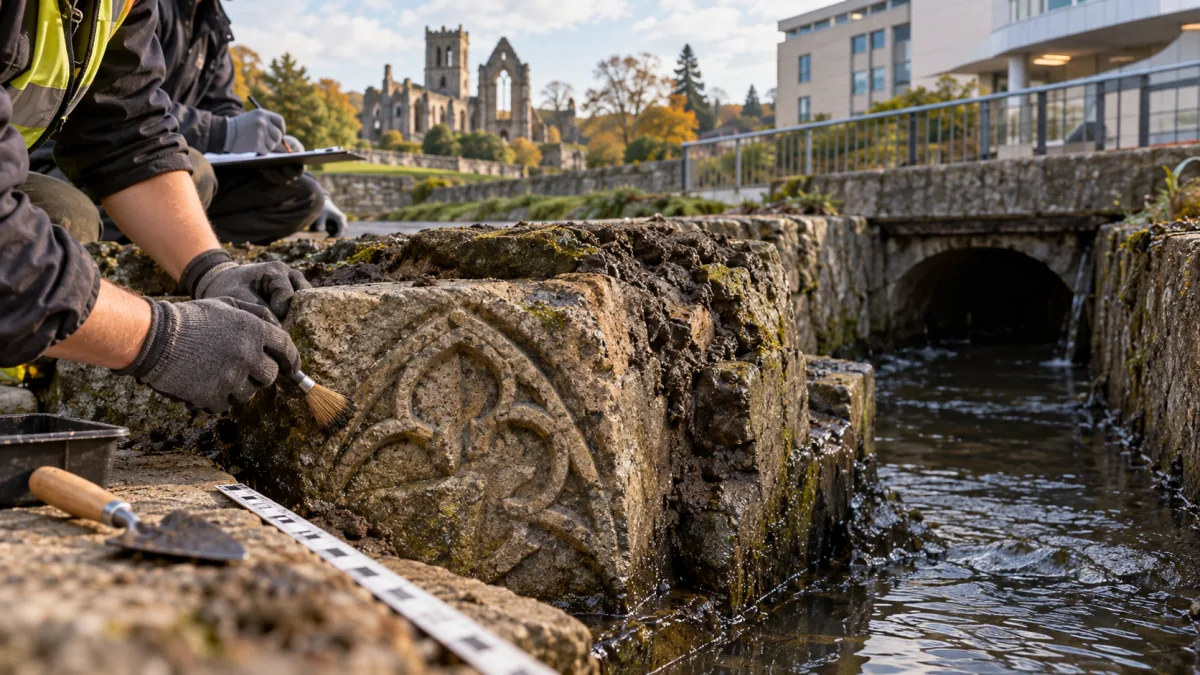
Archaeologists in Perth, Scotland, say stonework recovered from an 18th century drain may have originally belonged to a monastery that King James I of Scotland established nearly 470 years ago. The discovery came during an excavation last month at the site of the former King James VI Hospital, built around 1749 and 1750 and later converted into flats in the 1970s.
The culvert once carried waste water away from the hospital. Researchers say the stone blocks used in its construction show a level of craftsmanship that does not match typical drain-building practices of the 1700s, pointing instead to an origin in the long-demolished monastery.
What Researchers Found In The Perth Monastery Stone Reused In Drain
Dr. Gavin Lindsay, an archaeologist on the project, said the stone blocks pulled from the culvert carry chisel marks that suggest careful, deliberate shaping rather than functional drain-building. “You can see clear chisel marks from when they had been worked very carefully to create these beautiful smooth sides,” Lindsay said. “They are clearly far more elaborate, and far more effort had gone into their production, than you would do for a drain in the 1700s.”
Lindsay also raised the possibility that the stone had a direct connection to the monastery’s royal founder. “Possibly by many monks’ feet, and to push it a bit further, maybe King James’s feet had been across it,” he said.
The drain itself is lined with handmade 18th century bricks, consistent with its construction timeline for the hospital. Volunteers sifting through soil from the excavation also turned up medieval pottery and glass fragments mixed in with artifacts from the 19th and 20th centuries, suggesting the area saw continuous use and disturbance across several centuries.
Monastery Stone Turning Up Across Perth
The culvert is not the only place where archaeologists believe they have traced monastery masonry. Fragments identified as coming from the monastery have also been found built into the retaining wall of Perth railway station and into boundary walls surrounding local gardens, according to the BBC.
That pattern suggests that after the monastery was demolished, its stone was treated as a practical building resource and distributed across multiple construction projects in the area rather than discarded.
Background On The Monastery And Hospital Site
The monastery traces back almost 470 years to its founding by King James I of Scotland. The King James VI Hospital that later rose on part of the same ground was constructed around 1749 and 1750, more than two centuries after the monastery’s establishment. The hospital building stood until it was converted into residential flats in the 1970s.
The gap between the monastery’s founding and the hospital’s construction, combined with the apparent reuse of its stone in a drain, points to the monastery having been demolished at some point before the mid-1700s, when its materials became available for new building projects.
What’s Next
Archaeologists plan to move into archive studies aimed at learning more about the monastery’s history, according to the BBC report. The project also includes community outreach efforts tied to the excavation findings. No specific dates for those next steps have been announced.
”
More Religion news from Total Apex Entertainment.
 Don't stop here
Every Score. Every Story. One Home.
Breaking sports, entertainment and news from across the Total Apex network, updated all day.
Get the Full Story →
Don't stop here
Every Score. Every Story. One Home.
Breaking sports, entertainment and news from across the Total Apex network, updated all day.
Get the Full Story →