

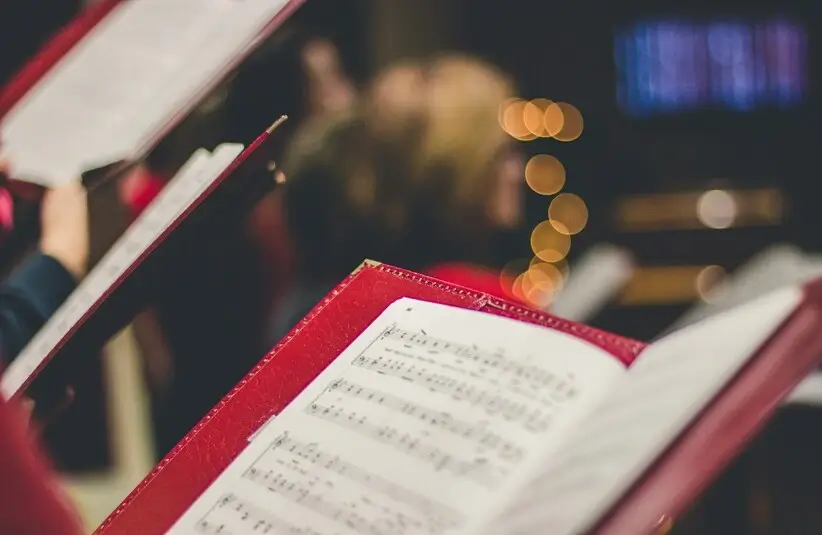
“O Come All Ye Faithful,” also known as “Adeste Fideles.” It is a Christmas carol attributed to many authors. With that being the case, one thing is certain: it is very old. Some of the credited authors are John Francis Wade, John Reading, King John IV of Portugal (Yes, a King), and many anonymous Cistercian monks. The earliest printed version is from 1751 and is currently held in the library at Stonyhurst College in Lancashire, England. The song has also grown over time. It was originally four verses but has since been expanded to eight verses. Does your church sing this carol?
“O Come All Ye Faithful” Explanation
The first version of “O Come All Ye Faithful” was written and attributed to various individuals. These include St. Bonaventure in the 13th century or King John IV of Portugal in the 17th century, among several others. However, the tune was most likely written by Cistercian monks. This is one of those rare songs that was revised multiple times.
John Francis Wade, an English Catholic, is commonly credited with writing the song. Wade lived in exile in France and was a copyist of musical manuscripts, which he found in libraries. That was a profession in the 18th Century. Wade signed his copies, possibly because his calligraphy was so nice. At any rate, in 1751, he published a printed compilation of his manuscript copies. This is the first printed source for “O Come All Ye Faithful,” so he gets credit for first writing the song.
The version published by Wade consisted of four Latin verses, but it grew. Over time, various people added verses. In the 18th century, the French Catholic priest Jean-François-Étienne Borderies wrote an additional three verses in Latin. In this way, “O Come All Ye Faithful” is unique among Christmas carols. It is one of the few that grew over time.
The text of the song has been translated several times into English, which is the version we hear now. It was first published in Murray’s Hymnal in 1852. That version is a combination of the various English translations of the text. It is a combination of one of Frederick Oakeley’s English translations of the original four verses and William Thomas Brooke’s translation of the first three additional verses.
John Francis Wade
John Francis Wade was born on January 1, 1711, and he died on August 16, 1786. He was an English hymnist who is usually credited with writing and composing “O Come All Ye Faithful,” because he was first. Frederick Oakeley is the person credited with translating the song into English in the mid-19th Century, at least three sevenths of it.
Wade was an exile. He fled to France after the Jacobite rising of 1745 was defeated. He lived with exiled English Catholics in France, where there were a lot of them, and he taught music and worked on church music. It has been noted that Wade’s Roman Catholic liturgical books were often decorated with Jacobite floral imagery, perhaps proof of his exile. It turns out you are not the only one who doodles.
Conclusion
“O Come All Ye Faithful” is now a popular Christian song. It is sung throughout the year, but the song has special meaning in the week between Christmas and the Epiphany. The song means that all should come to worship the newborn Jesus, as the three wise men did. After all, he is the King of the universe. This is one of twenty-three songs that can be sung at this time of celebration, perhaps the most famous.
 Don't stop here
Every Score. Every Story. One Home.
Breaking sports, entertainment and news from across the Total Apex network, updated all day.
Get the Full Story →


