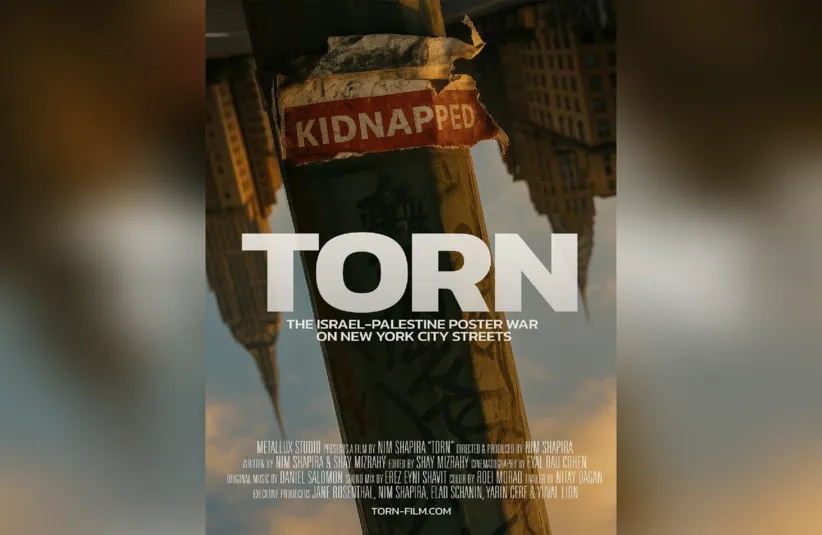
“Torn” Is Uncomfortable, Provocative, and Absolutely Essential Viewing

It is rare for a documentary to capture the pulse of a historical moment while the wound is still fresh, but that is precisely what “Torn” manages to achieve. Filmed in the immediate, chaotic aftermath of the October 7 attacks, director Nim Shapira’s essential debut feature isn’t just a recount of the Israel-Hamas war. Instead, it turns the camera toward a different battlefield: the brick walls, subway stations, and scaffolding of New York City.
Shapira’s Homecoming to NYC
Shapira, an Israeli-American filmmaker who was in Tel Aviv when the rockets began falling, returned to his home in New York to find a city divided. The documentary focuses on the now-infamous “Kidnapped from Israel” poster campaign. What began as a guerrilla art project by Nitzan Mintz and Dede Bandaid (which was inspired by the milk carton campaigns of the 80s) rapidly spiraled into a proxy war of public opinion. “Torn” serves as a crucial historical document of how a global tragedy became a local flashpoint, tearing apart one of the world’s most diverse cities.
A War Fought on City Walls
The visual language of “Torn” is striking because it is so familiar to anyone who walked a city street in late 2023 and in early 2024. The red, black, and white fliers were plastered on every available surface, demanding attention for the 240 hostages taken by Hamas. But just as quickly as they went up, they were slashed, ripped, and defaced.
Shapira captures this “paper arm” war with a kinetic, nervous energy that mirrors the anxiety of the time. The film doesn’t shy away from the visceral anger on display. We see the artists and activists frantically stapling faces to poles, driven by a desperate need to “do something” while feeling helpless thousands of miles away on American soil.
Conversely, the camera unflinchingly records the vitriol of those tearing them down. It shows scenes of screaming matches, doxxing, and brutal physical confrontations that make you want to look away. It highlights a terrifying reality: in the vacuum of information and the heat of social media polarization, compassion becomes a partisan weakness.
“Torn” Beyond Politics: The Human Cost of Polarization
Where “Torn” succeeds is in its staunch refusal to remain abstract. It grounds the political noise in crushing personal grief. The film spends time with the families of the hostages, including Alana Zeitchik and the friends of Omer Neutra. These aren’t political operatives; they are people living through a nightmare, forced to watch the faces of their loved ones be desecrated by strangers on their morning commute.
Hearing Julia Simon, a student at Parsons, describe the numbness of seeing her friend Omer’s face spray-painted or ripped down is heartbreaking. The film recontextualizes the “poster war” not as a debate over territory – or policy, but as a direct assault on the freedom and right to grieve. The documentary forces the audience to sit with that discomfort. It asks a difficult question: When did the suffering of civilians become a symbol to be debated rather than a tragedy to be mourned?
Nim Shapira’s Plea for Dialogue
Despite the heaviness of the subject matter, Shapira’s directorial intent leans toward hope, or at least, the possibility of communication. He makes a concerted effort to understand the motivations behind the vandalism, though the film notes the difficulty in getting the “other side” to speak on camera without hostility.
The documentary posits that the physical tearing of paper is a symptom of a much deeper rupture in our ability to hold multiple truths. Shapira, who identifies as a liberal, gay vegan living in Brooklyn, found himself alienated from communities he once called home. Yet, “Torn” is not a piece of propaganda. It is an invitation. As the director noted in recent screenings, the goal is to break the echo chambers. He captures a city that is alive, angry, and grieving, suggesting that empathy should never be a limited resource.
Why “Torn” Is Essential Viewing Right Now
We are living in an era where complex geopolitical conflicts are flattened into Instagram infographics and 15-second TikToks. “Torn” challenges that. It demands that the viewer look at the human face behind the paper. Not since “Mourning in Lod” has a film been this essential and crucial for the times.
The film doesn’t offer a solution to the Middle East crisis and it doesn’t pretend to have one. Instead, it holds up a mirror to Western society and asks us how we got to a place where we cannot look at a picture of a kidnapped child without projecting our own political biases onto it. It is a messy, contradictory, and deeply emotional film, much like New York itself. For anyone trying to understand the social fracture and chasm of the post-October 7 world, “Torn” is mandatory viewing.