
Good Boy Director Chronicles 3-Year Journey Filming Dog for Unique POV Horror

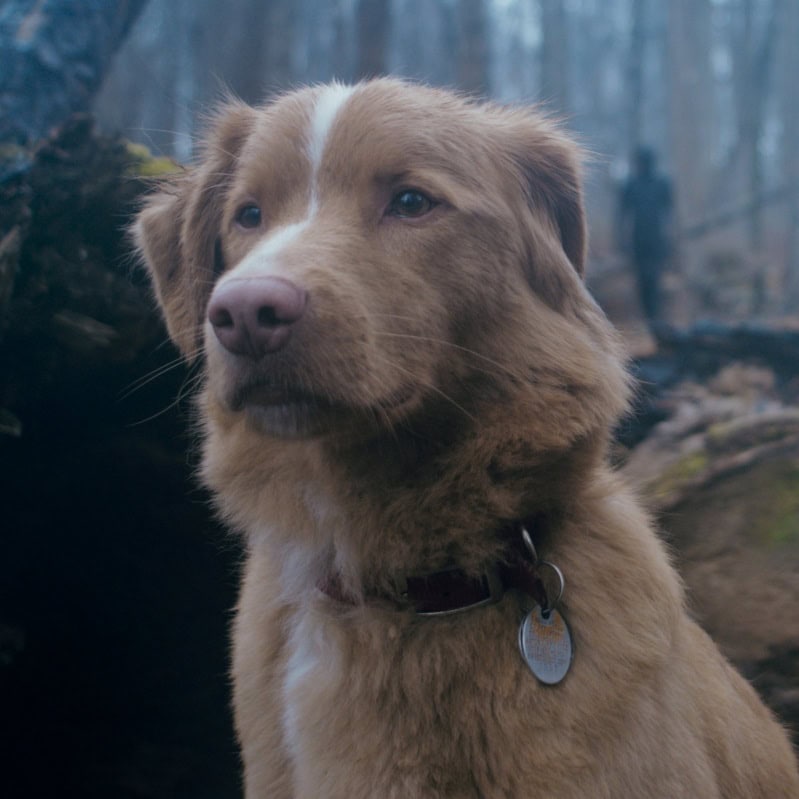
Few classic horror films would be complete without their beloved final girls (or their equivalents of other genders). But Good Boy, a supernatural horror flick slated to kick off Spooky Season with its wide release next Friday, is a groundbreaking movie in that its titular final boy is not human. No, he isn’t some vampire or demon who’s gone over to the good side: Good Boy is a horror film told from the POV of a dog.
Top Billing Goes to Indy
Good Boy, which opened at South by Southwest in March, is the feature-film debut of Ben Leonberg. Leonberg independently co-produced the movie with his wife, Kari Fischer, and in the lead role they cast another family member: their Nova Scotia duck-tolling retriever, named Indy. Indy portrays a dog who must protect his owner (Shane Jensen) after they move into a country house that turns out to be haunted by malevolent spirits.
And Leonberg and Fischer weren’t about to relegate their beloved Indy to the status of noble sidekick. On the contrary, they endeavored to tell this story from the perspective of their canine hero. Their cinematographer, Wade Grebnoel, shot Good Boy to reflect the viewpoint of Indy’s character, with many entire scenes framed to show the dog’s line of sight and perspective.
Not an Artistic Choice for Impatient Filmmakers
Now, considering how common it is in supernatural fiction to portray dogs (and sometimes other animals) as being innately keen to paranormal phenomena, you might be tempted to wonder why no one else has ever executed this idea for a horror movie before. The answer is that Good Boy’s production history speaks for itself: Leonberg, Fischer, and Grebnoel carried out principal photography (on location in New Jersey) over a period of roughly three years, with a total of over four hundred shooting days.
Why did it take this long to shoot an independent horror movie with a runtime of 73 minutes? Well, as everyone involved in making Good Boy learned the hard way, a totally DIY film production may be daunting enough already, but casting the lead role with an animal who lacks any professional training to act is something else altogether.
In a recent interview with Entertainment Weekly, Leonberg compared filming scenes with Indy to the scenario of a human actor who isn’t delivering their lines quite as the director wants: “At least the actor agrees on the reality of the premise that they are indeed making a movie… Indy is an X-factor, he can’t hit an exact mark, and he can’t do timing the way a human actor would. So you plan it out as much as you can and you layer in the shots as you’re getting them, which is frequently just one or two a day.”
Thinking Outside the Box: How to Teach a Dog Horror-Movie Tricks
It was difficult enough for the makers of Good Boy to film so much as a shot without Indy heading off the set at the slightest distraction. But keeping him in place was only part of the challenge. For Indy to portray a dog in a haunted house, he needed to act: to exhibit visible reactions that they could subsequently edit into the onscreen context of, say, an encounter with a sinister entity.
To obtain such reactions on film, Leonberg and Fischer improvised a variety of tricks to provoke different responses from Indy. Often, one of them (usually Fischer) would lie on the floor next to Indy in order to cue him into certain positions for a shot or scene. “There are lots of strange positions we had to put ourselves in to make him look at the right thing,” Leonberg recalled.
Leonberg also described how they would use certain words and gestures to get Indy’s attention, or in some cases to confuse him so that he would exhibit an appropriate expression for a dog confronted with the paranormal. This is just one example: “We would say words to him in the tone of a command that doesn’t make any sense, like, ‘Indy, “neon sign.”‘ And he would give a classic dog head tilt.”
Findy – Indy’s Still Double
Naturally, there was a limit to how still they could keep Indy, and for how long. Enter Findy, which Leonberg described as “a stand-in for lighting.” Findy is a life-like stuffed model of Indy, custom-made for Good Boy by a company that typically makes such dummies for people who’ve lost their pets. While ordering Findy to his specifications, Leonberg learned that most such models come with a zippered cavity for storing the dead animal’s ashes. “That feels like a different kind of horror movie,” he remarked. Of course, he declined this feature for Findy.
“He’s not exactly the right size,” Leonberg explained about Findy, “but he’s close enough to the right coloring, and we had him custom-made… trying to get it as close as possible so we could set up the lights.” He reported that Indy was “confused, perplexed, and sometimes enamored with the fake version of himself,” and that the dog did not appear to recognize his own likeness in Findy.
Long, Hard Work Paying Off
By most accounts at this early stage, Good Boy is a horror movie well worth the formidable time and effort that went into it. It currently holds a rating of 96% on Rotten Tomatoes. Critics have praised its novel approach to horror as an unusually effective way of lending the movie both horror and emotional resonance.
The performance of Indy was singled out for acclaim at SXSW, which awarded him the newly created “Howl of Fame Award” for Good Boy. On its website, SXSW declares: “Indy and his humans remind us even when darkness threatens to consume us, a faithful dog’s love knows no bounds.”
