
Chrysler Airflow (1934–1937): Full‑Size American Production Car Shaped by Streamlined Design

The Chrysler Airflow was a full-size car produced from 1934 to 1937. It was noteworthy because it was one of the first American production cars that used streamlining in a wind tunnel to make a sleek automobile. It had a revolutionary body design and looked like it was designed in a wind tunnel. It was far from the last American car to be produced in a wind tunnel, so it broke ground.
Chrysler made a significant and fundamentally revolutionary leap in automotive design. However, the car was a commercial failure. Chrysler built a wind tunnel at the Highland Park production facility and tested at least 50 scale models by April 1930. Do you think such a revolutionary design should have sold more?
Chrysler Airflow Production Story from 1934-1937
There is a funny story about the Chrysler Airflow. Even though the car was a commercial failure, it turns out that the revolutionary production of the car, using a wind tunnel, produced results that caused panic. Stories about the car being more efficient when driven backward are largely considered exaggerated or apocryphal, but engineers did experiment with unconventional configurations to study aerodynamics. These experiments did not demonstrate that the production Airflow was more efficient when driven backward. So, engineers produced a car that reversed the chassis and placed the front axle and steering gear of a conventional 1933 Chrysler Six at the back of the car, which allowed the car to be driven “backward” throughout Detroit. This experiment has often been retold in exaggerated ways.
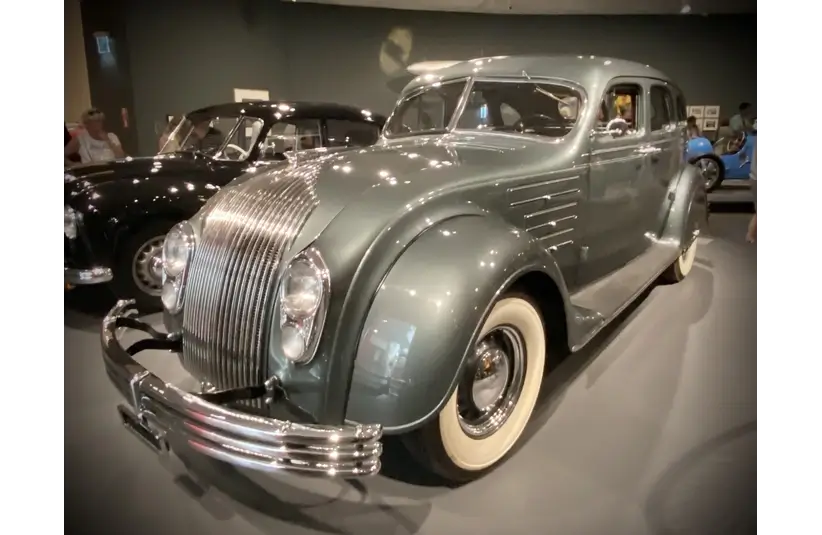
As far as design goes, the most revolutionary component of this car was the body. It introduced aerodynamic styling cues that influenced later automotive design. The car had a closed body, which was already common by the early 1930s but was more fully integrated and streamlined in the Airflow’s design. The Chrysler Airflow’s grille work cascaded forward and downward. That formed a waterfall look, which was very different from other makes. Headlights were flush with the grille. The front fenders enclosed the running surface of the tires, also a first. Finally, the rear wheels were also encased by fender skirts. That gave the car a closed look.
In terms of power, the Chrysler Airflow had a 299 cubic inch Chrysler I8 in 1934 and a 324 cubic inch engine. The car had a three-speed manual floor shift. It also had a 123.5-inch wheelbase. The car was available as a four-door sedan or a two-door coupe, and 29, 600 cars were produced between 1934 and 1937. The 1934 version of the car could be driven at 80 miles per hour.
Model Year Changes and Production Decline (1934–1937)
In 1935, Chrysler was offended by the lack of consumer interest in the automobile. The response included modifying the body in a way that the public liked. These changes included a peaked grille that replaced the waterfall version of 1934. Other than that, the models offered for 1935 were the same as in 1934. However, the two-door sedan was dropped. Only 8,000 cars were produced.
In 1936, the car, which was too revolutionary for consumers, got rid of its smooth backside, as a trunk was added to the body. Also, the Airflow continued to use inline engines and did not receive a V-12 engine, to give it considerably more power. Sales remained modest compared to traditional Chrysler models, and the changes did little to improve demand.
1937 was the final year the car was produced by the company. A total of 4,600 two-door sedans and four-door coupes were produced. This year was the year that the car became the official car of the President of the Philippines. The vehicle was restored in 1978 and is currently on display in Quezon City, Philippines.
Parting Shots
Even though the car was a commercial failure and produced for just four model years, it was revolutionary in design. It helped shape what future cars would look like. The story about the wind tunnel producing results that said the car would be more efficient if it were driven backward caused a panic in Detroit!
