
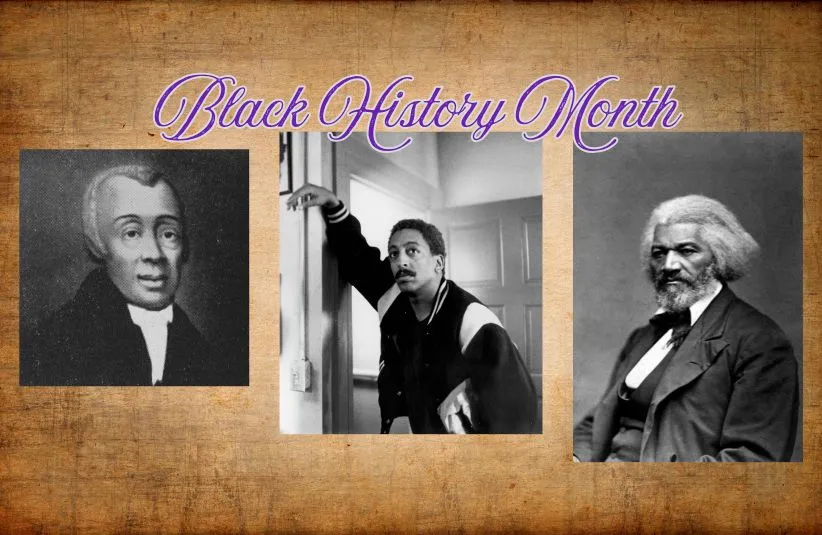
Focus on Black History February 14, 2026: The Birthdays of Rev. Richard Allen, Gregory Hines, and Frederick Douglass

On this day in Black History, February 14, several significant births took place. Two were during slavery, and one was in modern times. These prolific individuals are remembered for their amazing life’s work and dedication. They brought people together in unity, hope, and artistic creativity.
Richard Allen preached God’s word and advocated for Black people’s freedom in worship. Famed tap dancer Gregory Hines brought execution and brilliance to dance. And Frederick Douglass, orator, author, abolitionist, and activist, fought for freedom and justice for Black Americans. We salute these three great men for their contributions to Black History with their work in the church, entertainment, and activism.
Richard Allen
Born on February 14, 1760, the Right Reverend Richard Allen is the founder of the African Methodist Episcopal Church (AME), which opened its doors in 1794 in Philadelphia. In 1861, Allen became the first bishop of the AME Church, and his focus was to provide black people with worship experiences free from racial oppression. It was important to this Black History maker that enslaved people possess a measure of dignity.
As one of the most influential and active black leaders of America, he labored for the black community’s social status, organized Sabbath schools to teach literacy, and formed political strategy groups. Allen was a part of the Philadelphia abolitionist movement that petitioned Congress to end the international slave trade and to work toward gradual emancipation. His petitions were rejected, but he remained active as a minister, educator, abolitionist, and writer.
Gregory Hines

Gregory Oliver Hines was born on February 14, 1946, in New York City. Hines was a talented dancer, choreographer, singer, and actor who emulated Sammy Davis, Jr. One of the world’s most celebrated tap dancers, Hines also acted in over forty films and performed on Broadway. Hines was known for his improvisation of tap rhythms, sounds, and steps. Hines advocated for tap in America; in 1989, he helped create National Tap Dance Day, observed in the United States and abroad. An important Black History figure and dance advocate, Hines was a member of the Jazz Ensemble and the American Tap Dance Foundation.
Frederick Douglass
On February 14, 1818, we commemorate the birth of Frederick Douglass, born Frederick Augustus Washington Bailey, in Talbot County, Maryland. In 1838, Douglass escaped slavery and became a powerful and influential abolitionist and human rights leader. He once said, “If there is no struggle, there is no progress.”
Known for his brilliance and persuasiveness as an orator, he drew audiences of all backgrounds to hear him explicate the rights of freedom for all people. His heralded Fourth of July speech in 1852 is famous for its boldness, intellect, and mastery of persuasion. Douglass was not afraid to speak the truth in the face of personal consequences.
In 1889, he was appointed Minister-Resident and Consul General to Haiti, making him the first African American to hold a United States Government appointment. He was the 19th century’s most photographed man and became the United States’ first black U.S. marshal. Douglass was also a newspaper publisher and author whose acclaimed Narrative of the Life of Frederick Douglass is one of the best-known autobiographies in the United States.
In writing, Douglass recounts speaking to one of his former slave owners, Captain Thomas Auld, concerning the date of his birth. He tells Auld he’s always been curious about his age, and that it troubled him not to know his birthday. Auld replied that he couldn’t tell him that, but thought he was born in February 1818. Even though the exact date of Douglass’s birth is unknown, we celebrate this remarkable Black History maker’s birth today as well as his many outstanding contributions.
February is Black History Month
February 14 is a momentous day in Black History, celebrating the births of three notable individuals who left indelible marks on this country and the world. In 1830, Rev. Richard Allen was the first Black American to publish a pamphlet, focusing on his life and experiences. Frederick Douglass gave insight into his life as a slave and how he broke free to work toward freedom. And Gregory Hines left a legacy of artistic genius. On this day, we salute three influential powerhouses: Allen, Douglass, and Hines.
