

Recall: Walmart Great Value Cottage Cheese – What You Need to Know

Have you grabbed a tub of Great Value Cottage Cheese from Walmart recently? You might want to check your fridge right now — and we mean right now.
Saputo Cheese USA Inc. issued a voluntary recall on February 24, 2026, for select Great Value Cottage Cheese products. The reason? There’s a possibility that some liquid dairy ingredients used in production were not fully pasteurized according to state regulatory standards. That’s a big deal, and here’s why.
Why Unpasteurized Dairy Is Actually Dangerous
Pasteurization isn’t just a fancy food science term. It’s the process that kills off dangerous bacteria like Salmonella, E. coli, and Listeria — the kind of stuff that can put you in a hospital bed faster than you can say “cottage cheese.” The FDA mandates pasteurization as a basic public health measure for a reason.
While no illnesses have been reported yet (good news, technically), the risk is real — especially for young children, elderly individuals, and anyone who is immunocompromised. Their immune systems can’t fight off foodborne pathogens the way a healthy adult might. So no, this isn’t a “wait and see” situation.
How the Recall Was Discovered
Here’s where it gets a little nerdy — and honestly kind of interesting. The issue was uncovered during pasteurizer troubleshooting exercises conducted by Saputo in conjunction with the California Department of Food and Agriculture. Basically, routine diagnostic work flagged a malfunction in the pasteurizer equipment. The pasteurizer has since been repaired, verified, and sealed by California’s Department of Food and Agriculture. No other products from the facility were affected.
Credit where it’s due — catching this during internal troubleshooting before widespread illness occurred is exactly the kind of proactive food safety behavior we want to see from manufacturers.
Which Products Are Affected by This Recall
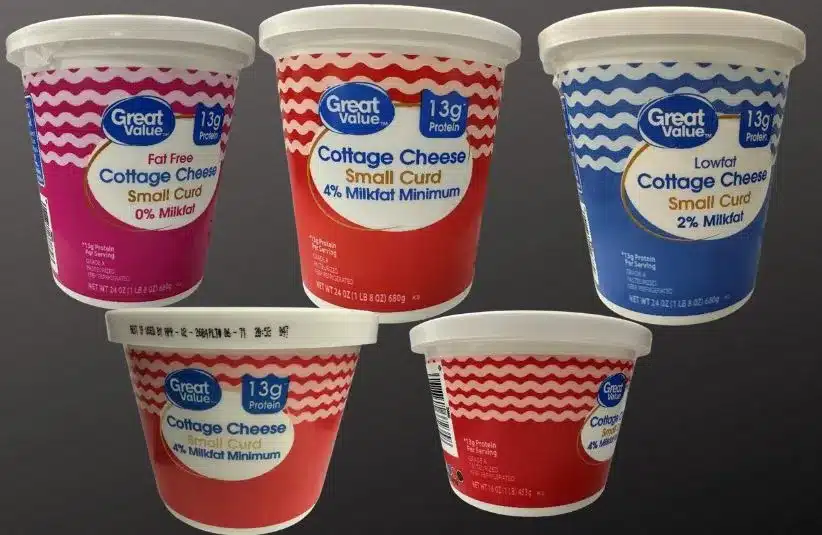
The recalled products were sold under the Great Value private label at Walmart stores. All products come in white plastic tubs with white lids, and the “Best By” dates are printed on the side of the lids.
Here’s the full list:
- Great Value Fat Free Small Curd Cottage Cheese (0% Milkfat) — 24 oz., UPC 078742373393, Best By: APR-01-26 or APR-03-26
- Great Value Lowfat Small Curd Cottage Cheese (2% Milkfat) — 24 oz., UPC 078742116730, Best By: APR-01-26, APR-02-26, or APR-03-26
- Great Value Small Curd Cottage Cheese (4% Milkfat minimum) — 16 oz., UPC 078742372358, Best By: APR-02-26
- Great Value Small Curd Cottage Cheese (4% Milkfat minimum) — 24 oz., UPC 078742372365, Best By: APR-02-26 or APR-03-26
- Great Value Small Curd Cottage Cheese (4% Milkfat minimum) — 3 lb., UPC 078742147970, Best By: APR-01-26 or APR-02-26
Which States Are Affected
The recalled products were distributed to Walmart stores and distribution centers across 24 states between February 17 and February 20, 2026:
Alaska, Alabama, Arkansas, Arizona, California, Colorado, Georgia, Iowa, Idaho, Illinois, Kansas, Kentucky, Louisiana, Missouri, Mississippi, Montana, New Mexico, Nevada, Oregon, Texas, Tennessee, Utah, Washington, and Wyoming.
If you live in any of these states and purchased Great Value Cottage Cheese during that window, check your tub’s UPC code and Best By date against the list above.
What To Do if You Have the Recalled Cottage Cheese
Short answer: don’t eat it.
You have two options:
- Throw it away — straight in the trash, not “finish it and hope for the best.”
- Return it to Walmart for a full refund — no receipt needed for recalled products.
For questions about the recall, call Saputo directly at 1-888-587-2423, Monday through Friday, 8 a.m. to 5 p.m. CT.
If you’ve already consumed the product and are experiencing symptoms like nausea, vomiting, diarrhea, or fever, contact your healthcare provider immediately. Listeria in particular can have a delayed onset of symptoms — sometimes up to 70 days — so don’t brush off any unusual symptoms if you’re in a high-risk group.
The Bottom Line on This Recall
Food recalls are nerve-wracking, but this one was caught before people got sick — and that matters. The machinery has been fixed, verified, and cleared. The affected products have a narrow distribution window and specific identifiers that make them easy to check.
That said, don’t get complacent. Unpasteurized dairy is not something to gamble with, especially if you’re feeding this to children or older family members. Check your fridge, check the UPC, check the date. Three steps, thirty seconds, potentially a very important health decision.
This recall is being conducted with the full knowledge and oversight of the FDA.
