
The New US Dietary Guidelines Just Dropped: Beef Tallow is In, Sugar is Out

Remember the 90s? When the Food Pyramid told us that the foundation of human existence should be 6–11 servings of bread, cereal, and pasta a day? It was a glorious, carb-loaded time to be alive, but it didn’t exactly do our waistlines (or our metabolic health) any favors.
Well, brace yourselves, because the script has officially been flipped. The 2025–2030 US dietary guidelines have landed, marking perhaps the most aggressive pivot in federal nutrition policy history. Under the banner of the “Make America Healthy Again” (MAHA) movement, the message from the Health and Human Services (HHS) and the USDA is startlingly simple: Eat real food.
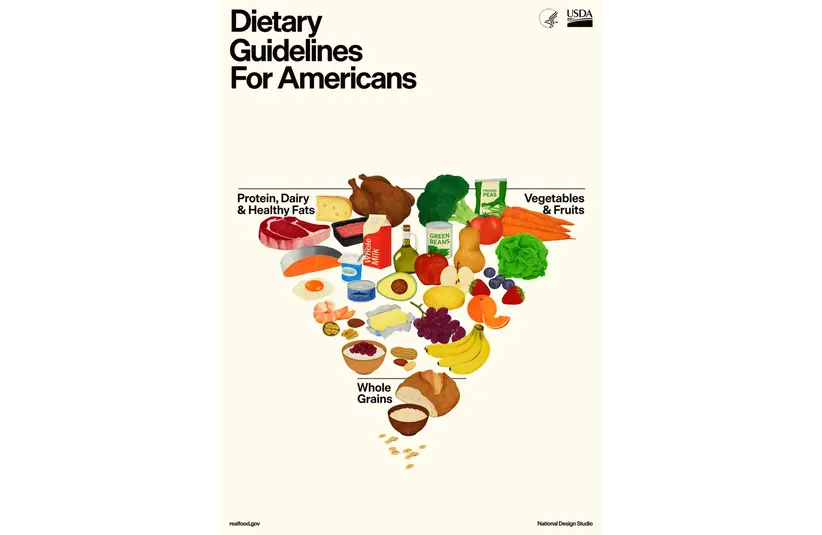
We aren’t just talking about minor tweaks here. We are talking about an inverted pyramid that puts meat, cheese, and veggies at the top and kicks ultra-processed junk to the curb. Let’s nerd out on the details, shall we?
The “Real Food” Revolution
The core philosophy of the new guidelines is that we are in a health emergency. With chronic diseases eating up 90% of healthcare spending, the government is finally admitting that maybe—just maybe—the Standard American Diet is the problem.
The villain of this story is “ultra-processed food.” You know the stuff: shiny packages, unpronounceable ingredients, and shelf lives longer than the average house cat. The new guidance explicitly advises avoiding foods with refined carbohydrates, added sugars, and petroleum-based dyes. Instead, we are being told to prioritize nutrient-density. That means food that actually looks like food.
Protein Gets a Massive Upgrade
If you’ve been skimping on protein, it’s time to recalculate your macros. The new US dietary guidelines are pushing for a significantly higher protein intake than we’ve seen in the past. We’re talking about a goal of 1.2 to 1.6 grams of protein per kilogram of body weight.
For a 150-pound human, that’s roughly 81 to 109 grams of protein a day. The focus isn’t just on quantity, but on source. Eggs, poultry, seafood, and—yes—red meat are back in the spotlight. The guidelines emphasize animal sources alongside plant sources like lentils and beans, but the vibe is definitely more carnivorous than previous iterations.
The Redemption of Fat (and the Return of Butter)
This is the part where traditionalists might clutch their pearls. For decades, we were told to fear the fat. We were told to eat low-fat yogurt and skim milk that tasted like cloudy water.
The new guidelines? They’re telling you to embrace the creaminess. Full-fat dairy is now recommended (with no added sugars, of course). Even more surprisingly, when discussing healthy fats for cooking, the text explicitly lists butter and beef tallow alongside olive oil.
Somewhere, your great-grandmother is nodding in approval while frying an egg in tallow. The argument here is that these natural fats are superior to the processed seed oils and industrial fats that have permeated our food supply.
Sugar is Public Enemy No. 1
While fat is getting a pass, sugar is getting served a restraining order. The guidelines are incredibly strict here, especially for the little ones.
- Infants: Zero added sugar. None.
- Children (up to age 10): Avoid added sugars entirely.
- Adults: One meal should contain no more than 10 grams of added sugar.
To put that in perspective, a single can of soda has about 39 grams of sugar. The guidelines are essentially asking us to break up with our sweet tooth, blaming added sugars for the spikes in diabetes and obesity.
Alcohol: The Party is (Sort of) Over
In previous years, the government gave us specific “safe” drinking limits—two drinks for men, one for women. The new update scraps the math and gives it to us straight: just drink less.
While they haven’t gone full prohibition, the guidance notes that alcohol is a neurotoxin and that, for “better overall health,” minimizing consumption is key. It’s a bit of a buzzkill, but scientifically, it’s hard to argue with.
The Controversy and The Science
Look, it wouldn’t be a government release without some drama. The American Heart Association isn’t exactly thrilled about the green light for red meat and beef tallow, citing concerns about saturated fats and heart disease. There is a genuine scientific tug-of-war happening between the “low-fat/heart-health” camp and the “whole-food/metabolic-health” camp.
Furthermore, implementing this in schools will be a logistical nightmare. School lunch ladies are currently wondering how they are supposed to scratch-cook nutrient-dense meals with beef tallow when they barely have the budget for frozen pizza. It’s a noble goal, but the infrastructure needs to catch up to the ideology.
The Bottom Line on the New US Dietary Guidelines
Whether you are a nutrition nerd or just someone trying to figure out what to cook for dinner, the takeaway is empowering. Stop counting calories on the back of a 100-calorie snack pack and start eating things that grew in the ground or walked on it.
The US dietary guidelines have finally caught up to what grandmothers (and biohackers) have known for years: Real food heals. Now, pass the butter.