
Cinema Marred by Death: 5 Films Completed After Their Lead Actors Died

Death is not only the most inevitable aspect of existence; it’s also something that can come for anybody at any time. While we all choose to hopefully assume that we have a long time left at any given point in our lives, any one of us could just as easily be dead tomorrow, from whatever cause. If there’s one key to immortality, it lies in the arts, where one’s talent – and, in the case of the silver screen, one ‘s image – will be preserved for as long as there’s a civilization to appreciate them. So long as the movie is finished, that is. Here are five films that were completed after the deaths of their stars.
1. “The Crow” (1994)
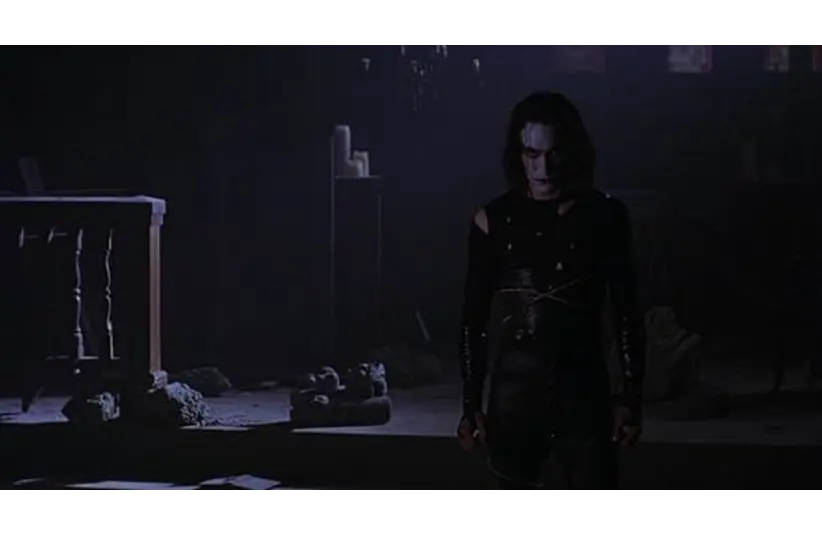
Of all the productions on this list, “The Crow” has the horrible distinction of being the only one that is itself responsible for its star’s death. It is a Gothic comic-book film in which 28-year-old Brandon Lee plays a musician who is murdered along with his girlfriend, only to come back from the grave and seek revenge. To film the scene of his character’s murder, Lee was to be shot at with a blank round, but the gun and its ammunition were not inspected as carefully as they should have been. The weapon had a dummy round stuck in its barrel, and when it was fired, this projectile had nearly as much power as an ordinary bullet, fatally injuring Lee.
Because Lee’s death came late in the filming, when the great majority of his scenes had been shot, the filmmakers were able to finesse “The Crow” to completion via a few rewrites, and through the use of a stunt double and the very new technology of digital face replacement (the very first confirmed use of which was for “Jurassic Park” the previous year) to fill in the star’s remaining scenes. Lee did not live to experience the career windfall from what might well have been his big break. But like his father, martial-arts-flick legend Bruce Lee, who died at 32 from a sudden cerebral edema, he earned a legacy fit for a would-be Hollywood star.
2. “Dark Blood” (2012)
Here’s a film that proves it’s never too late to bring a deceased star’s unfinished work to completion. During his life, River Phoenix (the older brother of modern A-lister Joaquin Phoenix) was Oscar-nominated for his supporting role in Sidney Lumet’s “Running on Empty” (1988), and he was also known for his starring role in Rob Reiner’s coming-of-age classic “Stand By Me.” In 1993, at the age of 23, he died from drug poisoning. He was in the process of filming “Dark Blood,” a thriller in which he was playing a desert hermit who has become dangerously unhinged after the death of his wife from radiation poisoning.
As a result of Phoenix’s death, “Dark Blood” was shelved with roughly 20% of it left to be shot. In 1999, the film was nearly destroyed by the insurance company that owned the film’s negatives because they wanted to save themselves the price of storage, but director George Sluizer stepped in and took the negatives himself, intending to finish the film with some edits and voiceover narration that he himself provided. “Dark Blood” was finally released in 2012, albeit only at a couple of European film festivals.
3. “Avalanche Express” (1979)
Robert Shaw, who died at 51 from a heart attack in 1978, is best remembered for his performance as the tough Ahab-esque shark hunter in “Jaws” just three years earlier. His death came during production on “Avalanche Express,” which was not only his last film, but also that of director and producer Mark Robson (“Peyton Place,” “Valley of the Dolls,” “Earthquake”), who suffered a fatal heart attack two months before Shaw did. The production company brought in Monte Hellman to finish Robson’s job as a director and Gene Corman to take over the role of producer.
Moreover, Robert Rietti, an actor who was famous for his dubbing work, was hired to re-record all of Shaw’s dialogue after Shaw’s death: the filmmakers wanted to redo the dialogue in just one of Shaw’s scenes, but because he was no longer alive for this, it could only be appropriately accomplished by re-recording his lines in every one of his scenes. “Avalanche Express” was released in 1979 to negative reviews, with criticism for its acting and a certain messy aspect to its filmmaking that probably resulted from its production’s major setbacks.
4. “Saratoga” (1937)
One of the earliest examples of a film with this kind of tragic production history is “Saratoga,” the last film of Jean Harlow. Harlow rose to prominence as a major star in 1930s Hollywood; she was in the middle of filming “Saratoga” in 1937 when she died of kidney failure. (She was, in fact, in the middle of shooting a scene when her illness made her suddenly too sick to continue working; her death was a little over a week later). She was 26 years old. Public opinion compelled MGM not to bring in a new actor to complete “Saratoga”; instead, the film was finished via dubbing and body doubles.
“Saratoga” would become the most financially successful film in Harlow’s brief but iconic and inspirational career. One actor whom she greatly influenced is Marilyn Monroe (1926-1962), who was intending to play Harlow onscreen at the time of her own tragic death from a drug overdose.
5. “The Imaginarium of Dr. Parnassus” (2009)
The final story on this list concerns the last film of Heath Ledger, who at the age of 28 had already established himself as a versatile A-lister when he died of an accidental prescription-drug overdose in 2008. He did not live to see the release of Christopher Nolan’s acclaimed “The Dark Knight” (2008), in which he earned a posthumous Oscar win for his performance as the villainous Joker, but he’d already finished all of his work on that film at the time of his death. This wasn’t the case for “The Imaginarium of Dr. Parnassus,” a fantasy film directed by Monty Python’s Terry Gilliam
As it happened, this film was about a fantastical dimension – the Imaginarium – in which people are transformed in accordance with their wishes and imaginations. In view of this, the similarly renowned actors Jude Law, Johnny Depp, and Colin Farrell were brought in to portray Ledger’s protagonist post-transformations. Gilliam took care to cast actors who had been good friends of Ledger, explaining in a contemporary CBS interview that “It had to be in the family somehow, I don’t know why; it was my attitude.” The film was released to moderately positive reviews.
