
AMD Ryzen Z1 Driver Support Problem Hurts ROG Ally


Handheld PCs have quietly become the new frontier of gaming. They’re not going away anytime soon, and honestly, they shouldn’t — they’re fun, flexible, and finally powerful enough to matter. But if you own one powered by an AMD Ryzen Z1 or Z1 Extreme, like the Asus ROG Ally, you might want to check something before you boot up your next big release. Not a setting. Not a feature. Something far more important: driver support. Or rather, the complete lack of it.
It wasn’t until Resident Evil Requiem launched that the cracks really started to show. The Ally wasn’t just struggling — it was collapsing. And suddenly, the rumor that AMD has quietly abandoned its Z1 APU went from “internet speculation” to “oh, this is actually happening.”
Why Resident Evil Requiem Exposed AMD’s Z1 Problem
When Requiem dropped, PC gamers immediately noticed something was off. The ROG Ally — a device that should be punching well above its weight — couldn’t even run the game at the lowest settings with upscaling enabled. TechPowerUp reported it. Social media confirmed it. But the truth is, the signs were already there.
If you own a Z1 or Z1 Extreme handheld, you’ve probably noticed the same thing everyone else has: no GPU driver updates in over six months. Not a hotfix. Not a compatibility patch. Nothing.
Pair that with Requiem’s disastrous performance, and suddenly the rumor that AMD has abandoned the Z1 doesn’t just make sense — it’s the only explanation left standing.
The Performance Gap That Makes No Sense
I test games on the ROG Ally constantly, so I’m used to its quirks. But Requiem was the first time the device felt like it was actively fighting the game. At 720p, lowest settings, upscaling on, the Ally struggled to break into double‑digit framerates. It felt broken.
At first, I assumed the game was simply too demanding for a 2023 handheld. Then Wes — who was supposed to be relaxing in Hawaii — fired it up on his Steam Deck and casually pulled 40 fps.
Let me be very clear:
The Z1 Extreme is significantly more powerful than the Steam Deck’s APU. There is no universe where the Deck should outperform the Ally this dramatically.
Unless the Deck is getting fresh, optimized drivers… and the Ally isn’t.
Six Months Without Drivers — and It Shows
This isn’t an Asus problem. The Lenovo Legion Go — another Z1 Extreme handheld — is stuck on the exact same outdated GPU driver from last September. Two different devices. Two different manufacturers. One common denominator: AMD’s Z1 APU.
Meanwhile, Valve is updating the Steam Deck’s Mesa drivers constantly, rolling in new optimizations and fixes every few weeks. The Deck is aging gracefully. The Z1 handhelds are aging like milk.
And the performance gap is widening with every new release.
Valve Updates the Steam Deck, AMD Leaves the Z1 Behind
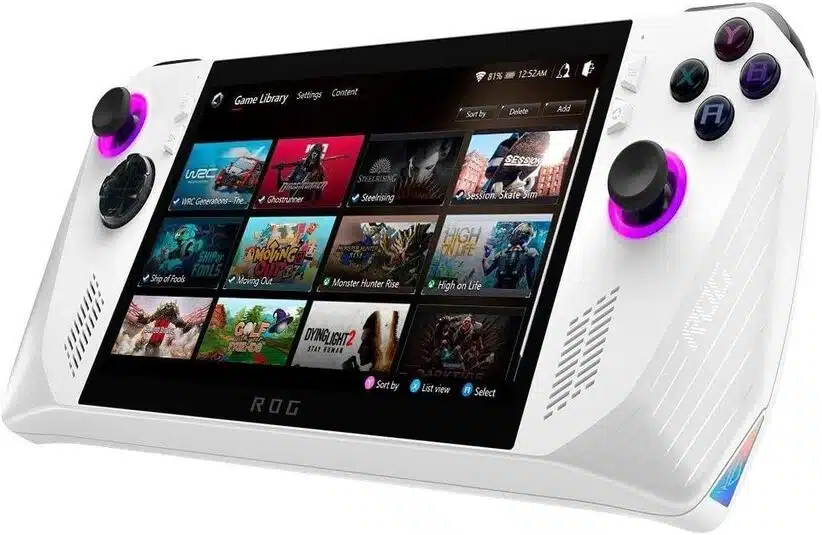
Here’s the part that makes this whole situation feel like a cosmic joke:
The Z1 Extreme and the Ryzen 7 7840U are basically the same chip. Same architecture. Same integrated GPU. Same everything that matters. And AMD is still actively updating the 7840U.
The latest Adrenalin 26.2.2 drivers should work on the Ally.
They don’t — because AMD’s drivers simply refuse to recognize the Z1. This isn’t a technical limitation. This is a product‑segmentation decision enforced by a few lines of code.
And here’s the kicker: the Z1 is used in the Lenovo Legion Go S, but if you buy the SteamOS version, you don’t have to rely on AMD at all. Valve handles the drivers, and Valve actually updates things. The chip magically works again — because the problem was never the hardware.
Why AMD’s Decision Makes No Technical Sense
There is absolutely no reason for the Z1’s iGPU to be excluded like this. AMD already did the hard work. The drivers exist. They’re out in the wild. They just won’t let Z1 owners use them.
And that raises a bigger, uglier question:
If AMD bailed on the Z1 after barely a year, what’s stopping them from doing the same to the Z2?
The Z1 isn’t some exotic, heavily customized unicorn APU. It’s an off‑the‑shelf chip with a few tweaks to clocks and power levels. There is no technical justification for abandoning it.
Which makes the silence even louder.
What This Means for Z2 and the Future of Handheld PCs
The Ally isn’t useless — far from it. It still runs thousands of games beautifully. But the writing is on the wall:
- No driver updates
- No optimization for new releases
- No guarantee AMD won’t repeat this with future chips
So my next handheld?
It’s running SteamOS, full stop.
If a device has a “Z” anywhere near its processor name and relies on AMD for driver support, I’m not touching that anytime soon.
Author
