

Aristotle: Summary of “Nicomachean Ethics” from Oxford World’s Classics

Aristotle was taught by Plato, who received instruction from Socrates. This version of “The Nicomachean Ethics,” as published by Oxford World’s Classics, is one of many outlets that have published this famous book. This is Aristotle’s best-known work on ethics. It is about the science of the good for life. That, a good life, is the goal or end at which all our actions aim. “The Nicomachean Ethics” has ten sections, called books. It is closely related to “Eudemian Ethics.” The work is essential for the interpretation of Aristotelian ethics. Have you read Aristotle’s “The Nicomachean Ethics?”
Summary of Aristotle’s “The Nicomachean Ethics”
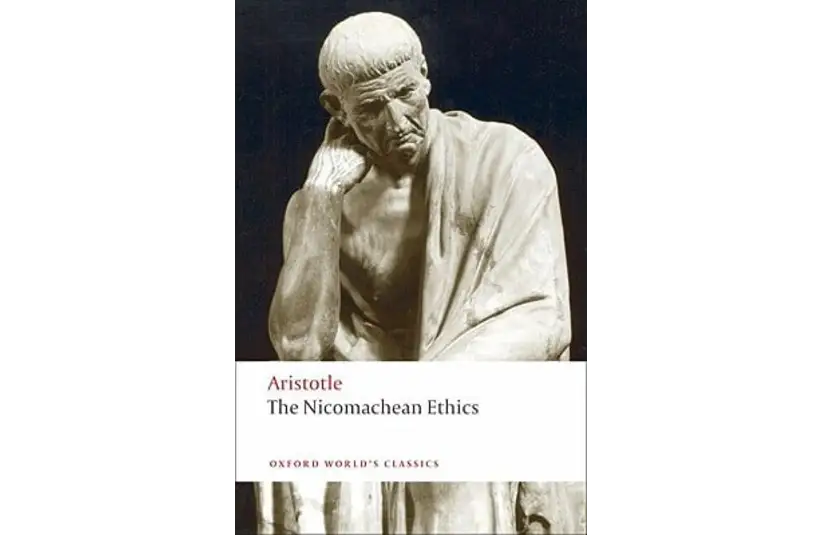
Aristotle wrote a dense book, but “The Nicomachean Ethics” can be boiled down to its essential idea – the goal of life is goodness. It may be best to summarize the ten books of which “The Nicomachean Ethics” is composed, but first, it is important to point out that Aristotle, Plato, and Socrates were philosophically related. Plus, parts of this book overlap with Aristotle’s other book, “Eudemian Ethics.”
Books I through III
The first book defines the study of ethics and sets out a plan for the work. As part of this, Aristotle considers sensible opinions along with those of poets and philosophers. Books II and III define what it means to be of good moral character. He says that whereas intellectual virtue requires teaching, experience, and time, virtue of character comes about through the adoption of good habits. People, whom he refers to as humans, have a natural capacity to develop these virtues, but that training determines whether they develop.
Books IV and V
The fourth book gives another example of moral virtue. The moral virtues written about in Book IV concern behavior in social or political situations. Book IV is described as reflecting the norms of an Athenian gentleman in Aristotle’s time. Athens was the seat of Greek democracy, so it was fertile for this thought. While this book is consistent with the approach Aristotle said he would take in Book I, namely, that his ethical thinking was parochial.
In Book V, he is mainly concerned with justice and fairness. This book is the same as book four of “Eudemian Ethics.” This is the first of three books that are common to both works by Aristotle. This book also covers the same themes as are in Plato’s “Republic.”
Books VI and VII
Book VI concerns intellectual ethics. Aristotle is concerned with defining a virtuous and knowledgeable man. If people are to pursue a good life, then intellectual virtue must be defined. Aristotle recognizes the ways of recognizing the correct boundary-marker. So, practical ethics (having a good character) requires knowledge.
Book VII discusses impediments to good virtue by the classic author. There are three main sources of such impediments. Vice and intemperance impede good virtue. So do incontinence and imperfect self-control. The final impediment to good virtue is brutishness, or brutality.
Books VIII through X
Books VIII and IX are concerned with friendship. They are continuous. The treatment of friendship in the “Nicomachean Ethics” is longer than that of any other topic and comes just before the concluding book of the inquiry. He must think the topic of friendship is important. This makes sense as people need friends to be virtuous.
Book X is where the author concludes and discusses pleasure and happiness. This is a sensible concluding chapter. Even though the work discusses pleasure throughout the books, the concept gets a more focused and theoretical treatment in this concluding book.
Oxford World’s Classics
The best thing about this book was the summary that was presented before the full reproduction of Aristotle’s “The Nicomachean Ethics.” This version of the book, by Oxford World’s Classics, includes significant interoperation, which is helpful to understand what Aristotle meant in his writing. The Oxford World’s Classics is a series of classic works of world literature. It would be interesting to see if the other volumes in this series also include helpful analysis.