
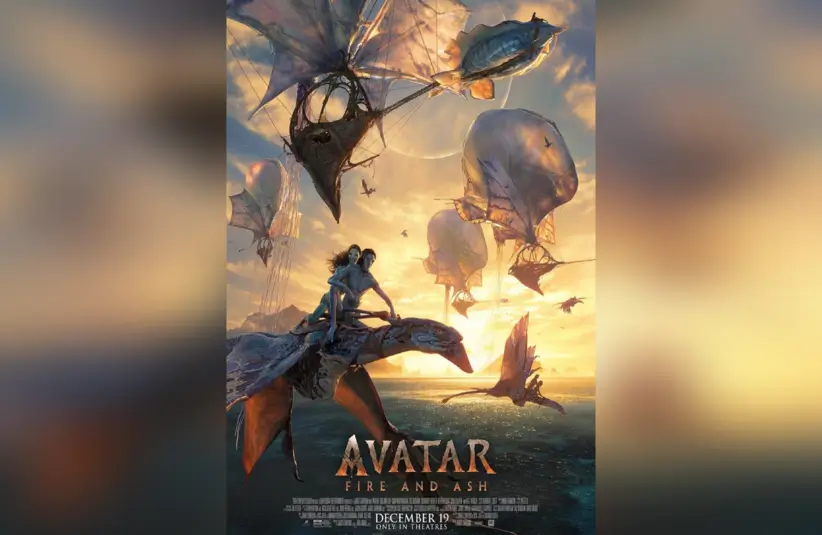
Avatar: Fire and Ash (2025) – Pandora’s Trilogy Concludes with a Refreshing Bang

Disclaimer: This review may contain spoilers.
In the modern climate of Hollywood blockbusters, James Cameron is a uniquely frustrating figure. The first two films in his “Avatar” saga (the 2009 original and its 2022 sequel, “The Way of Water”) have wielded Marvel-sized budgets and resources in the service of a visionary, visually ineffable, environmentally concerned cinematic enterprise, made with an undeniable passion that distances it conspicuously from any IP conveyor belt. At the same time, this franchise has stranded Cameron in a scarcely-preferable realm of recycled cardboard storytelling and facile primitivist hooey that is now in danger of dominating the blockbuster auteur’s later career.
“Avatar: Fire and Ash,” which opens wide on December 19, offers a pleasant surprise: it’s a valiant attempt at staving off this danger. It takes the franchise’s boldest narrative swings yet, some of which even manage to partially redeem its immediate predecessor (an exasperating placeholder that accomplished little more than table-setting with its 192-minute runtime) and to elevate Pandora’s ecological morality play from a stacked deck to a living, breathing onscreen conflict. If only said conflict had fewer familiar beats to hit.
Stick Out the First 15 Minutes
“Avatar: Fire and Ash” begins in ho-hum fashion, with the same kind of solemn prologue as the ones that opened both previous films. This time, it’s not Jake Sully (Sam Worthington) but his surviving son, Lo’ak (Britain Dalton), whose grave narration bridges the gap between films and tells us a tad bit more character development than the script is apt to show. Jake has remained the stoic patriarch, Neytiri is consumed by her maternal rage and grief (Zoe Saldaña remains the “Avatar” cast’s standout for how raw and palpable she makes these emotions), and the neural afterlife of Pandora’s Gaia, Eywa, enables Lo’ak to pay a visit to his dead older brother, Neteyam (Jamie Flatters).
The Film’s Greatest Visual Kicks the Plot into High Gear
Just as we’re sagging in our seats, anticipating three more hours of recycled storytelling from the ever-environmentally-minded “Avatar” franchise, we get a novel plot thread: Spider (Jack Champion), the human teenager who could be the Sullys’ adopted son if it weren’t for Neytiri’s deeply speciesist wariness of him, is beginning to experience the perils of living in an atmosphere that makes his life dependent on fallible breathing equipment. It seems that his biology will indeed necessitate separation from his blue family, who resolve to share one last adventure with him by joining the Na’vi trade caravan that has agreed to ferry him to a friendly human settlement.
This peaceful caravan provides what is quite possibly the most arresting visual in the entire franchise. It consists of a small Na’vi encampment hanging like a gondola from the body of a gigantic creature that resembles a floating jellyfish and is filled with buoyant gas that makes it a living hot-air balloon; meanwhile, a similar but more propulsive creature is harnessed to this vehicle to tow it through the sky. This stunning variant on the floating-city trope easily surpasses any sequence of martial bombast, and indeed you may find yourself groaning anew when you learn that the ruthless, avatar-ized Colonel Miles Quaritch (Stephen Lang) is once again homing in on the Sully family.
A Phenomenal New, True-Blue Villain – and the OG Is All the Stronger for Her
Yet here, too, “Avatar: Fire and Ash” has something fresh in store, as the caravan instead comes under attack from vicious Na’vi raiders led by the striking Varang (Oona Chaplin). After two films that pitted the evil of humankind against glib paragons of noble savagery, here is a Na’vi chieftain who has broken all bonds with Eywa and now wields her kuru (the distinctive tentacled ponytail that gives every Na’vi such an intimate connection with the entire Pandoran biosphere) as a weapon of cruel violation. Quaritch may have turned blue back in “The Way of Water,” but it’s a true revelation to see that he has a counterpart among Pandora’s true natives.
This is also part of why Quaritch’s subsequent negotiating foray into Varang’s volcano-side lair represents a new high for the “Avatar” franchise. It’s a grossly discomfiting and unexpectedly funny sequence in which, for once, the writing and (especially) the acting are nearly as immersive as the visuals. As they exchange malicious put-downs in the growing realization of how symmetrical their goals and outlooks are, this tête-à-tête between two motion-capture aliens achieves a kind of heady realism that every previous one-on-one conversation has been too wooden to reach.
The specter of an alliance between invading supremacists and the traditional enemies of their indigenous targets also has keen historical parallels of the sort that the “Avatar” films otherwise only clumsily establish (why would a Na’vi such as Neytiri apply the epithet “pink-skin” to a species that is far more variable in skin tone than her own?), and it adds newfound political complexities that help to paper over some of the movie’s many thin characterizations – best exemplified by a scene in which the flatly written military honcho General Ardmore (Edie Falco) must wrestle over how to handle Quaritch’s new partnership.
The Sully Family – A Divine Development
It’s hard for the heroes of “Avatar: Fire and Ash” to leave nearly as strong an impression, though Worthington’s screen presence has improved along with what he has to work with dramatically. Lo’ak reunites with the outcast militant Payakan, who (you may recall from the last film) belongs to a sapient whale-like species of pacifists (the tulkun) for whom even self-defense is an inexcusable form of violence. This time, the exiled tulkun gets to articulate his personal philosophy, and the resulting debate retroactively redeems the wishy-washy prevarication with which the subject was (not) handled in “The Way of Water.”
At the center of the Sully family’s most compelling development are the aforementioned Spider and their adopted avatar daughter, Kiri (Sigourney Weaver). The latter, who was introduced in “The Way of Water” as the mysteriously conceived biological child of Weaver’s previous character, Grace Augustine, resolves a genuinely suspenseful predicament by performing nothing short of a miracle, after which a new revelation cements her status, hinted at in the previous film, as the young Christ of Pandora.
Indeed, Kiri’s remarkable deed – and its wondrous, irrevocable, and terrifying effect on Spider – opens the door for “Avatar: Fire and Ash” to traffic in more overt Christian allegory than any other sci-fi epic this side of the “Matrix” trilogy. Fortunately, this isn’t a descent into muddled, anything-goes esotericism: it’s a compelling expansion on the animistic spiritualism that has defined Pandora since the original film. As such, the film wisely doesn’t handle it as sheer mysticism, but as yet another sign that this alien ecosystem contains forces that are beyond the ability of human science to understand – and all those arrogant human invaders are messing with something more powerful than they can comprehend.
A Regrettably Rehashed Finale
Of course, this is the same lesson that said invaders were taught in the climax of the original “Avatar,” and alas, the climax of “Fire and Ash” simply combines those of its two predecessors. In light of this, it’s both interesting and frustrating to recall that the Cameron classics “Aliens” and “Terminator 2: Judgment Day” both copied the plots of their respective originals almost from start to finish – this is an easy thing to forget, because both sequels did so in broad strokes and with more than enough wholly new set pieces, characters, and character development to make them stand on their own.
The “Avatar” films are far too sprawling and messy for them to excusably adhere to the same kind of rigid formula. The very world of Pandora with its limitless biodiversity offers Cameron the most expansive filmmaking canvas of his career, which is also why it’s not enough for him to give us just another alien nature show cum battle epic with a few more awesome creatures added in. And it doesn’t help at all that this movie’s finale involves so many of the same antagonists, down to the supporting cast. (I won’t spoil who dies or doesn’t this time; I’m just asking you to recall the fact that Cameron hasn’t killed off a single villain since this franchise began).
But At Least It’s a Finale
Nonetheless, “Avatar: Fire and Ash” does conclude on a satisfactory note, if no more than that. While several characters’ payoffs feel a bit cheap, there is one whose arc is completed as well as it can be. Reportedly, this film is itself the end of an arc for the series, though it’s hard to believe that there won’t be any more films.
But regardless of whether “Avatar”s 4, 5, and beyond break wholly free from the franchise’s increasingly tired mold, the third film is still at least a half-triumph for Pandora. After all these years of coasting on visual spectacle above all else, Cameron’s earnest but half-baked epic saga has finally added in some rich storytelling that we can appreciate for its three-hour runtime – or at least the first two hours of it.
