
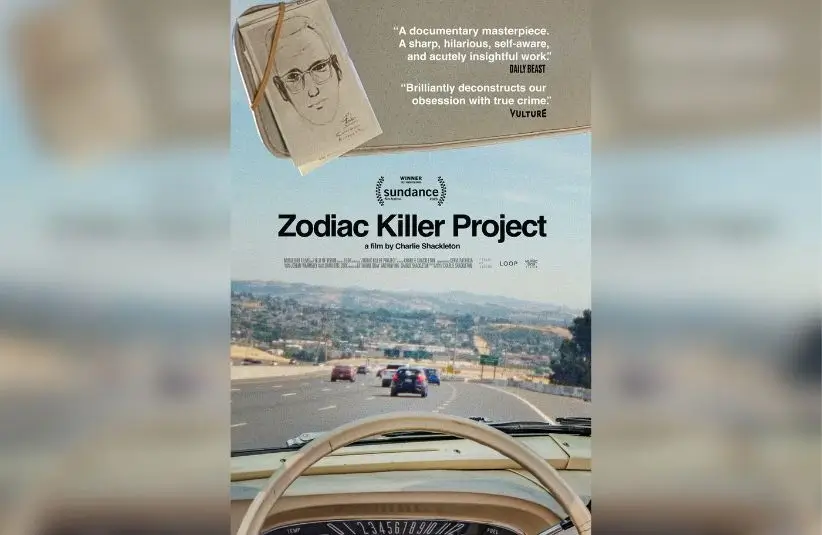
“Zodiac Killer Project” Brings Together Fans and Critics of True Crime

If you’ve ever sat through midnight-marathon streaming sessions of true-crime documentaries, you know the thrill — and the chill — that comes with unresolved cold cases. The new film “Zodiac Killer Project” takes that fascination, turns the lens inward, and asks us: what are we really drawn to — and at what cost?
A Film About a Film That Never Was
Directed by Charlie Shackleton, “Zodiac Killer Project” isn’t a typical documentary about the infamous Zodiac Killer. Instead, it’s a self-aware, meta film about the false start Shackleton experienced while attempting to adapt “The Zodiac Killer Cover-Up: The Silenced Badge” by Lyndon E. Lafferty. Rights fell through, and rather than abandon the project, Shackleton reimagined it: he made a film about what his film would have been.
The result is cinematic sleight-of-hand. As described by one reviewer on The Daily Beast, “over panoramas of empty parking lots, non-descript streets, and buildings used as stand-ins … Shackleton narrates ‘Zodiac Killer Project’ with wry incisiveness.” It’s partly what true-crime documentaries look like — and partly a mirror held up to the genre itself.
Deconstructing the True Crime Machine
Rather than offer new evidence about the Zodiac case, Shackleton uses his film to dissect the conventions and clichés that now define the true-crime genre: dramatic re-enactments, atmospheric b-roll, ominous music, and slow zooms.
It’s a film that celebrates true crime’s seductive pull even as it questions the ethics of its allure. As Shackleton himself puts it in an article from Indie Wire, he wants to explore “the contradictory impulses that are part and parcel of working in true crime” — the morbid fascination, the sensationalism, and the responsibility toward the real people and victims behind the stories. The result is part satire, part elegy, part cultural critique.
Why It Resonates — And Ruffles Feathers
For longtime followers of the Zodiac mystery, “Zodiac Killer Project” offers something novel: not a fresh crack at solving the killings of the late 1960s and early 1970s, but an invitation to think about the meaning of obsession. The Zodiac case itself remains one of America’s most enduring unsolved serial-killer mysteries; the killer’s identity has never been confirmed, and the case continues to draw amateur sleuths, theories, books, and documentaries. At the same time, the film has drawn criticism — not for being inaccurate, but for feeling at times like a long-form essay that overstays its welcome. But that very ambivalence may be the point.
A Gathering Place for Fans — and Skeptics
In that sense, “Zodiac Killer Project” becomes a kind of meeting ground. For die-hard fans who hope someone — someday — will crack the Zodiac case, it asks: What are you really looking for: closure? Truth? The thrill of the hunt? For critics and skeptics, it offers a mirror to the ways the true-crime industry packages tragedy as entertainment. By doing that, the film draws together both camps: those drawn to clues, suspects, and speculation, and those drawn to reflection, ethics, and media literacy.
In today’s era of podcasts, streaming platforms, and endless true-crime content — often driven more by clicks than closure — “Zodiac Killer Project” is timely. It doesn’t claim to solve the mystery, and it doesn’t pretend to. What it does do is make you wonder why the mystery still matters, and whether what we really crave is understanding — or just another story.
Ultimately, “Zodiac Killer Project” may be the closest modern true-crime work gets to self-aware art: unsettling, uncertain, provocative — and uniquely suited to bring together fans and critics in the same room, confronting both the legend of the Zodiac Killer and the shape of our fascination.
