
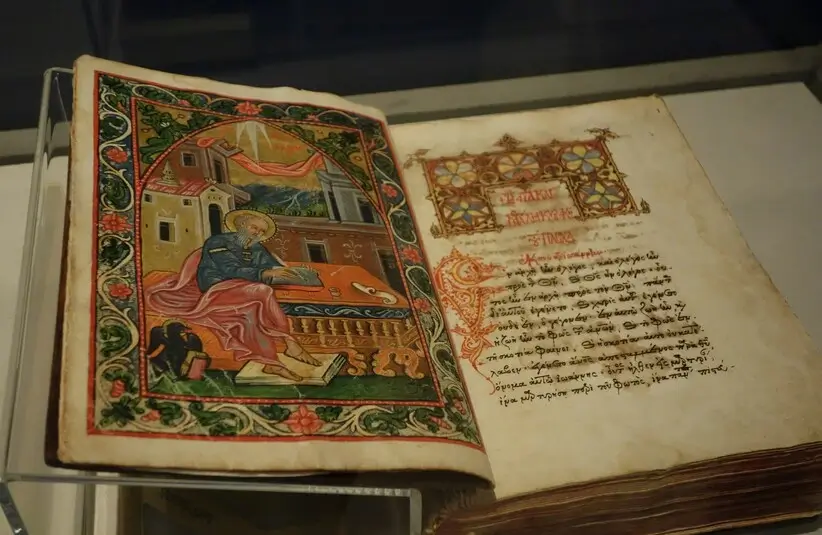
Isaak of Nineveh 7th Century Theologian Best Remembered for His Written Works on Christian Asceticism

Isaak of Nineveh was born around 613, and he died around 700. He is also remembered as Saint Isaac the Syrian, Isaac of Nineveh, Abba Isaac, Isaac Syrus, and Isaac of Qatar. He was a 7th-century Syriac Christian bishop of the Church of the East and theologian best remembered for his written works on Christian asceticism. Isaak of Nineveh was a prolific author, and his written works can best be understood in five parts. Have you ever read anything by Isaak of Nineveh?
Isaak of Nineveh Biography
Isaak of Nineveh was born in Eastern Arabia. That is all we know about his early life. When the Catholicos Giwargis I of the Church of the East visited Beth Qatraye in 676 to attend a synod, he ordained Isaac bishop of Nineveh. The administrative duties did not suit Isaak of Nineveh’s ascetic bent: he requested to abdicate after only five months, and went south to the wilderness of Mount Matout, a refuge for anchorites.
On Mount Matout, Isaak of Nineveh lived in solitude for many years, eating only three loaves a week with some uncooked vegetables, a detail that never failed to astonish many people. Eventually, blindness and old age forced him to retire to the monastery of Rabban Shabur (located near present-day Khuzestan, Iran), where he died and was buried. At the time of his death, he was nearly blind, a fact that some attribute to his devotion to intense study and his prolific writing.
Isaak of Nineveh is remembered for his spiritual homilies on the inner life, which have a human breadth and transcendent theological depth. The homilies survive in Syriac manuscripts and in later Greek, Arabic, and Georgian translations. From Greek, they were translated into Slavonic.
Isaak of Nineveh stands in the tradition of the eastern mystical saints and placed an emphasis on the work of the Holy Spirit. His melancholic style, as well as his affinity towards the sick and dying, exerted great influence on Eastern Orthodoxy. His writings were continuously studied by monastery circles outside his church during the 8th and 9th centuries.
Isaak of Nineveh’s writings, strongly influenced by the early Christian writers. They offer an example of a large corpus of ascetical texts written by an experienced hermit and are thus an important writer when it comes to understanding early Christian asceticism.
Isaak of Nineveh Venetion and Written Works
He has long been regarded as a saint in many churches. For instance, in the Catholic Church, Pope Francis announced on November 9, 2024, that Isaac of Nineveh is being added to the Roman Martyrology. Isaac composed dozens of homilies that he collected into seven volumes on topics including spiritual life, divine mysteries, judgements, providence, and more. These seven volumes have survived in five parts, titled from the “First Part” to the “Fifth Part.” It is worth writing bout these parts.
The “First Part” is the most widely known. It has been translated into English. A critical edition containing an English translation, The “Ascetical Homilies of Isaac the Syrian,” was published by the Holy Transfiguration Monastery in 1983, while a revised second edition was published in 2011. “Part 1” has 82 homilies by Isaak of Nineveh, although the number and order of homilies can vary greatly depending on the manuscript or edition.
The “Second Part” contains 41 chapters. Chapter 3, also known as the “Kephalaia Gnostica” (or “Chapters/Headings on Spiritual Knowledge”), contains 400 sections organised into 4 centuries (groups of 100 sections). Recently, parts of the “Kephalaia Gnostica” (i.e., Chapter 3 of the “Second Part”) have been identified in Sogdian fragments from Turfan. The “Second Part” was discovered in April 1983 at the Bodleian Library.
After 1983, incomplete manuscripts of “Part 2” were discovered in Cambridge MS Or. 1144, which is a part of Bibliothèque Nationale de France, MS syr. 298 (c. 11th-13th century).[33] Chapters 1–3 have been translated into English by Brock (2022)[28] (with Chapters 1–2 previously published in Brock (1997) as well[34]), while an English translation of chapters 4–41, along with the original Syriac text, can be found in Brock (1995).[31] A complete French translation was published by André Louf (2003),[35] and a partial Greek translation was published by Kavvadas (2006).[36] Selections from “Part 2” have been translated into Italian by Bettiolo (1985)[37] and into Catalan by Nin (2005).[38]
The “Third Part” has also been translated into English. It is based on Issayi MS 5, held in Tehran, Iran. Issayi MS 5 has 133 folios, with 111 folios containing 17 homilies that can be attributed to Isaak of Nineveh. There are 14 homilies not found in other texts that are numbered as 1–13 and 16 within “Part 3.” The other three texts in Issayi MS 5 can also be found in extant “Part 1” and “Part 2” manuscripts.
While the fourth part is missing, portions of the “Fifth Part” have been discovered in Sharfet, MS Dawra cir. 694 and MS Dawra, cir. 938, both held in Baghdad and the Vatican. This part has been translated into English. Other discourses from “Part 5” can be found in Hansbury (2015).[46]
Conclusion
Isaak of Nineveh lived a long time ago, in a part of the world where we do not have good records. Things are not helped by the fact that Isaak was a hermit. However, we are fortunate that there is an extensive written record from him.
