

The Ultimate Debate: Can “Die Hard” Be Considered a Christmas Classic?

“Die Hard,” one of the greatest and most celebrated action films ever made, can be viewed as either a summer movie with Christmas-season trappings or vice versa. Originally released in July of 1988 (and liberally adapted from the 1979 terrorist-thriller novel “Nothing Lasts Forever,” which also takes place on Christmas Eve), it tells the story of one brave cop who happens to be attending a Christmas Eve office party when a team of armed criminals takes the whole building hostage to set in motion their especially ambitious heist plan. Are its holiday setting and spirit as important to its essence as all its explosions and shootouts?
An Action Film Set at Christmastime – Coincidentally or Poignantly?
This question has been a point of great debate over the decades since “Die Hard” came out. Some are eager to place “Die Hard” on the same list as “A Christmas Story” and “It’s a Wonderful Life” – the list of December must-watches that rank as the greatest Christmas films of all time.
If one’s only criterion for a “Christmas movie” is a film set on or around December 25, then “Die Hard” undoubtedly passes the test. However, many argue that this is too superficial a definition, and that “Die Hard” doesn’t qualify as a Christmas movie because it lacks any actual thematic resonance with the holiday. But, while cheering on the violent deaths of despicable robbers may not be the most traditional Christmas pastime, a close examination of this film reveals how its setting and character arcs do, in fact, affirm some of the season’s most cherished principles.
Family – Its Fracture and Ultimate Reparation, Just in Time for Christmas

If there’s one traditional truism about Christmas, it’s that this holiday must be spent with your family. That’s why John McClane (Bruce Willis), a New York policeman separated from his estranged wife, Holly (Bonnie Bedelia), after her job took her across the country, is flying to L.A. to see his kids and (he hopes) reconcile with her. Their initial reunion doesn’t go too well – he’s offended that she goes by her maiden name at work, while she maintains that nothing she’s done for her career has harmed anything except for his “idea of what our marriage should be” – but their imminent peril may make them more fully aware than ever before of how much they love each other.
The most fascinating and commendable aspect of “Die Hard”‘s family dynamic is the fact that the greatest threat to stereotypically traditional family values comes from John’s own regressive, superficial version of such ideals. When Holly’s burgeoning career with the Nakatomi Corporation led her to move to California with the kids, he opted to stay with the NYPD. He wasn’t choosing his own job over his family: rather, his decision indicates his profound condescension towards her career, which he expected to fizzle out and thus culminate in her returning to him.
Ultimately, John’s and Holly’s reconciliation is dependent on his redemption – his recognition of how terribly unsupportive he’s been in regard to her professional growth. His arrogant, chauvinistic attitude towards their relationship, best encapsulated by his regretful third-act admission that “she’s heard me say ‘I love you’ a thousand times; she never heard me say ‘I’m sorry,” is solely responsible for the damage it has suffered, leaving their kids to wonder whether their daddy will be home for Christmas and Holly to fend off the advances of her sleazy colleague, Harry Ellis (Hart Bochner), who is unmoved by her suggestion that Christmas Eve is a time for families.
The Villains of “Die Hard”: How Greed and Hubris Cheapen Christmas
It goes without saying that the bad guys in “Die Hard” – a team of ruthless would-be thieves led by Alan Rickman’s charismatic, conscienceless Hans Gruber – care nothing at all for the spirit of Christmas. Moreover, their Christmastime grand theft constitutes an open mockery of the holiday and what it stands for. Just as these robbers pose as socialist terrorists, claiming to be punishing the Nakatomi Corporation for its “legacy of greed around the globe” as a cover for what is actually an extremely lucrative heist, so too do they appropriate and warp some of the Christmas season’s most sacred associations with self-aware hypocrisy.
This sacrilege manifests most egregiously during the scene in which Theo (Clarence Gilyard Jr.), the crew’s tech expert, warns Hans that they’ll need a miracle to break the final seal on the safe containing the object of their heist. “It’s Christmas, Theo,” Hans replies coolly, “It’s the time of miracles.” Of course, he’s speaking ironically: the “miracle” he has in mind is really the well-anticipated next step in his carefully planned scheme. He and his cronies are so arrogant, so secure in their own unholy master plan, that they enjoy thinking of themselves as performing the kind of miracle that most people associate with divinity.
By contrast, John McClane, the self-proclaimed fly in said scheme’s ointment, is far more sincere when he remarks at his lowest point that his fate is “up to the Man Upstairs,” and when he prays to God for his own survival before undertaking his most death-defying stunt. McClane is the quintessential underdog, whose involvement in this predicament couldn’t be more unplanned or unexpected, and the odds are so stacked against him throughout “Die Hard” that he genuinely thinks he may not make it out of Nakatomi alive without a Christmas miracle or two.
…And So Does Commercialism: How Nakatomi and McClane Do the Same
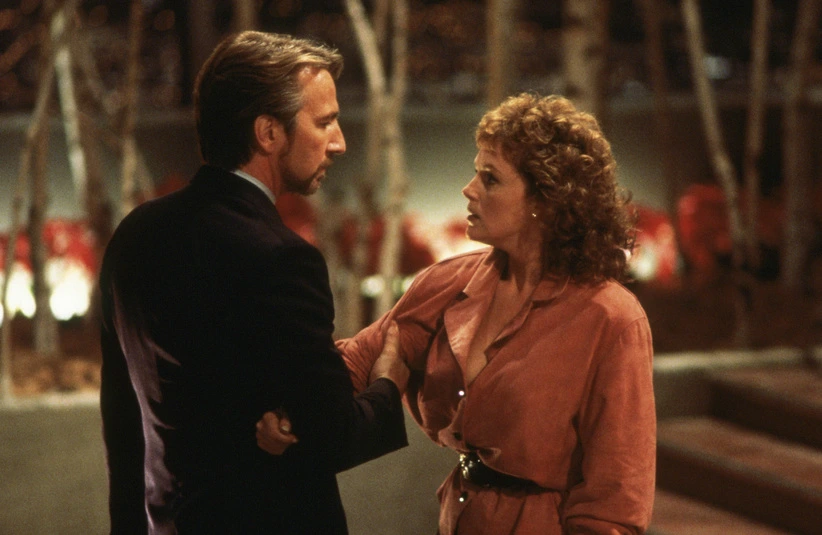
The villains of “Die Hard” aren’t the only ones guilty of desecrating Christmas. Their victim, the Japanese multinational Nakatomi Corporation, commits its own sacrilege simply by hosting a celebration for the holiday. “I didn’t realize they celebrated Christmas in Japan,” McClane remarks early on to high-ranking executive Joseph Takagi (James Shigeta), who jokes in reply that “Pearl Harbor didn’t work out, so we got you with tape decks.” In other words, the Christmas party that will become the target of a money-grubbing scheme is a cynical sham in its own right, orchestrated by an organization that likewise bends the meaning of Christmas for profit.
While “Die Hard” never explains whether Nakatomi truly bears the global legacy of greed that Hans, in his terrorist guise, claims, the company’s lavish Christmas Eve gala is a study in how a holiday founded on generosity and family love has become commodified. Early in the film, this theme dovetails with that of John McClane’s deficiencies as a husband and father. The fact that he arrives in L.A. burdened with an enormous teddy bear – presumably a gift for his children – is a subtle mark of how he initially handles his planned reconciliation with shallow gestures and sentiments. (Incidentally, Holly is obliged to use her maiden name at work because Nakatomi has its own prejudices about married career women).
How perversely fitting, then, that the happy ending of “Die Hard” should entail not only the violent defeat of Hans and Co., but also the destruction of the corporate skyscraper while the trapped hostages are liberated with minimal casualties. It’s a great triumph of humanity over materialism, a scene in which the visual style looks almost post-apocalyptic, but John, Holly, and the good-hearted police Sergeant Al Powell (Reginald VelJohnson) couldn’t be happier because they have each other. (Though it would be even nicer if Al’s insufferable stuffed-shirt superior weren’t berating John about “property damage”). What could be truer to the Christmas spirit than that?
Final Thoughts
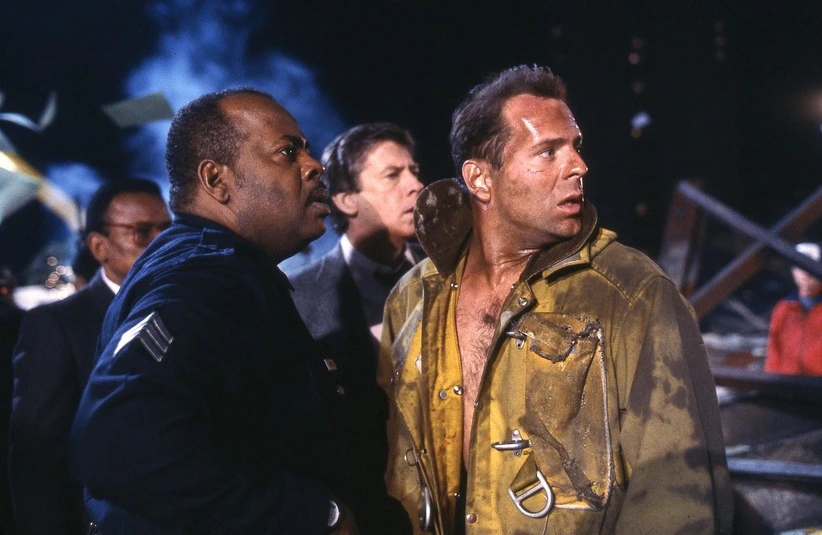
“Die Hard” is a Christmas action movie, through and through. From beginning to end, it’s peppered with references to the holiday, whether sincere, comedic, or cruelly ironic. On a more subtextual level, it’s also a unique fable of family love, redemption, and fighting for the true meaning of Christmas. All in all, there’s a good reason why “their [John’s and Holly’s] idea of Christmas” (to appropriate the phrase that John’s intrepid young chauffeur, Argyle, uses to conclude “Die Hard”) is as much a fixture of December programming as any Hallmark movie.
